Harry Luman Russell / Edwin George Hastings
 Librería Samer Atenea
 Kálamo Books
 Librería Elías (Asturias)
 Librería Kolima (Madrid)
 Librería Proteo (Málaga)
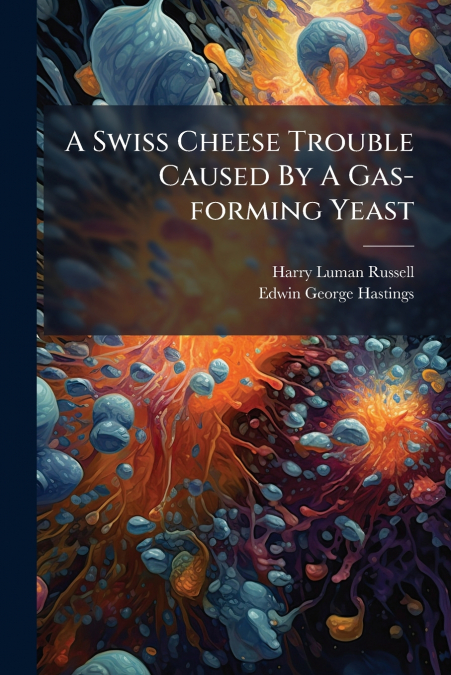
'A Swiss Cheese Trouble Caused By A Gas-forming Yeast' delves into the scientific investigation of a common defect in Swiss cheese production. Authored by Harry Luman Russell and Edwin George Hastings, this work meticulously examines the causes and characteristics of undesirable gas formation within Swiss cheese, a problem that can significantly impact its quality and marketability. The book provides a detailed analysis of the specific yeast strains responsible for this spoilage, offering insights into their microbiological properties and the conditions under which they thrive. This study is invaluable for cheesemakers, food scientists, and microbiologists seeking to understand and mitigate the challenges associated with gas formation in cheese. It presents practical approaches to prevent spoilage and maintain the high quality of Swiss cheese.This work has been selected by scholars as being culturally important, and is part of the knowledge base of civilization as we know it. This work was reproduced from the original artifact, and remains as true to the original work as possible. Therefore, you will see the original copyright references, library stamps (as most of these works have been housed in our most important libraries around the world), and other notations in the work.This work is in the public domain in the United States of America, and possibly other nations. Within the United States, you may freely copy and distribute this work, as no entity (individual or corporate) has a copyright on the body of the work.As a reproduction of a historical artifact, this work may contain missing or blurred pages, poor pictures, errant marks, etc. Scholars believe, and we concur, that this work is important enough to be preserved, reproduced, and made generally available to the public. We appreciate your support of the preservation process, and thank you for being an important part of keeping this knowledge alive and relevant.