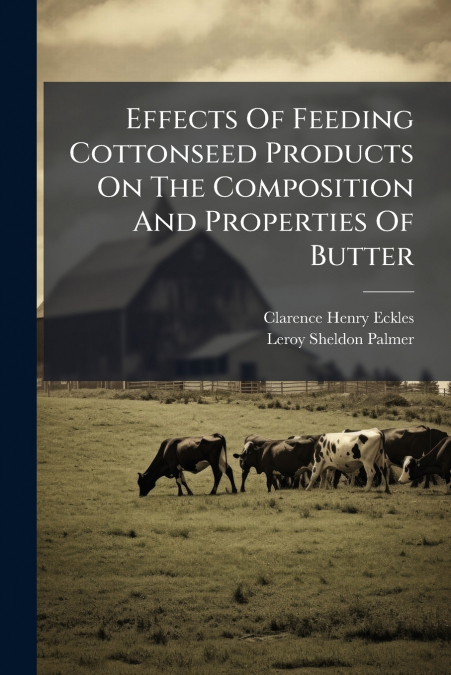
Clarence Henry Eckles / Leroy Sheldon Palmer
 Librería Samer Atenea
 Kálamo Books
 Librería Elías (Asturias)
 Librería Kolima (Madrid)
 Librería Proteo (Málaga)
Explore the intricate relationship between animal feed and dairy product quality in 'Effects Of Feeding Cottonseed Products On The Composition And Properties Of Butter.' This comprehensive study, focusing on the influence of ration character and the quantity of cottonseed products, delves into the science behind butter composition. Authored by Clarence Henry Eckles and Leroy Sheldon Palmer, this work offers invaluable insights into agricultural technology and nutrition. Originally published as part of a larger series, Volumes 26-35, this meticulous research examines how cottonseed affects the properties of butter, providing crucial data for dairy farmers, nutritionists, and food scientists. Discover the nuances of animal science and food science with this detailed exploration of a key aspect of dairy production.This work has been selected by scholars as being culturally important, and is part of the knowledge base of civilization as we know it. This work was reproduced from the original artifact, and remains as true to the original work as possible. Therefore, you will see the original copyright references, library stamps (as most of these works have been housed in our most important libraries around the world), and other notations in the work.This work is in the public domain in the United States of America, and possibly other nations. Within the United States, you may freely copy and distribute this work, as no entity (individual or corporate) has a copyright on the body of the work.As a reproduction of a historical artifact, this work may contain missing or blurred pages, poor pictures, errant marks, etc. Scholars believe, and we concur, that this work is important enough to be preserved, reproduced, and made generally available to the public. We appreciate your support of the preservation process, and thank you for being an important part of keeping this knowledge alive and relevant.