 Librería Samer Atenea
 Kálamo Books
 Librería Elías (Asturias)
 Librería Kolima (Madrid)
 Librería Proteo (Málaga)
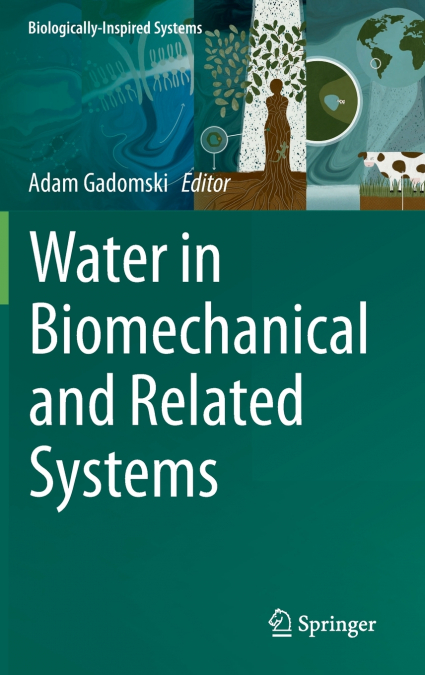
The contributed volume puts emphasis on a superior role of water in (bio)systems exposed to a mechanical stimulus. It is well known that water plays an extraordinary role in our life. It feeds mammalian or other organism after distributing over its whole volume to support certain physiological and locomotive (friction-adhesion) processes to mention but two of them, both of extreme relevance.Water content, not only in the mammalian organism but also in other biosystems such as whether those of soil which is equipped with microbiome or the ones pertinent to plants, having their own natural network of water vessels, is always subjected to a force field.The decisive force field applied to the biosystems makes them biomechanically agitated irrespective of whether they are subjected to external or internal force-field conditions. It ought to be noted that the decisive mechanical factor shows up in a close relation with the space-and-time scale in which it is causing certain specific phenomena to occur.The scale problem, emphasizing the range of action of gravitational force, thus the millimeter or bigger force vs. distance scale, is supposed to enter the so-called macroscale approach to water transportation through soil or plants’ roots system. It is merely related to a percolation problem, which assumes to properly inspect the random network architecture assigned to the biosystems invoked. The capillarity conditions turn out to be of prior importance, and the porous-medium effect has to be treated, and solved in a fairly approximate way.The deeper the scale is penetrated by a force-exerting and hydrated agent the more non-gravitational force fields manifest. This can be envisaged in terms of the corresponding thermodynamic (non-Newtonian) forces, and the phenomena of interest are mostly attributed to suitable changes of the osmotic pressure. In low Reynolds number conditions, thus in the (sub)micrometer distance-scale zone, they are related with the corresponding viscosity changes of the aqueous, e.g. cytoplasmatic solutions, of semi-diluted and concentrated (but also electrolytic) characteristics. For example, they can be observed in articulating systems of mammals, in their skin, and to some extent, in other living beings, such as lizards, geckos or even insects. Through their articulating devices an external mechanical stimulus is transmitted from macro- to nanoscale, wherein the corresponding osmotic-pressure conditions apply.The content of the proposed work can be distributed twofold. First, the biomechanical mammalian-type (or, similar) systems with extraordinary relevance of water for their functioning will be presented, also including a presentation of water itself as a key physicochemical system/medium. Second, the suitably chosen related systems, mainly of soil and plant addressing provenience, will be examined thoroughly. As a common denominator of all of them, it is proposed to look at their hydrophobic and/or (de)hydration effects, and how do they impact on their basic mechanical (and related, such as chemo-mechanical or piezoelectric, etc.) properties. An additional tacit assumption employed throughout the monograph concerns statistical scalability of the presented biosystems which is equivalent to take for granted a certain similarity between local and global system’s properties, mostly those of mechanical nature. The presented work’s chapters also focus on biodiversity and ecological aspects in the world of animals and plants, and the related systems. The chapters’ contents underscore the bioinspiration as the key landmark of the proposed monograph.