
The Technology of Vitamins in Food

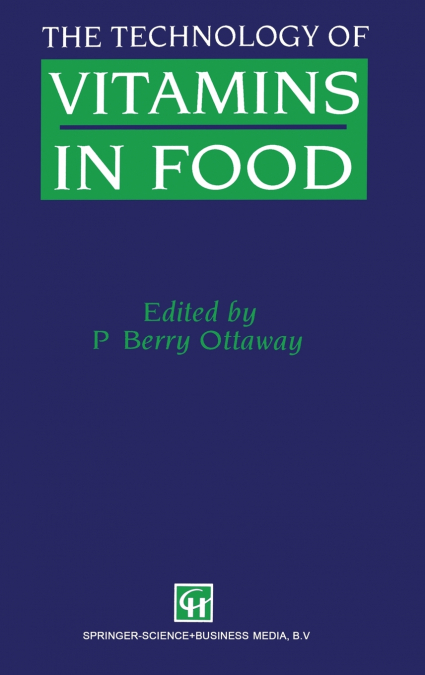
The Technology of Vitamins in Food

P. Berry Ottaway

66,32 €
IVA incluido
Disponible
Editorial:
Springer Nature B.V.
Año de edición:
2012
Materia
Tecnología de alimentos y bebidas
ISBN:
9781461358893
66,32 €
IVA incluido
Disponible

Selecciona una librería:

  • Librería Samer Atenea
  • Librería Aciertas (Toledo)
  • Kálamo Books
  • Librería Perelló (Valencia)
  • Librería Elías (Asturias)
  • Donde los libros
  • Librería Kolima (Madrid)
  • Librería Proteo (Málaga)

The roleofvitamins inhuman nutrition is an importantaspectofnutrition and food science, and our knowledge in this area is still advancing. Over the last few years there has been a considerable consumer awareness ofnutrition and healthy eating which has been enhanced by numerous articles in the media and by nutritional labellingon products. As aconsequence, the food industry has hadtobecomemore concernedwiththenutritional valueofproductsandthemaintenanceofguaranteed micronutrient levels. While the food industry has the responsibility ofproducing foods that provide a realistic supply ofnutrients, including vitamins, it is now also required to offer products with ahigh degree ofconvenience and long shelflives. Vitamins are a group of chemical compounds which are relatively unstable. They are affected by a number of factors such as heat, light and other food components and also by the processes needed to preserve the food or to convert it into consumer products (e.g. pasteurisation, sterilisation, extrusion, irradiation, etc.). The result ofthese interactions may be a partial or total loss ofthe vitamins. Food technology is concerned with both the maintenance ofvitamin levels in foods and the restoration of the vitamin content to foods where losses have occurred. In addition, foods designed for special nutritional purposes such as baby and infantfoods and slimming foods need to be enriched or fortified with vitamins and other micronutrients. In addition to being essential nutrients, some vitamins have an important role astechnological additives infoods andcanbefound acting as colours, antioxidants and texture improvers.
Artículos relacionados

  • Improving the quality of apples
    Fabrizio Costa
    This collection reviews the wealth of recent research undertaken on the factors which can determine the quality of apples, focussing on attributes such as texture and nutritional content. The book also considers how these attributes can be optimised at both the pre- and postharvest stages in the value chain for apples as a means of meeting the increasing expectations and demand...
  • FOOD CHEMISTRY
    V. Ramani Alex
    This enlightening guide explores the chemical intricacies of what we eat. It unravels the basic chemical substances that constitute our food, and the methods through which these can be analyzed, providing a comprehensive understanding of what we consume. The book delves into how food supports our well-being, focusing on the essential nutrients required for our biochemical proce...
    Disponible

    21,52 €

  • Culinary Innovations
    Thirdy Ventenilla
    'Culinary Innovations: A Textbook Exploring Solar Energy in the Kitchen' is a comprehensive manual that delves into the intersection of solar energy and culinary artistry. Through a blend of scientific exploration and practical application, this book offers readers a unique journey into the world of eco-friendly cooking powered by sunlight.The book begins by demystifying solar ...
    Disponible

    12,83 €

  • Chemical Changes in Lipid After Heat Treatment of The Meat
    Mitre Stojanovski
    Meat is a rich source of lightly-digestible proteins, fats, and minerals. The meat contains all the necessary nutrients in an appropriate ratio for maximum utilization by the human organism, and as a result, the meat is characterized by high digestibility of 96% and utilization of 98%, thus bringing meat into a high biological food product and nutritional value.The meat as a fo...
    Disponible

    47,76 €

  • Innovations in Engineering and Food Science
    As the global population continues to grow, the depletion of Earth’s resources poses a significant challenge in ensuring food security for current and future generations. This book addresses this pressing issue by presenting innovative strategies and methods to reduce food loss, enhance production, identify alternative ingredients, and digitize the food system. It explores topi...
    Disponible

    262,26 €

  • Billion Dollar Burger
    Chase Purdy
    ...
    Disponible

    25,74 €

Otros libros del autor

  • The Technology of Vitamins in Food
    P. Berry Ottaway
    1 Biological functions of vitamins.- 1.1 Introduction.- 1.2 Retinol (vitamin A) and the provitamin carotenoids.- 1.3 Vitamin D.- 1.4 Vitamin E (tocopherol).- 1.5 Vitamin K.- 1.6 Thiamin.- 1.7 Riboflavin.- 1.8 Pyridoxin.- 1.9 Niacin.- 1.10 Vitamin B12.- 1.11 Folates.- 1.12 Pantothenic acid.- 1.13 Biotin.- 1.14 Taurine and choline.- 1.15 Carnitine.- 1.16 Ascorbic acid.- 1.17 Othe...