
The Passenger Pigeon

The Passenger Pigeon

A. W. Schorger / AWSchorger

53,46 €
IVA incluido
Disponible
Editorial:
The Blackburn Press
Año de edición:
2004
Materia
Ecología, la biosfera
ISBN:
9781930665965
53,46 €
IVA incluido
Disponible

Selecciona una librería:

  • Librería Samer Atenea
  • Librería Aciertas (Toledo)
  • Kálamo Books
  • Librería Perelló (Valencia)
  • Librería Elías (Asturias)
  • Donde los libros
  • Librería Kolima (Madrid)
  • Librería Proteo (Málaga)

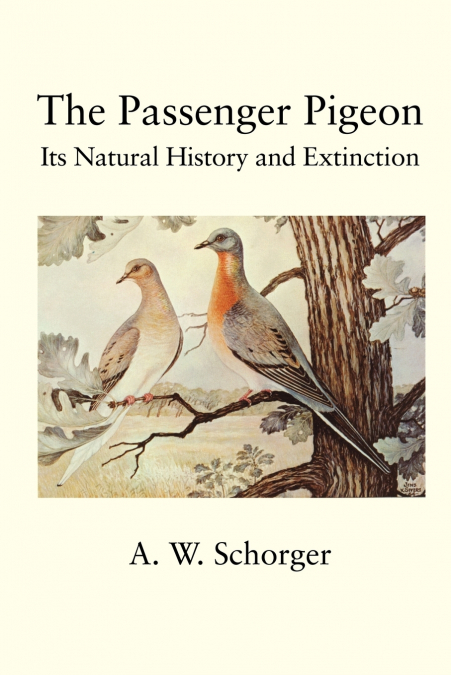
Published in 1955 by the University of Oklahoma Press, this is the classic study of the extinction of the passenger pigeon.The passenger pigeon, once probably the most numerous bird on the planet, made its home in the billion or so acres of primary forest that once covered North America east of the Rocky Mountains. Their flocks, a mile wide and up to 300 miles long, were so dense that they darkened the sky for hours and days as the flock passed overhead. Population estimates from the 19th century ranged from 1 billion to close to 4 billion birds. Total populations may have reached 5 billion birds and comprised up to 40% of the total number of birds in North America. This may be the only species for which the exact time of extinction is known.No appreciable decline in the numbers was noted until the late 1870s but, thereafter, their destruction took only twenty-five years. The immense roosting and nesting colonies invited over-hunting. Tens of thousands of individuals were harvested daily from nesting colonies, and shipped to markets in the east. Modern technology hastened the demise of the passenger pigeon. With the coming of the telegraph, the locations of flocks could be ascertained, and the birds relentlessly pursued.The last bird died in 1914 at the Cincinnati Zoological Garden before any competent ornithologists could write an account of the species.A. W. Schorger reconstructed the life history of the passenger pigeon. Through painstaking research, he examined every aspect of the species -- behavioral characteristics, feeding methods, traveling and roosting habits, nesting - and the various stages of the species encounter with man, from utilization by the Native American to extinction at the hands of white settlers.From the original reviews:'This really shocking book ought to be required reading for every thoughtful citizen' Audubon Magazine'Reads as fascinatingly as many a novel' Cleveland Plain Dealer'Prodigious' Newsweek'Absorbing' Scientific American'An excellent book' Michigan History
Artículos relacionados

  • Water from a Transdisciplinary Perspective
    Ana Isabel Pereira Cardoso / Teresinha M. Gonçalves
    Life in cities has distanced human beings from nature and made it difficult to understand the ecology of life dependent on the environment. Urban water collection and distribution processes contribute significantly to the fragmentation of knowledge and the vital recognition of the water cycle. Without the effective participation of the subject in environmental actions, it is no...
    Disponible

    43,82 €

  • Modeling Populations of Adaptive Individuals
    Bret C. Harvey / Steven F. Railsback
    Ecologists now recognize that the dynamics of populations, communities, and ecosystems are strongly affected by adaptive individual behaviors. Yet until now, we have lacked effective and flexible methods for modeling such dynamics. Traditional ecological models become impractical with the inclusion of behavior, and the optimization approaches of behavioral ecology cannot be use...
    Disponible

    65,53 €

  • Scaling in Ecology with a Model System
    Aaron Ellison / Aaron M. Ellison / Nicholas J. Gotelli
    A groundbreaking approach to scale and scaling in ecological theory and practiceScale is one of the most important concepts in ecology, yet researchers often find it difficult to find ecological systems that lend themselves to its study. Scaling in Ecology with a Model System synthesizes nearly three decades of research on the ecology of Sarracenia purpurea-the northern pitcher...
  • Population Ecology
    Deborah E. Goldberg / John H. Vandermeer
    The essential introduction to population ecology-now expanded and fully updatedEcology is capturing the popular imagination like never before, with issues such as climate change, species extinctions, and habitat destruction becoming ever more prominent. At the same time, the science of ecology has advanced dramatically, growing in mathematical and theoretical sophistication. He...
    Disponible

    124,92 €

  • Physiological Ecology
    Carlos Martínez del Rio / William H. Karasov
    Unlocking the puzzle of how animals behave and how they interact with their environments is impossible without understanding the physiological processes that determine their use of food resources. But long overdue is a user-friendly introduction to the subject that systematically bridges the gap between physiology and ecology. Ecologists--for whom such knowledge can help clarif...
  • Critical Transitions in Nature and Society
    Marten Scheffer
    How do we explain the remarkably abrupt changes that sometimes occur in nature and society--and can we predict why and when they happen? This book offers a comprehensive introduction to critical transitions in complex systems--the radical changes that happen at tipping points when thresholds are passed. Marten Scheffer accessibly describes the dynamical systems theory behind cr...
    Disponible

    89,46 €