 Librería Samer Atenea
 Kálamo Books
 Librería Elías (Asturias)
 Librería Kolima (Madrid)
 Librería Proteo (Málaga)
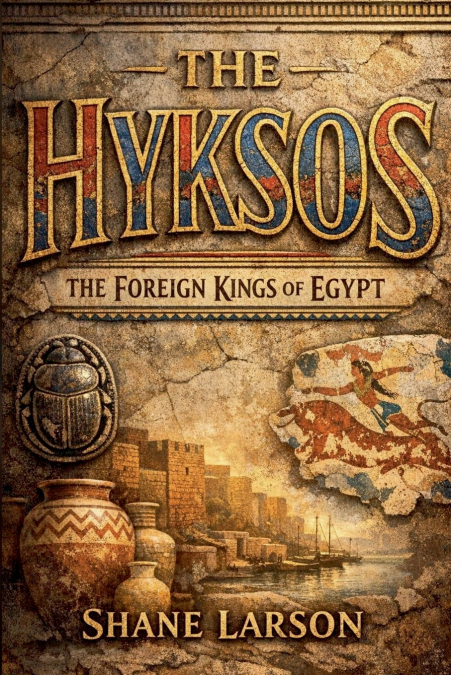
'Hyksos' was never the name of a people. It was a title - heka khasut, 'ruler of foreign lands' - held by a handful of kings, garbled into Greek a thousand years after the last of them died, and then mistaken, for two thousand years, for the name of a barbarian horde.The story Egypt told is the one most people still know: in the days of a weak king, invaders out of the east swept into the Nile Valley, burned the temples, enslaved the population, and ruled by terror until the princes of Thebes rose and drove them out. It is a magnificent story, and it governed the subject from antiquity until living memory. Almost none of it survives contact with the ground.Fifty years of excavation at Avaris, the foreign kings’ capital in the eastern Delta, has uncovered something stranger than an invasion: a city where Levantine families had been settling, house by house and grave by grave, for generations before any foreign king existed. Canaanite temples on Egyptian soil. Donkeys buried at tomb entrances. And on the walls of a palace beside the Nile, Minoan bull-leaping frescoes - the art of Knossos, a thousand miles from Crete, where no one thought to look for it. The temples said to have been razed show no razing. There is no destruction layer where the invasion should be. And in 2020, strontium isotope analysis of the city’s dead put numbers to it: the immigrants arrived generations before the takeover, and the kings rose from a community already long at home. Not an invasion - a takeover from within.The Hyksos tells the story of Egypt’s lost century and its long afterlife: the Middle Kingdom’s slow unraveling that left the Delta open; the excavated streets, harbors, and cemeteries of Avaris; the kings - Khyan, Apepi - who wore the full royal titulary, wrote their names in cartouches, and governed through Egypt’s own machinery; a divided land of three powers, with a Nubian kingdom pressing from the south and an intercepted letter proposing an alliance against Thebes; the arrival of the horse, the light war chariot, and the composite bow; and the war itself - Seqenenre’s shattered skull, Kamose’s proclamations, Ahmose’s siege of Avaris, and the pursuit into the Levant.Then the reckoning that gives the book its spine. The New Kingdom that followed - the Egypt of Thutmose III, of Megiddo, of empire - was built, piece by piece, with the military toolkit of the dynasty it expelled. Egypt’s greatest imperial age was armed by the people it spent that age insisting had never really ruled it. So the kings were written out: monuments usurped, the century recast as ruin, the dynasty converted into the standard villain of state ideology - a rewriting done so thoroughly that it held for fifteen hundred years of Egyptian history and two thousand more of everyone else’s.If you know Egypt through Tutankhamun, Ramesses, and the golden age of the New Kingdom, this is the origin story you have been missing - the century that explains where the chariots, the standing army, and the empire actually came from. No prior knowledge is assumed: the tangled chronology of the period is sorted into a clear appendix, the science is explained as it is used, and the propaganda is read as propaganda. Includes appendices on the overlapping dynasties, the surviving sources and what weight each can bear, and how the chariot worked and why it reorganized Bronze Age warfare.For a hundred years, foreigners ruled Egypt. This is what actually happened - and why Egypt could never admit it.