 Librería Samer Atenea
 Kálamo Books
 Librería Elías (Asturias)
 Librería Kolima (Madrid)
 Librería Proteo (Málaga)
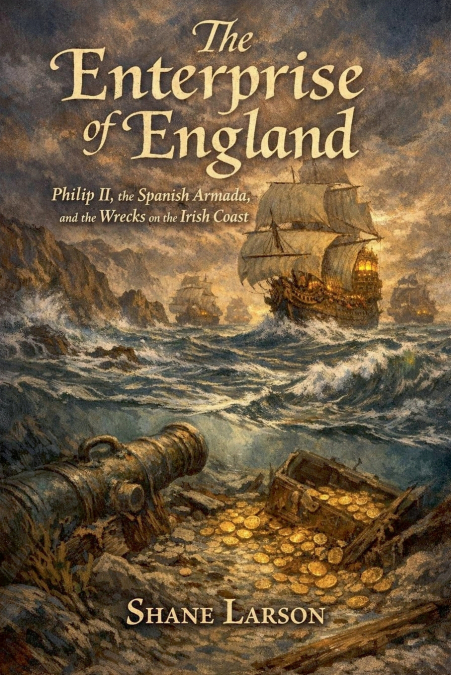
The English did not sink the Spanish Armada. Nine days of fighting up the Channel and the battle off Gravelines cost the fleet three ships to English gunnery, perhaps four. Most of its losses came afterwards, on the way home, and more Spaniards died on the coast of Ireland than in every engagement of the campaign put together.The story everyone knows ends at Gravelines, with Drake, the fireships and a Protestant wind, and its most famous scene, the game of bowls, was first written down decades after the event. The Spanish story is longer. It begins with a king at a desk in the Escorial, writing orders for a fleet from Lisbon to meet an army in Flanders that had no harbour to meet it in. It continues with a commander who wrote to the king in February 1588 asking not to be given the job, and then held a hundred and thirty ill-matched ships in formation under continuous attack from Plymouth to Calais. It ends on the beaches of Kerry, Sligo, Donegal and Antrim, where ships that had cut their anchors to escape the fireships had nothing left to hold them off a lee shore.This book is told from both flagships. In the Channel you always know what Medina Sidonia on the San Martín and Howard on the Ark Royal knew and did not know. A full quarter of the book belongs to the voyage home: Fair Isle, Blasket Sound, Kinnagoe Bay, and Streedagh Strand, where three ships broke up in an hour and an English officer reported eleven hundred bodies on the sand. Survivors were put to death on the Lord Deputy’s written orders; some Irish lords sheltered them, and paid for it. Captain Francisco de Cuéllar, who lived through Streedagh and got out by way of Leitrim, Ulster and Scotland, tells the best of it in his own letter.Then the seabed gives evidence. Since Robert Sténuit found the Girona off Lacada Point in 1967, divers have brought up the Armada’s guns, carriages and coin, and with them a fleet that had prepared for a boarding fight it was never allowed to have: siege guns on land carriages, a dozen calibres aboard a single ship, and much of its heavy shot never fired.What you’ll learn:Why Philip’s plan was coherent on paper and impossible on the water, and who told him soWhat Medina Sidonia’s letter actually asked for, and how his nine days in the Channel look beside itWhy the anchors left off Calais killed men in Ireland six weeks laterWhat happened on the Irish coast, who gave the orders, and who defied themWhat the wreck archaeology proved about Spanish guns and English gunneryWhy both fleets lost more men after the fighting than during it, and why the war ran on until 1604This book is for you if:You know the English Armada and have never heard the Spanish oneYou read naval and military history and want the Spanish side given the same weight as the EnglishYou know the Antrim, Donegal, Sligo or Kerry coast and want to know what lies off itYou have read Elizabeth I and Mary, Queen of Scots and want the war that followedThe fleet that broke on the Irish coast was built in a study, on paper. This is the story from both decks.