 Librería Samer Atenea
 Kálamo Books
 Librería Elías (Asturias)
 Librería Kolima (Madrid)
 Librería Proteo (Málaga)
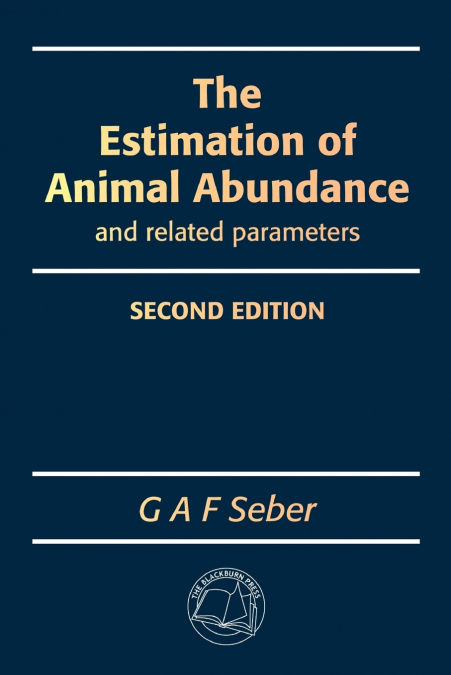
Originally published in 1982, this reprint of the second edition of The Estimation of Animal Abundance and Related Parameters has been described as the 'bible' of the field.Censuses of living populations are required for many purposes in wildlife management, fisheries and pest control and they are essential in policy making for the protection of the environment. In this book Professor Seber, one of the leading experts in the field, explains in detail the methods that have been developed by ecologists for estimating animal numbers and related parameters such as mortality and birth rates. He insists on the importance of experimental design and describes a great variety of statistical techniques that are required in analyzing the data obtained.These designs and techniques are classified for easy reference according to the particular types of problems encountered by the field worker and the kind of information that is available. The assumptions underlying practical methods in current use are fully examined, together with procedures for testing their validity. Each method is demonstrated by at least one worked example; in all there are over 90 such examples, mostly using data obtained from natural or free-ranging populations around the world.Ecologists will find this book - the first full-length treatment of its subject - a sound statistical assessment of methods which in the past were frequently developed on an intuitive basis; while applied mathematicians will benefit no less from a study of the interaction between mathematics and biology in this important branch of statistics. Field workers will be stimulated and helped by the real-life examples and the practical nature of the work.'George Seber’s book became an instant classic following its publication in 1973. It dealt comprehensively with previously published research on methods for estimating abundance and demographic parameters of animal populations. Professor Seber provided detailed reviews of methods that were originally published with adequate statistical development, and he provided derivations and development for intuitive estimators that had been initially presented by ecologists. The second edition of the book was published in 1982 and included substantive additional coverage of 'new' developments that had occurred since 1973. The 1982 book has become a citation classic and can be found on the bookshelf of every serious animal population ecologist and every biostatistician dealing with animal population data. For the 20 years since its publication, it has remained the only book of its kind. Many important methodological developments have occurred in animal estimation problems since 1982, but virtually all such methods represent extensions of the initial methods described by Seber (1982). Several excellent monographs and books have been written over the last 2 decades that deal in detail with particular subsets of the material in Seber (1982). What is remarkable is that these recent contributions have not superseded Seber’s book, but are best viewed as supplements to his original comprehensive treatment. Thus, Seber’s (1982) book can still be found on the bookshelf of every serious animal population ecologist and biostatistician. Now, in 2002, it is surrounded on the bookshelf by a handful of related books and monographs, but it has not lost its relevance or importance and remains the most detailed, comprehensive treatment of methods to estimate animal abundance and related parameters.' Jim Nichols, Patuxent Wildlife Research Center, U.S. Geological Survey, Laurel, MDProfessor Seber, Professor Emeritus at the University of Auckland, is regarded as the world’s foremost authority on statistical methods for estimating the size of animal populations. His early work on capture-recapture methods was groundbreaking and the Jolly-Seber method still forms the basis of most modern work, more than 30 years after his first paper on the method in 1962.