 Librería Samer Atenea
 Kálamo Books
 Librería Elías (Asturias)
 Librería Kolima (Madrid)
 Librería Proteo (Málaga)
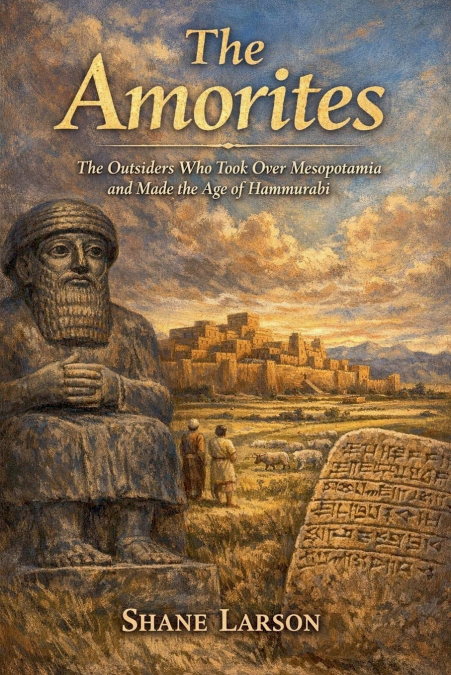
The Sumerians said they ate their meat raw and left their dead unburied. Two hundred years later, they were the kings.For about three hundred years, from roughly 1900 to 1600 BC, nearly every throne between the Mediterranean and the Persian Gulf was held by a dynasty the Sumerians had called MAR.TU, 'westerners.' Babylon, Larsa, Mari, Aleppo, Qatna, Eshnunna, and for a generation Assur: all of them Amorite. Hammurabi was an Amorite. So was Shamshi-Adad, who built the first great kingdom of northern Mesopotamia. And until 2022, when Andrew George and Manfred Krebernik published two Old Babylonian bilingual tablets pairing Amorite with Akkadian line by line, their language had never been read as anything but names. Everything known about the ruling class of an age had been written by others.The old story was an invasion: nomads pour out of the steppe, overwhelm the cities, and rule from the ruins. The documents tell a slower, stranger story. Amorites appear inside the empire of Ur as soldiers, messengers and labourers, paid in sheep and silver by the same kings who gave a frontier wall a name meaning 'the one that keeps the Tidnum out.' When Ur finally fell in 2004 BC, it was an Elamite army that took the city, and the men who picked up the pieces were already inside the system. Within a century they ruled cities while still calling themselves chiefs of tribes. Two hundred years after that, their descendants could no longer be told apart from the people they had replaced.This book follows the Amorites through the whole arc, from the steppe edge of the Sumerian world to Hammurabi’s unification and the Hittite raid of 1595 BC that closed the age, then follows the name onward to the Nile Delta and into the Bible. Where scholars divide, it gives both sides and the evidence, and does not quietly pick a winner.What you’ll learn:Why a Sumerian poem’s portrait of the truffle-digging tent-dweller says more about Sumerian anxiety than about Amorite lifeWhat the ration lists of Ur reveal that the laments conceal: a state paying the very people its walls were built againstHow the 4.2-kiloyear drought became the leading explanation for the Amorite rise, and why serious scholars reading the same cores reject itWhy the royal houses of Babylon and Assur, rivals at opposite ends of Mesopotamia, recited the same tent-dwelling ancestors over their deadHow Shamshi-Adad, an exiled chief’s son, took Ekallatum, Assur and Mari in turn, and why his empire did not outlive himWhat thousands of personal names reveal about a language nobody wrote, and what two bilingual tablets changedWhether the Hyksos rulers of Egypt were Amorites in any meaningful sense, and what a 2020 isotope study of burials at Avaris suggestsWhat the 'Amorites' of Genesis and Joshua have to do with the Bronze Age people, and why a scholarly consensus about that collapsed in the 1970sThis book is for you if:You know Hammurabi’s name and want to know who his people wereYou reached the fall of Ur and asked who came nextYou read histories of outsiders who became rulers and want the earliest case that can be followed in documentsYou want a contested subject laid out plainly, objections included, by a writer who trusts you to weigh the evidenceA king of Ur named a wall for keeping them out. It did not.