 Librería Samer Atenea
 Kálamo Books
 Librería Elías (Asturias)
 Librería Kolima (Madrid)
 Librería Proteo (Málaga)
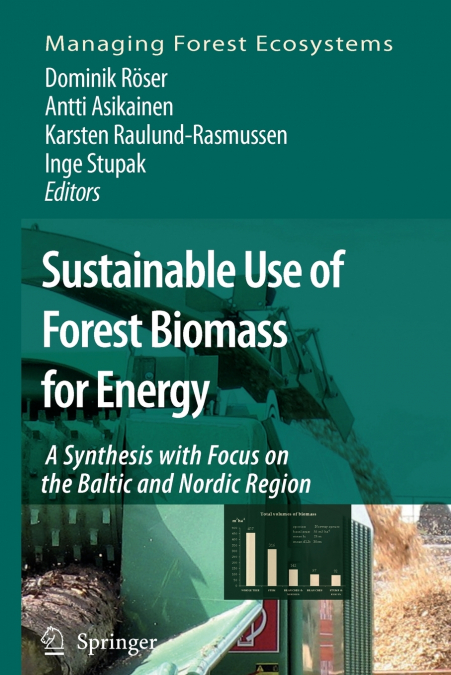
Preface.- List of Contributors.- 1. Introduction to Sustainable Utilisation of Forest Energy. 1.1 Introduction. 1.2 Energy policy. 1.3 Sustainable development and forest policy. 1.4 The WOOD-EN-MAN project. 1.5 References; A. Lunnan et al.- 2. Forest Energy Resources and Potentials. 2.1 Introduction. 2.2 Natural conditions. 2.3 Types of forest bioenergy. 2.3.1 Forest types. 2.3.2 Differences among tree species. 2.3.3 Physical properties. 2.4 Present use of forest biomass for energy. 2.4.1 Firewood. 2.4.2 Primary residues. 2.4.3 Secondary residues. 2.5 Estimation of woodfuel potential. 2.5.1 Net annual increment, fellings, and roundwood balance. 2.5.2 Residues from fellings and roundwood balance. 2.6 References; D. Röser et al.- 3. Effects of Very Intensive Forest Biomass Harvesting on Short and Long Term Site Productivity. 3.1 Introduction. 3.2 Nutrient fluxes to and from forest ecosystems. 3.2.1 Deposition. 3.2.2 Leaching. 3.2.3 Nutrient removals in forest biomass harvesting. 3.2.4 The soil as a source and a store of nutrients. 3.3 Assessment of long term productivity consequences of very intensive harvesting. 3.4 Case studies - examples of assessments of vulnerability and compensation recommendations. 3.5 Synthesis and nutrient compensation recommendations. 3.6 References; K. Raulund-Rasmussen et al.- 4. Wood Ash Recycling - Possibilities and Risks. 4.1 Introduction. 4.2 Wood ash properties. 4.2.1 Wood ash composition and quality. 4.2.2 Contamination risks. 4.2.3 Pre-conditioning before recycling. 4.3 Effects of wood ash application on soils. 4.3.1 Soil acidity changes. 4.3.2 Effects on microbiological processes in the soil. 4.4 Effects of wood ash application on trees. 4.4.1 Mineral soils. 4.4.2 Peat soils. 4.4.3 Tree physiology, morphology and biochemical status. 4.4.4 Effects on fine root growth, mycorrhiza and vitality. 4.5 Effects of wood ash application onground and understorey vegetation. 4.5.1 Species composition. 4.6 History, current use and regulation of ash recycling. 4.7 Recommended doses and regulations. 4.8 References; E. Karltun et al.- 5. Insect Pests and Forest Biomass for Energy. 5.1 Introduction. 5.2 Pest species. 5.2.1 The spruce bark beetle. 5.2.2 Pityogenes chalcographus. 5.2.3 The pine shoot beetles. 5.2.4 The pine weevil. 5.3 Risk for tree mortality in relation to insect density and tree vigour. 5.4 Insect reproduction in forest fuel. 5.5 Influence on regional population densities. 5.6 Risk for damage close to forest fuel piles. 5.7 Legislation. 5.8 Conclusions. 5.9 Management recommendations from an insect pest perspective. 5.10 References; L.M. Schroeder.- 6. The Effects of Forest Biomass Harvesting on Biodiversity. 6.1 Introduction. 6.2 Potential problems for biodiversity due to forest biomass harvesting. 6.3 Organisms that may be affected by bioenergy use. 6.3.1 Wood living organisms. 6.3.2 Organisms dependent on piles of logging residue. 6.4 Associations with different types of wood. 6.4.1 Tree species. 6.4.2 Sun exposure. 6.4.3 Diameters. 6.4.4 Decay stages. 6.4.5 Tree part. 6.5 Dispersal of saproxylic organisms. 6.6 Risks for species loss. 6.6.1 Processes that create dead wood in natural and managed forests. 6.6.2 Risks of species loss due to degree of sun exposure. 6.6.3 Risk of species loss due to tree species associations. 6.7 Trapping of insects in piles of logging residues. 6.8 Management recommendations. 6.8.1 Extraction of logging residues. 6.8.2 Storage of logging residues in the forest. 6.9 References; M. Jonsell.- 7. Review of Recommendations for Forest Energy Harvesting and Wood Ash Recycling. 7.1 Introduction. 7.2 Environmental aspects. 7.2.1 Soil nutrient fertility. 7.2.2 Soil organic matter and carbon storage. 7.2.3 Wood ash recycling and other nutrient compensation. 7.2.4 Hydrology and water