 Librería Samer Atenea
 Kálamo Books
 Librería Elías (Asturias)
 Librería Kolima (Madrid)
 Librería Proteo (Málaga)
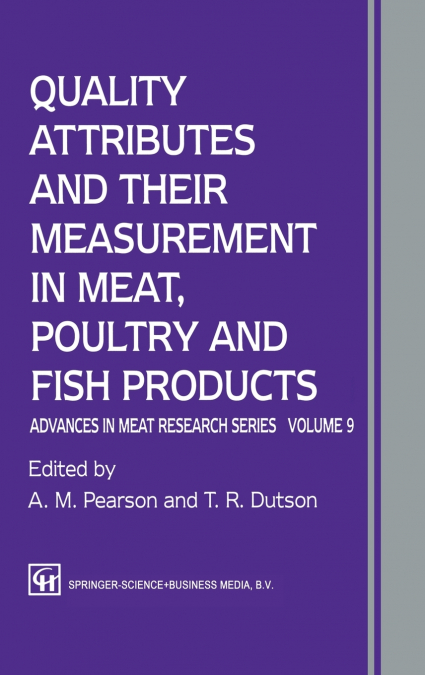
1 Introduction to quality attributes and their measurement in meat, poultry and fish products.- 1.1 Introduction.- 1.2 Color.- 1.2.1 Importance.- 1.2.2 Variability and measurement.- 1.3 Juiciness and/or water-binding.- 1.3.1 Importance.- 1.3.2 Effects of variability and measurement.- 1.4 Flavor.- 1.4.1 Importance.- 1.4.2 Variability.- 1.4.3 Physiology and psychology of flavor/aroma.- 1.4.4 Specific flavors/odors.- 1.4.5 Flavor and aroma problems.- 1.5 Tenderness.- 1.5.1 Importance.- 1.5.2 Some factors influencing tenderness and its measurement.- 1.6 Microbial problems.- 1.6.1 Importance.- 1.6.2 Measurement.- 1.7 Additives and residues.- 1.7.1 Additives.- 1.7.2 Residues.- 1.8 Contributions of meat to human nutrition.- 1.8.1 Proteins and essential amino acids.- 1.8.2 Fats and essential fatty acids.- 1.8.3 Vitamins.- 1.8.4 Minerals.- 1.9 Summary.- References.- Appendix 1.1.- Appendix 1.2.- 2 Color - its basis and importance.- 2.1 Introduction.- 2.1.1 Retail importance of meat color.- 2.2 Myoglobin and its derivatives.- 2.2.1 Myoglobin concentration in muscle.- 2.3 Factors affecting fresh meat color stability.- 2.3.1 Oxygen tension.- 2.3.2 Bacteria.- 2.3.3 Vacuum-packaging.- 2.3.4 Packaging with oxygen-permeable films.- 2.3.5 Modified-atmosphere packaging.- 2.3.6 Effects of pH.- 2.3.7 Temperature.- 2.4 Dark-cutting beef and related dark color problems.- 2.4.1 Characteristics of dark-cutting meat.- 2.4.2 Mechanism by which pH affects color.- 2.4.3 Changes occurring after death.- 2.4.4 Shelf-life of high pH meat.- 2.4.5 Vacuum packaging.- 2.4.6 Minimizing dark-cutters by management.- 2.4.7 Dark, coarse band in beef ribs.- 2.5 Pale, soft, exudative (PSE), porcine stress syndrome (PSS) and dark, firm, dry (DFD) pork’.- 2.5.1 Importance ofPSE, PSS and DFD pork.- 2.5.2 Genetic basis.- 2.5.3 Influence of environmental factors.- 2.6 Enzymatic reduction of metmyoglobin.- 2.6.1 Enzymes involved.- 2.6.2 Variation among muscles.- 2.6.3 Other factors influencing color stability.- 2.7 Non-enzymatic reductants and inhibitors of oxidation.- 2.7.1 Effects of antioxidants and reductants.- 2.8 Irradiation and other antimicrobial treatments.- 2.8.1 Irradiation of fresh and cooked meats.- 2.8.2 Sulfites and meat color.- 2.9 Effects of light, freezing, salt and lipid oxidation on meat color.- 2.10 Cooked meat color.- 2.10.1 Pink color in cooked, uncured meat.- 2.11 Cured meat color.- 2.11.1 Role of nitrite.- 2.11.2 Action of cysteine and ascorbate.- 2.11.3 The cured meat pigment.- 2.11.4 Fading of cured meat color.- 2.12 Summary.- References.- 3 Colour of meat.- 3.1 Introduction to vision and colour.- 3.2 Colour vision.- 3.2.1 Colour measurement.- 3.2.2 Uniform colour space.- 3.3 Terminology.- 3.4 Instrumentation.- 3.4.1 Trichromatic colorimeters.- 3.4.2 Spectrophotometers.- 3.4.3 Sources of variation among colorimeters and spectrophotometers.- 3.5 Absorption, scatter and pigmentation.- 3.5. 1 Reflectance.- 3.5.2 Light scatter.- 3.6 Meat colour.- 3.6.1 Measurement procedure.- 3.6.2 Reflectance spectral changes in meat.- 3.6.3 Colour changes in beef.- 3.6.4 Differences between CIELAB and Hunter scales.- 3.7 Summary.- References.- 4 Juiciness - its importance and some contributing factors.- 4.1 Introduction.- 4.2 Subjective assessment of juiciness.- 4.3 Relationship to objective measurements.- 4.3.1 Juiciness vs. water-holding.- 4.3.2 The state of water.- 4.3 .3 Heating method and end-point temperature vs. juiciness.- 4.3.4 The role of fat.- 4.3.5 Relationship between drip losses and juiciness.- 4.3.6 Relationship between press fluid and juiciness.- 4.4 Factors influencing the juiciness of intact meat.- 4.4.1 Interference from other experimental and textural factors.- 4.4.2 Heating/cooking methods.- 4.4.3 Animal characteristics.- 4.4.4 Factors related to rigor development.- 4.4.5 Restructured meat.- 4.4.6 Processed meats.- 4.4.7 Marinaded meat.- 4.5 Conclusions.- References.- 5 Measurement of water-holding capacity and juiciness.- 5.1 Introduction.- 5...