 Librería Samer Atenea
 Kálamo Books
 Librería Elías (Asturias)
 Librería Kolima (Madrid)
 Librería Proteo (Málaga)
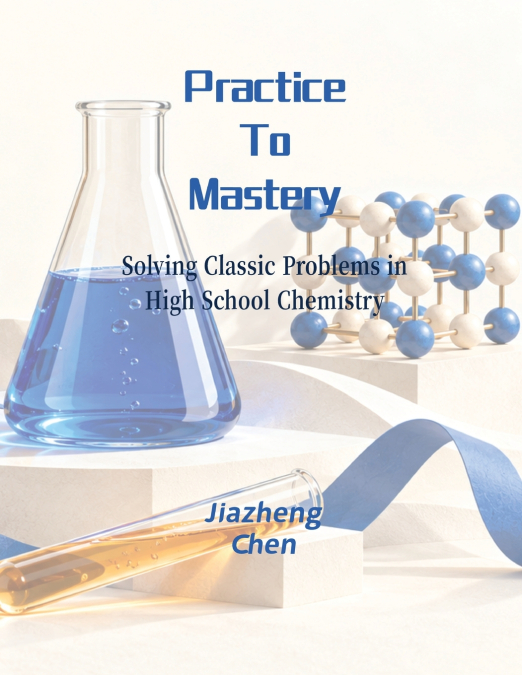
Practice to Mastery: Solving Classic Problems in High School Chemistry is not a question bank and it does not replace your textbook. Instead, it takes the small number of classic problems that high school chemistry and AP® Chemistry are built on and works each one all the way through, so that you learn not just one answer but a method for the whole family of problems.Fifteen chapters cover the core of the course: the mole and mole conversions; mass spectra, elemental analysis, and formulas; electron configurations and periodic trends; Lewis structures and molecular shape; intermolecular forces; ideal gases and partial pressures; solution concentration and Beer’s law; chemical equations and redox; stoichiometry; reaction rates and mechanisms; calorimetry, enthalpy, and Hess’s law; chemical equilibrium and ICE tables; acids, bases, and titration curves; solubility equilibria; and thermodynamics and electrochemistry.The book contains 47 classic problems, and every one is worked through in the same eight parts:- The Problem: the full question, usually in several parts.- Identify the Model: how to recognize the type of problem from its wording and setup.- The General Strategy: a step-by-step method that works for the whole family of problems.- Step-by-Step Solution: every setup, substitution, unit, and significant figure written out, with nothing skipped.- Variations: the conditions changed one at a time, solved again, so you see how the method adapts.- Another Way: a second method when one is worth knowing.- Common Mistakes: the errors students make most often on this kind of problem.- Takeaways: the ideas to carry forward.The heart of the book is one idea: take one setup and evolve it. A single titration setup produces the curves for a strong acid, a weak acid, a weak base, and a polyprotic acid. One ICE table handles finding K, finding equilibrium concentrations, and predicting the direction of a reaction. The mole map in Chapter 1 becomes the starting point for nearly every calculation that follows. Problems that look different turn out to be the same problem viewed from different sides.Formulas, symbols, and constants follow U.S. high school conventions: molarity is written M, molar mass is written with a script M so the two never collide, and constants match the standard equation sheet. Common formulas are derived rather than simply stated, so you can rebuild them when you forget them. Every number in the book has been recalculated and checked. All problems, data, and illustrations are original, and the diagrams are clean black-and-white line drawings used only where a picture genuinely helps.Use this book alongside a high school chemistry, honors chemistry, or AP® Chemistry course, or on your own to review for an exam. Try each classic problem before reading the solution, then treat each variation as a new problem. When you can solve every variation without help, you have learned the problem, and the exam’s version of it will look familiar.A Chinese-English bilingual edition, 美高化学解题手册 (A Bridge to Solving Classic Problems: High School Chemistry), is also available.AP® is a registered trademark of the College Board, which was not involved in the production of, and does not endorse, this product.