 Librería Samer Atenea
 Kálamo Books
 Librería Elías (Asturias)
 Librería Kolima (Madrid)
 Librería Proteo (Málaga)
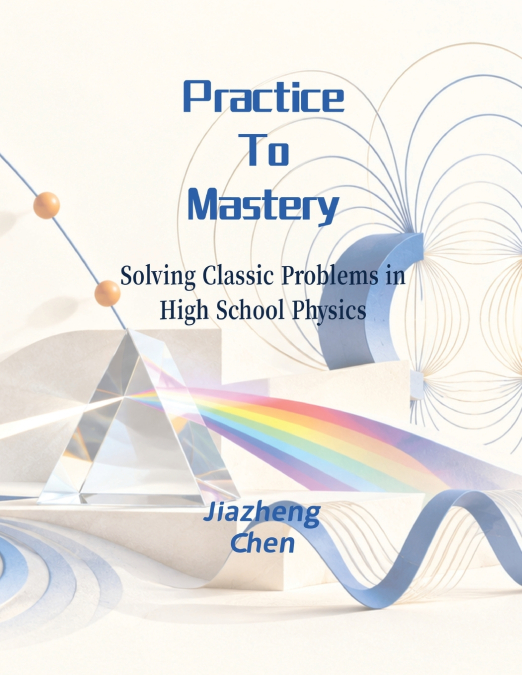
You can understand the ideas in physics and still freeze on a test. You know Newton’s laws, you know energy is conserved, you recognize every formula on the equation sheet. Then a problem changes one condition, and nothing you memorized seems to fit. Understanding concepts and solving problems are two different skills, and this book is about the second one.Practice to Mastery: Solving Classic Problems in High School Physics is not a problem bank. It takes the small set of classic problems that high school physics is built on, 53 of them across 17 chapters, and works each one all the way through. Each problem is a setup that keeps coming back in homework and on exams.Every problem follows the same eight-part structure:- The Problem: the problem as you would see it- What Kind of Problem Is This?: how to recognize the type from its wording and setup- The General Approach: a method that works for the whole family of problems- Step by Step: a complete solution with every equation, substitution, unit, and direction written out- Now Change One Thing: the conditions change one at a time, and you see how the solution responds- More Than One Way: a second method, and when each one saves effort- Watch Out: the mistakes students make most often- The Takeaway: what to carry forwardThe heart of the book is Now Change One Thing. A block on an incline can sit on a smooth surface or a rough one. It can stay at rest, slide at constant velocity, or speed up. It can be alone or tied by a string to a second block. Following one setup through every variation, and seeing which steps stay the same and which have to change, teaches more than a stack of unrelated problems.Part I covers mechanics: motion in a straight line, projectile and circular motion, Newton’s laws, work and energy, momentum, torque and rotation, simple harmonic motion, gravitation, and fluids. Part II covers gases and thermodynamics, electrostatics, DC circuits, magnetism, electromagnetic induction, geometric optics, waves and physical optics, and modern physics.The book uses algebra and trigonometry only, with no calculus. Most common formulas are derived rather than simply stated, so you can see where they come from and rebuild them if you forget them. Notation and sign conventions follow common U.S. high school usage, and g = 9.8 m/s² throughout. Black-and-white diagrams appear wherever a free-body diagram, a graph, a ray diagram, or a circuit is needed. All problems, data, and diagrams are original.The content lines up with the topics of AP® Physics 1 and AP® Physics 2, which makes the book a strong companion for students preparing for those exams. It also works for honors and regular high school physics, and for anyone who wants to learn to solve physics problems on their own, without a teacher at their side. It does not cover the calculus-based AP® Physics C courses.A Chinese-language edition, A Bridge to Solving Classic Problems: High School Physics, is also available.AP® and Advanced Placement® are registered trademarks of the College Board, which was not involved in the production of, and does not endorse, this product.