
Practice to Mastery

Practice to Mastery

Jiazheng Chen

69,31 €
IVA incluido
Disponible
Editorial:
Jiazheng Chen
Año de edición:
2026
Materia
Ciencia, ingeniería y tecnología medioambientales
ISBN:
9781965630617
69,31 €
IVA incluido
Disponible

Selecciona una librería:

  • Librería Samer Atenea

  • Kálamo Books
  • Librería Elías (Asturias)
  • Librería Kolima (Madrid)
  • Librería Proteo (Málaga)

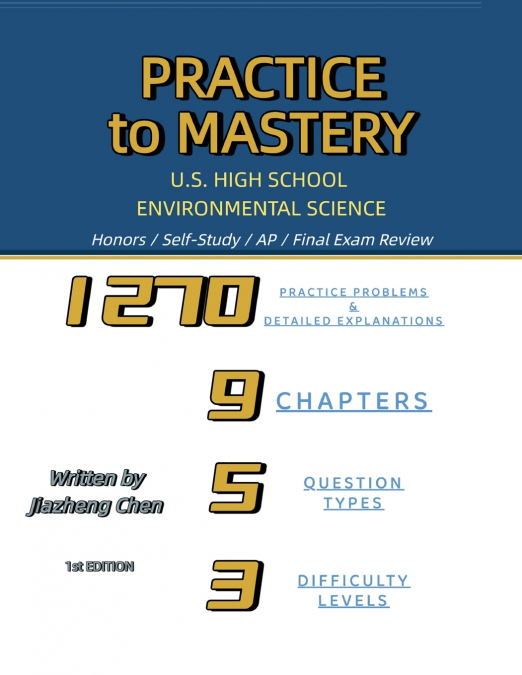
1,275 original practice questions. A worked explanation for every single one.Environmental science asks students to do something unusual: to reason quantitatively about messy, real systems - a watershed, a fishery, a power grid, an atmosphere - using tools borrowed from biology, chemistry, earth science, and economics. Recognizing a definition is not the same as being able to use it. This workbook is built to close that gap.Nine chapters cover the full scope of a year-long high school environmental science course: ecosystems and biogeochemical cycles; biodiversity and ecosystem services; populations and human demography; Earth’s physical systems; land and water use; energy resources; air pollution; pollution of water and land and its effects on human health; and global change.Each chapter presents five distinct question types, so that students are tested the way the subject is actually practiced:Part A - Single-Answer Multiple Choice. Exactly one correct answer. Builds core recall and reasoning.Part B - Multiple-Select. Five statements per item; mark every one that is correct. The number of correct choices varies from item to item, so a vague impression will not do.Part C - Short Answer & Calculations. Open-response problems with room to work. Show every step and carry units through every line.Part D - Scenario Applications. Each item drops a concept into a real setting - a farm, a landfill, a utility, a city council - and asks the student to reason from it.Part E - Data Analysis & Investigation Design. Read a figure or a data table and defend a conclusion; or design a controlled investigation, identify the variables, and state what result would refute your own hypothesis.WHAT MAKES THE ANSWER KEY DIFFERENTEvery question in this book is answered in full. The explanation states why the correct choice is correct - and why each of the other four is wrong. Every calculation is worked line by line, with units. Where a common misconception is in play, it is named and dismantled rather than simply marked incorrect.Every question is also tagged for difficulty: Easy (recall and single-step problems), Medium (multi-step reasoning and application to a new context), and Hard (multi-concept synthesis and demanding quantitative work). The tags appear only in the answer key, so that no question is prejudged.HOW THE BOOK IS ORGANIZEDAll 1,275 questions appear in the first half of the book, chapter by chapter. The complete answer key follows in the second half. That structure is deliberate: working a whole chapter before turning to the key forces retrieval practice, which is what builds durable mastery - recognition does not.FIGURES AND DATA58 original figures and 25 data tables, all created for this book. Climographs, cycle diagrams, food webs, survivorship curves, age-structure pyramids, soil texture triangles, dose-response curves, dissolved-oxygen sag curves, hydrographs, and climate records. All are printed in black and white and distinguish their data series by line style, marker shape, and fill pattern - never by color - so that nothing is lost in a monochrome printing or a photocopy.FOR STUDENTS AND TEACHERSStudents can work through a chapter and self-assess against the key. Teachers can pull items by topic, by question type, or by difficulty for homework, quizzes, review sessions, or in-class practice. Individual pages may be reproduced for classroom or personal study use.Every question, option, explanation, figure, and table in this book is original work.
Artículos relacionados

  • Ocean Remote Sensing with Synthetic Aperture Radar
    The ocean covers approximately 71% of the Earth’s surface, 90% of the biosphere and contains 97% of Earth’s water. The Synthetic Aperture Radar (SAR) can image the ocean surface in all weather conditions and day or night. SAR remote sensing on ocean and coastal monitoring has become a research hotspot in geoscience and remote sensing. This book—Progress in SAR Oceanography—prov...
    Disponible

    83,90 €

  • Handbook of Research on Advancements in Environmental Engineering
    Nediljka Gaurina-Medjimurec
    The protection of clean water, air, and land for the habitation of humans and other organisms has become a pressing concern amid the intensification of industrial activities and the rapidly growing world population. The integration of environmental science with engineering principles has been introduced as a means of long-term sustainable development. The Handbook of Research o...
  • Computer Vision and Pattern Recognition in Environmental Informatics
    Computer Vision and Pattern Recognition (CVPR) together play an important role in the processes involved in environmental informatics due to their pervasive, non-destructive, effective, and efficient natures. As a result, CVPR has made significant contributions to the field of environmental informatics by enabling multi-modal data fusion and feature extraction, supporting fast ...
  • Handbook of Research on Environmental Policies for Emergency Management and Public Safety
    Augustine Nduka Eneanya
    In a world of earthquakes, tsunamis, and hurricanes, it is evident that emergency response plans are crucial to solve problems, overcome challenges, and restore and improve communities affected by such negative events. Although the necessity for quick and efficient aid is understood, researchers and professionals continue to strive for the best practices and methodologies to pr...
  • A New Water Future
    Ric Davidge
    Just as cities and nations face the challenge of providing clean water to their citizens and their economies, a new opportunity has finally been constructed that can fix these challenges.  This is a time-sensitive opportunity, and this book is provided to help you move forward. AQUEOUS International, Inc. has developed this over the past 30 years with global research and the co...
    Disponible

    12,86 €

  • Microbial Bioremediation
    P Gunasekaran / P Rajendran
    Discover the groundbreaking world of bioremediation with 'Microbial Bioremediation' authored by Dr. P. Rajendran and Dr. P. Gunasekaran. This comprehensive book unveils the power of living organisms, including plants in phytoremediation and microbes such as bacteria, algae, and fungi in microbial bioremediation, as efficient, eco-friendly, and cost-effective alternatives to con...
    Disponible

    30,82 €

Otros libros del autor

  • Core to Score
    Jiazheng Chen
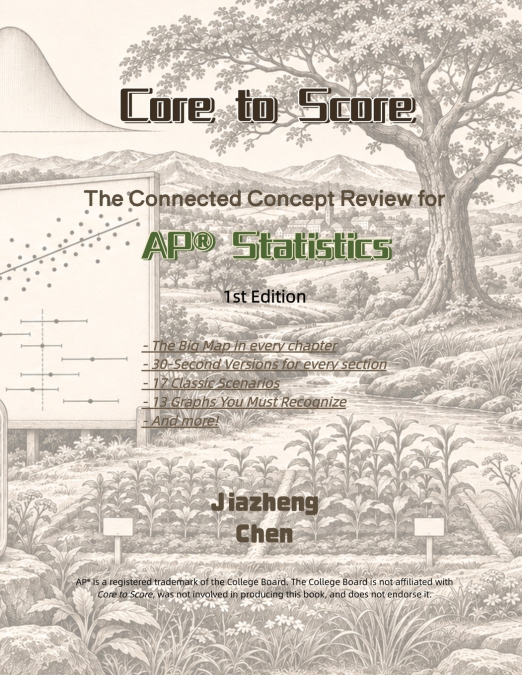
    AP® Statistics is often studied as two separate courses: graphs and study design in the fall, probability and inference formulas in the spring. The exam treats it as one. A single free-response question can start with how a study collected its data, ask you to describe a graph, and end with a confidence interval or a significance test. Core to Score is written to make those con...
  • Core to Score
    Jiazheng Chen
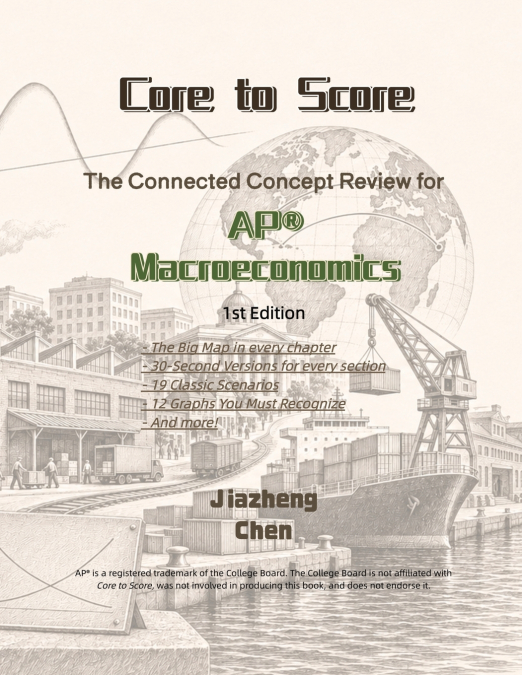
    Most students who struggle in AP® Macroeconomics have memorized the graphs. What they can’t do yet is follow one change through all of them. A higher interest rate on reserves starts in the reserve market, moves interest rates, shifts aggregate demand, changes employment, and ends in the foreign exchange market. The exam is built on chains like that one.Core to Score: The Conne...
  • Core to Score
    Jiazheng Chen
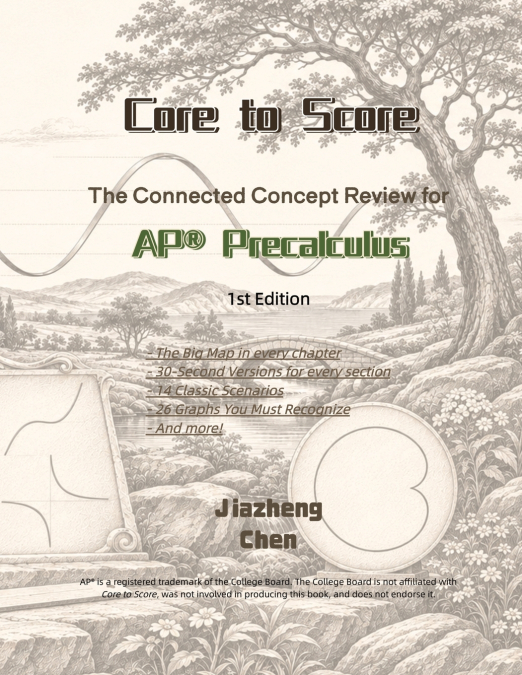
    AP® Precalculus is not a list of formulas to memorize. Every unit keeps asking the same few questions: How is the output changing? What does this graph, table, or formula tell you? Which kind of function fits this situation, and how far can you trust it? Core to Score: The Connected Concept Review for AP® Precalculus makes those common questions visible, so the course finally f...
  • Core to Score
    Jiazheng Chen
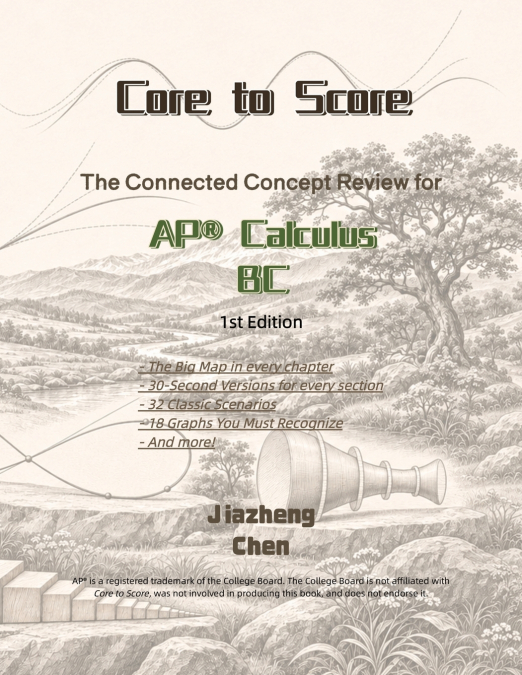
    AP® Calculus BC is not ten separate units. It is one set of ideas, the limit, the derivative, and the integral, extended three times: to parametric curves, to polar graphs, and to infinite series. Core to Score: The Connected Concept Review for AP® Calculus BC is written to make those connections visible, so you can use the course’s ideas on questions you have never seen before...
  • Core to Score
    Jiazheng Chen
    AP® Environmental Science is not a list of separate topics. Energy flows from the sun through food webs. Carbon moves from power plants into the air and the oceans. Fertilizer on a Midwestern farm becomes a dead zone in the Gulf of Mexico. Population growth drives demand for land, water, and energy. This book is built to show you those connections, because the exam rewards stud...
  • Core to Score
    Jiazheng Chen
    AP® Calculus AB is often taught as a list of rules: a rule for each kind of derivative, a test for each kind of extremum, a technique for each kind of integral. Students memorize them, and then a free-response question gives a table of values or the graph of a derivative, and the rules no longer seem to apply. Core to Score is written for that moment. It explains where every ru...