 Librería Samer Atenea
 Kálamo Books
 Librería Elías (Asturias)
 Librería Kolima (Madrid)
 Librería Proteo (Málaga)
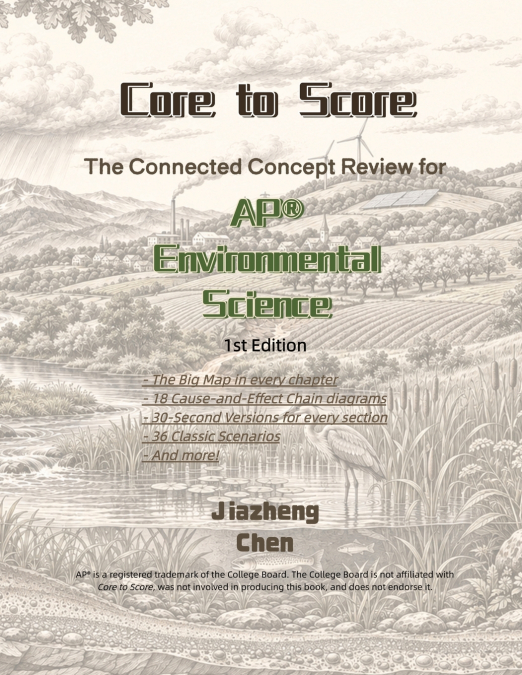
AP® Environmental Science is not a list of separate topics. Energy flows from the sun through food webs. Carbon moves from power plants into the air and the oceans. Fertilizer on a Midwestern farm becomes a dead zone in the Gulf of Mexico. Population growth drives demand for land, water, and energy. This book is built to show you those connections, because the exam rewards students who can see them.Core to Score: The Connected Concept Review for AP® Environmental Science covers every topic in the official course framework, all nine units with sections numbered to match the topics. Instead of asking you to memorize disconnected facts, it explains each environmental problem as a cause-and-effect chain: where it starts, how it works, what it does, and what it would take to fix, along with what that fix costs. That habit is exactly what the free-response questions ask for.Inside you’ll find:The Big Map, a one-page diagram of how all nine units connect. Each chapter opens with its own view of the map, showing which chapters feed into it and which it affects.Cause-and-effect chain diagrams for major problems, including eutrophication, smog, acid rain, ozone depletion, climate change, overfishing, and invasive species.Real-world data with the year and source given, from the UN, NOAA, EPA, FAO, WHO, USGS, the IPCC, and the Energy Institute, so you know what each number means and where it comes from.Clear science and fair policy. The scientific consensus is stated plainly. Policy debates such as nuclear power, carbon taxes versus cap-and-trade, and the Endangered Species Act are presented from more than one side.Must Know and Good to Know labels, so you can see what the exam emphasizes.Boxes in every section: 30-Second Versions, Common Misconceptions, Exam Tips, Word Roots, and How Do We Know? boxes that tell the stories behind key discoveries.Practice built into every chapter: Quick Recall questions after each section, a 15-question Cumulative Check, and four Classic Scenarios that apply the chapter to a real situation. Answers to every question are at the back of the book.Appendices covering every calculation type on the exam (unit conversions, percent change, the rule of 70, energy and cost, half-life, LD50, CO₂-equivalents, pH), a Science Practices guide with an Investigations at a Glance table, a gallery of graphs you must recognize, and a word roots index.Putting It All Together, a final chapter that traces the course’s four Big Ideas across all nine units.Written for students in an AP Environmental Science course or studying for the exam on their own, this book is meant to be read, not just skimmed. When you finish, you will understand how the whole subject fits together, and you will be ready to show it on exam day.AP® is a trademark registered by the College Board, which is not affiliated with, and does not endorse, this product.