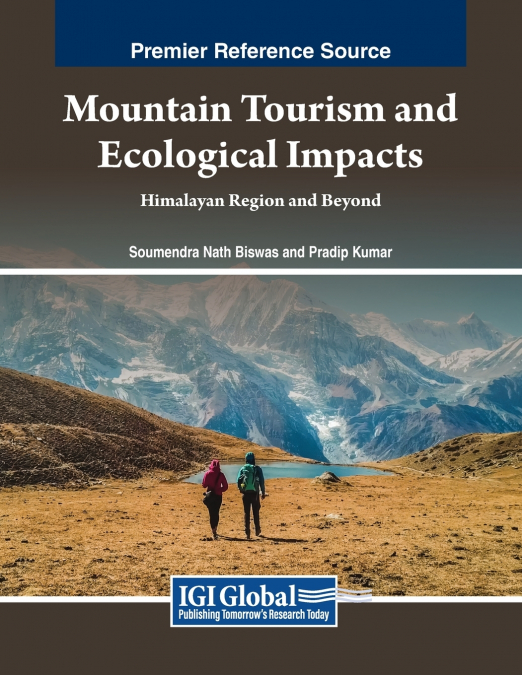

Mountain Tourism and Ecological Impacts

Mountain Tourism and Ecological Impacts


259,22 €
IVA incluido
Disponible
Editorial:
IGI Global
Año de edición:
2024
Materia
Ecología, la biosfera
ISBN:
9798369347140
259,22 €
IVA incluido
Disponible

Selecciona una librería:

  • Librería Desdémona
  • Librería Samer Atenea
  • Librería Aciertas (Toledo)
  • Kálamo Books
  • Librería Perelló (Valencia)
  • Librería Elías (Asturias)
  • Donde los libros
  • Librería Kolima (Madrid)
  • Librería Proteo (Málaga)

The Himalayas, with their grandeur and cultural richness, magnetize global travelers searching for an escape from the ordinary. However, behind this allure lies an ecological responsibility and sustainability imperative. Many involved with the tourism industry in mountainous regions have been confronting the stark realities of tourism’s impact on these delicate ecosystems. There is an urgency to address the challenges posed by climate change, all while safeguarding the indigenous traditions that define the Himalayas. Mountain Tourism and Ecological Impacts: Himalayan Region and Beyond unravels the intricate connections between tourism development and its far-reaching implications. This comprehensive exploration delves deep into the heart of the Himalayan region and beyond, shedding light on the diverse dimensions of mountain tourism and its profound impact on local environments, communities, and cultural heritage. This book reveals the tapestry of tourism experiences found in the peaks and vistas of the Himalayas. It delves into eco-tourist’s delicate dance with fragile ecosystems, the coexistence of travelers and wildlife, the exhilaration of adventure tourism, and the spiritual pilgrimages that draw seekers from across the globe. This book comprehensively explores the pivotal role of preserving local cultures and underscores this as a key element of conserving the pristine natural habitats. This book is ideal for academics and researchers, tourism professionals, environmentalists and conservationists, government and NGOs, and travel enthusiasts.
Artículos relacionados

  • Microalgae
    Maria-Nefeli Tsaloglou
    ...
  • Etude floristique des steppes à armoise blanche (Artemisia herba-alba)
    Leila Kadik / Rachda Berrached
    Les écosystèmes steppiques ont connu une dégradation importante affectant leur structure, leur fonctionnement et les services écologiques rendus. Cependant, déterminer les facteurs abiotiques et/ou biotiques agissant sur la composition et la diversité floristique, la structure du couvert végétal et la phénologie des espèces permettrait de contribuer à la gestion de ces écosystè...
  • Structural connectivity analysis in eastern Antioquia
    Daniel A Martinez Castano
    Biological connectivity is understood as those 'corridors' that allow the connection between two or more natural elements of interest at a landscape scale. These corridors indicate, for example, how two patches of forest can be linked and which is the most appropriate path to achieve this connection, so that animal and plant species can use them and pass through them to get fro...
  • Analyse de la connectivité structurelle dans l’est d’Antioquia
    Daniel A Martinez Castano
    La connectivité biologique s’entend comme les 'corridors' qui permettent la connexion entre deux ou plusieurs caractéristiques naturelles d’intérêt à l’échelle du paysage. Ces corridors indiquent, par exemple, comment deux parcelles de forêt peuvent être reliées et quelle est la manière la plus appropriée de réaliser cette connexion, afin que les espèces animales et végétales p...
  • Анализ структурной связанности в Восточной Антиокии
    Дан Мартинес Кастано
    Под биологической связностью понимаются те 'коридоры', которые обеспечивают связь между двумя или более природными объектами, представляющими интерес в ландшафтном масштабе. Эти коридоры указывают, например, на то, как можно соединить два участка леса и какой способ соединения является наиболее подходящим, чтобы виды животных и растений могли использовать их и проходить через н...
  • Цветение бамбука и болезни, переносимые грызунами, в регионе NEH, Индия
    Шьямал Бисвас
    Бамбук является универсальным видом недревесной продукции леса (НДЛП). Из 125 видов бамбука, произрастающих в Индии, 8,4 таксона встречаются в регионе NEH. Мизорам занимает наибольшую площадь лесов (30,8%) под различными видами бамбука, за ним следует Мегхалая с 26,0%. Бамбук является природным ресурсом и составляет примерно 12,8% от общей площади лесов в Индии, особенно в севе...