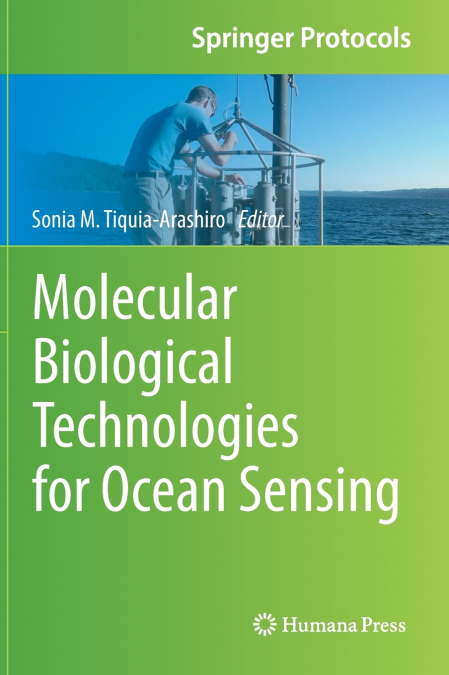

Molecular Biological Technologies for Ocean Sensing

Molecular Biological Technologies for Ocean Sensing

Sonia M. Tiquia-Arashiro

182,06 €
IVA incluido
Disponible
Editorial:
Springer Nature B.V.
Año de edición:
2016
Materia
Ecología, la biosfera
ISBN:
9781493962709
182,06 €
IVA incluido
Disponible

Selecciona una librería:

  • Librería Samer Atenea
  • Librería Aciertas (Toledo)
  • Kálamo Books
  • Librería Perelló (Valencia)
  • Librería Elías (Asturias)
  • Donde los libros
  • Librería Kolima (Madrid)
  • Librería Proteo (Málaga)

The development of ocean sensors remains a ripe area for future investigation from science, policy and systemsengineering standpoints. Clearly, there are many options forrealizing integrated molecular analytical sensing systems. The definition of key target molecules, detection methodsand signal transduction models largely remain to be determined.Moreover, there remains ahuge challenge of merging this new class of instrument with different deployment platforms, and supplying necessarypower and data telemetry infrastructure for their operation. Molecular Biological Technologies for Ocean Sensing features methods papers on the application of ecogenomic sensors on autonomous platforms in the ocean. Topics include the use of ecogenomic sensors as a tool in whole-cell and cell-free based detection and monitoring a suite of pathogens and biotoxins that are of public health concern; documenting species diversity, evolution and metabolic function; identification and quantification of aquatic organisms; and inferring metabolic potential and activities of microorganisms in the ocean. Each contribution focuses on the (1) functional requirements for detecting specific microorganisms and the genes that they harbor and express;(2) examples of research activities that take advantage of molecular detection technologies;(3) some of the challenges faced when projecting development and use of novel instruments that will utilize molecular techniques onboard autonomous platforms;and future directions. Bringing these advancements on autonomous platforms, monitoring required sample collection and processing schemes will differ from those currently used (i.e. biomedical diagnostics). This book is the first of its kind to compile current technologies for studying organisms in situ. It will aid in transfer technology to oceanographers, ecologists, microbiologists, and environmental scientists with needs for a remote, in-water sensing capability and for integration with larger scale observatory operations. With this network in place, there is a potential to bridge the gap among regulatory agencies and academics about how this kind of technology can be used for research and monitoring purposes.
Artículos relacionados

  • Water from a Transdisciplinary Perspective
    Ana Isabel Pereira Cardoso / Teresinha M. Gonçalves
    Life in cities has distanced human beings from nature and made it difficult to understand the ecology of life dependent on the environment. Urban water collection and distribution processes contribute significantly to the fragmentation of knowledge and the vital recognition of the water cycle. Without the effective participation of the subject in environmental actions, it is no...
    Disponible

    43,82 €

  • Modeling Populations of Adaptive Individuals
    Bret C. Harvey / Steven F. Railsback
    Ecologists now recognize that the dynamics of populations, communities, and ecosystems are strongly affected by adaptive individual behaviors. Yet until now, we have lacked effective and flexible methods for modeling such dynamics. Traditional ecological models become impractical with the inclusion of behavior, and the optimization approaches of behavioral ecology cannot be use...
    Disponible

    65,53 €

  • Scaling in Ecology with a Model System
    Aaron Ellison / Aaron M. Ellison / Nicholas J. Gotelli
    A groundbreaking approach to scale and scaling in ecological theory and practiceScale is one of the most important concepts in ecology, yet researchers often find it difficult to find ecological systems that lend themselves to its study. Scaling in Ecology with a Model System synthesizes nearly three decades of research on the ecology of Sarracenia purpurea-the northern pitcher...
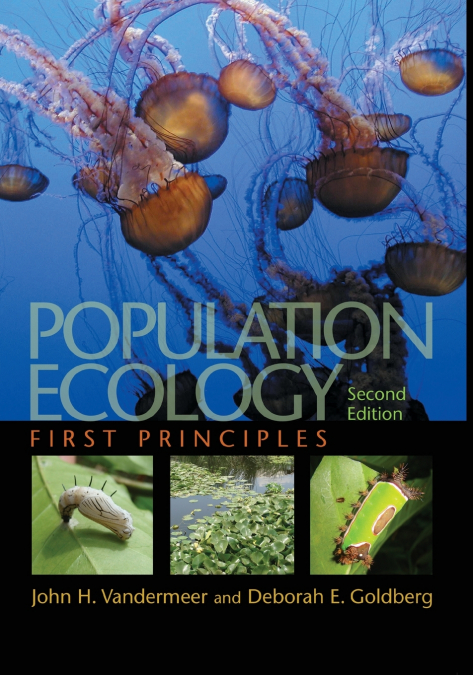
  • Population Ecology
    Deborah E. Goldberg / John H. Vandermeer
    The essential introduction to population ecology-now expanded and fully updatedEcology is capturing the popular imagination like never before, with issues such as climate change, species extinctions, and habitat destruction becoming ever more prominent. At the same time, the science of ecology has advanced dramatically, growing in mathematical and theoretical sophistication. He...
    Disponible

    124,92 €

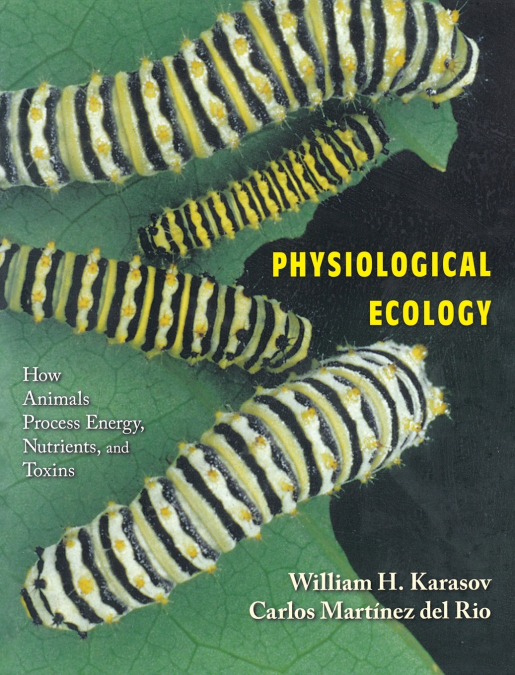
  • Physiological Ecology
    Carlos Martínez del Rio / William H. Karasov
    Unlocking the puzzle of how animals behave and how they interact with their environments is impossible without understanding the physiological processes that determine their use of food resources. But long overdue is a user-friendly introduction to the subject that systematically bridges the gap between physiology and ecology. Ecologists--for whom such knowledge can help clarif...
  • Critical Transitions in Nature and Society
    Marten Scheffer
    How do we explain the remarkably abrupt changes that sometimes occur in nature and society--and can we predict why and when they happen? This book offers a comprehensive introduction to critical transitions in complex systems--the radical changes that happen at tipping points when thresholds are passed. Marten Scheffer accessibly describes the dynamical systems theory behind cr...
    Disponible

    89,46 €

Otros libros del autor

  • Thermophilic Carboxydotrophs and their Applications in Biotechnology
    Sonia M. Tiquia-Arashiro
    The book describes the products produced by carboxydotrophic bacteria and their biotechnological applications. Carbon monoxide (CO) is a widespread pollutant and a hazard to man because of its extremely toxic nature. It is a major component of some industrial gas mixtures and may be derived from coal. The carboxydotrophic bacteria obtain energy and carbon from the oxidation of ...
    Disponible

    48,55 €

  • Molecular Biological Technologies for Ocean Sensing
    Sonia M. Tiquia-Arashiro
    The development of ocean sensors remains a ripe area for future investigation from science, policy and systemsengineering standpoints. Clearly, there are many options forrealizing integrated molecular analytical sensing systems. The definition of key target molecules, detection methodsand signal transduction models largely remain to be determined.Moreover, there remains ahuge c...