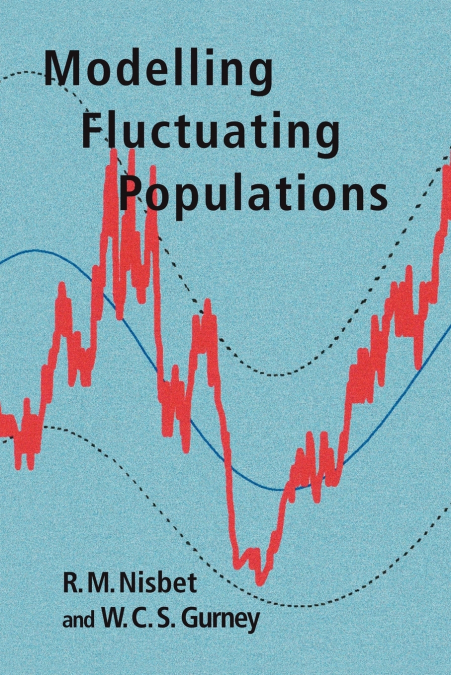
R. M. Nisbet / RMNisbet / W. C. Gurney / WCGurney
 Librería Samer Atenea
 Kálamo Books
 Librería Elías (Asturias)
 Librería Kolima (Madrid)
 Librería Proteo (Málaga)
Modelling Fluctuating Populations, originally published in 1982, is a classic textbook because primarily, this book takes a distinctive approach to population dynamics, by emphasizing from the earliest chapters that all populations fluctuate continuously. Traditional themes in theoretical ecology such as equilibrium and population stability are linked to analyses of the response of a population to environmental fluctuations and to extinction probabilities. Thus, the book’s approach confronts head-on one common criticism of simple ecological models - the mismatch between the mathematical mechanisms studied and the questions of top ecological concern.Secondly, the book demonstrates the power of techniques based on linear mathematics. It has become fashionable to emphasize the importance of nonlinearity in ecological models, and there are some situations, notably those involving competition in fluctuating environments, where fundamentally nonlinear phenomena are critical to ecological understanding. But the importance in the real world of other nonlinear phenomena that attract much excitement among theorists, such as deterministic chaos, is much more doubtful. Many properties of fluctuations in nonlinear systems are well described by mathematical approaches that use linear equations to describe dynamics in the vicinity of an equilibrium state. The book gives a thorough introduction to these approaches, with particular focus on methods that exploit Fourier analysis.Thirdly, chapters 6 and 7 of the book take an unconventional approach to the formulation and analysis of stochastic population models. The starting point is a rigorous treatment of 'demographic stochasticity', the randomness that occurs because population change is caused by a sequence of individual births and deaths. We introduce the concept of 'white noise' in a manner appropriate for ecologists, develop powerful approximate methods for predicting the intensity of fluctuating populations, and offer a systematic approach to modeling the probability of extinction.''However, Modelling Fluctuating Populations is exceptional in more than one way and provided me with an unexpected pleasure; I enjoyed almost all of the book and found every chapter valuable.' Nature'This is a splendid book which brings to the mathematically competent biologist, for the first time, a range of techniques which will enable him to construct and analyze more realistic models. 'Biometrics'A second reason is that this is the best book on mathematical modelling of population growth in existence.' Natural Resource Modelling'This excellent book gives a state-of-the-art account of our understanding of the dynamical behavior of biological populations. The book has been carefully designed to be read at several different levels: all ecologists -- no matter how empirical -- will benefit from dipping into it; while expert mathematicians will find it a valuable reference work.' Robert M. May in Acta Applicandae Mathematicae'This book comes very close to the reviewers’ ideal of what a perfect textbook for an introductory course in the mathematical modeling of population growth should be.' Mathematical BiosciencesRoger Nisbet is Professor of Biology at the University of California, Santa Barbara, and has over 30 years experience in ecological modeling. His current research focuses on models that relate population dynamics to the physiology and behavior of individual organisms, and on spatially explicit population models.W.S.C Gurney is Professor of Mathematical Biology at the University of Strathclyde, Glasgow, Scotland. He has been researching theoretical population dynamics for over 30 years, and his current interests are mainly in spatially and physiologically structured population models of marine systems with particular reference to marine resource management issues. He is co-author, with Roger Nisbet, of Ecological Dynamics (1998).