Inicio > Matemáticas y ciencia > Biologia, ciencias de la vida > Ciencias de la vida: cuestiones generales > Ecología, la biosfera > Microbiota from the Late Cretaceous-Early Palaeocene Boundary Transition in the Deccan Intertrappean Beds of Central India
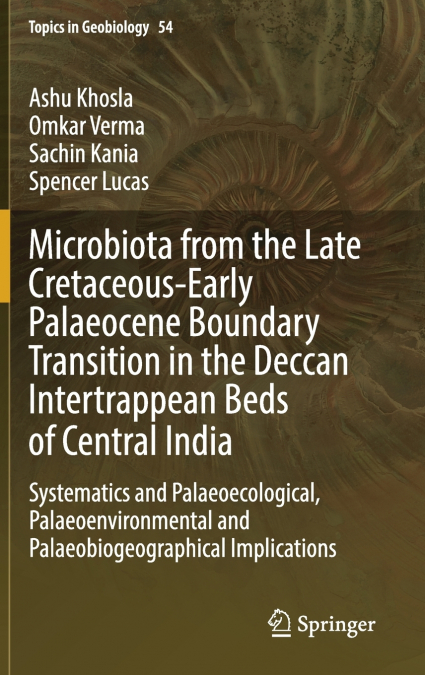
Microbiota from the Late Cretaceous-Early Palaeocene Boundary Transition in the Deccan Intertrappean Beds of Central India

Microbiota from the Late Cretaceous-Early Palaeocene Boundary Transition in the Deccan Intertrappean Beds of Central India

Ashu Khosla / Omkar Verma / Sachin Kania

47,80 €
IVA incluido
Disponible
Editorial:
Springer Nature B.V.
Año de edición:
2023
Materia
Ecología, la biosfera
ISBN:
9783031288562
47,80 €
IVA incluido
Disponible

Selecciona una librería:

  • Librería Samer Atenea
  • Librería Aciertas (Toledo)
  • Kálamo Books
  • Librería Perelló (Valencia)
  • Librería Elías (Asturias)
  • Donde los libros
  • Librería Kolima (Madrid)
  • Librería Proteo (Málaga)

This book describes the microbiota of the intertrappean beds in the Chhindwara District, Madhya Pradesh, India. In this work, special emphasis is placed on the microbiota from the Late Cretaceous-Early Palaeocene transition of the central Narmada River region. Recently, the intertrappean beds of the Eastern Deccan Volcanic Province (one of the subprovinces of the Deccan Volcanic Province) have received considerable attention, which resulted in the addition of some significant biotic assemblages to the existing record from the Dindori-Chhindwara area of the province. The biotic assemblages include charophytes, ostracods, foraminiferans, fishes, frogs, lizards, turtles, crocodiles, and mammals. In spite of the recent discoveries, the known fossil record of the Late Cretaceous-Early Palaeocene biota of India is not sufficient and thus does not permit us to speculate on the possible impact of environmental changes triggered by the Deccan volcanic lava flows on the contemporary biota and toprecisely document their palaeoecologic, palaeoenvironmental and palaeobiogeographic implications. The recent biotic reports from the intertrappean beds exposed in the Chhindwara region of the Eastern Deccan Volcanic Province clearly indicate that these beds have a vast potential in terms of fossil content, which could reveal new and dissimilar biotic remains when compared to the Western Deccan Volcanic Province. The record of diverse accumulations of freshwater charophytes, brackish to freshwater ostracods, and planktic foraminiferal and fish assemblages from the intertrappean beds of Jhilmili and adjacent areas of Early Danian (P1a) age and lying just north of Chhindwara town and in the heart of peninsular India has intriguing implications for defining the age limits of the basaltic flows. The occurrence of non-marine taxa, for example, algae, molluscs, and vertebrates, associated with brackish water ostracods in the nearby Singpur and Mohgaon Kalan localities of the Chhindwara region, has also raised concerns about the sedimentary environments of these intertrappean beds. The new finds (presented in this book) prove useful for the better understanding of the palaeoecology and palaeoenvironment of the biota and also throw light on various paleobiogeographic models proposed for the northward drifting Indian plate. The microbiotic assemblages of the intertrappean beds of the eastern Deccan volcanic province at District Chhindwara, Madhya Pradesh are documented in this book. The microbiota of the central Narmada River region, the charophytes, ostracods, planktic foraminifera, and fishes, receive special attention in this study.

Artículos relacionados

  • Water from a Transdisciplinary Perspective
    Ana Isabel Pereira Cardoso / Teresinha M. Gonçalves
    Life in cities has distanced human beings from nature and made it difficult to understand the ecology of life dependent on the environment. Urban water collection and distribution processes contribute significantly to the fragmentation of knowledge and the vital recognition of the water cycle. Without the effective participation of the subject in environmental actions, it is no...
    Disponible

    43,82 €

  • Modeling Populations of Adaptive Individuals
    Bret C. Harvey / Steven F. Railsback
    Ecologists now recognize that the dynamics of populations, communities, and ecosystems are strongly affected by adaptive individual behaviors. Yet until now, we have lacked effective and flexible methods for modeling such dynamics. Traditional ecological models become impractical with the inclusion of behavior, and the optimization approaches of behavioral ecology cannot be use...
    Disponible

    65,53 €

  • Scaling in Ecology with a Model System
    Aaron Ellison / Aaron M. Ellison / Nicholas J. Gotelli
    A groundbreaking approach to scale and scaling in ecological theory and practiceScale is one of the most important concepts in ecology, yet researchers often find it difficult to find ecological systems that lend themselves to its study. Scaling in Ecology with a Model System synthesizes nearly three decades of research on the ecology of Sarracenia purpurea-the northern pitcher...
  • Population Ecology
    Deborah E. Goldberg / John H. Vandermeer
    The essential introduction to population ecology-now expanded and fully updatedEcology is capturing the popular imagination like never before, with issues such as climate change, species extinctions, and habitat destruction becoming ever more prominent. At the same time, the science of ecology has advanced dramatically, growing in mathematical and theoretical sophistication. He...
    Disponible

    124,92 €

  • Physiological Ecology
    Carlos Martínez del Rio / William H. Karasov
    Unlocking the puzzle of how animals behave and how they interact with their environments is impossible without understanding the physiological processes that determine their use of food resources. But long overdue is a user-friendly introduction to the subject that systematically bridges the gap between physiology and ecology. Ecologists--for whom such knowledge can help clarif...
  • Critical Transitions in Nature and Society
    Marten Scheffer
    How do we explain the remarkably abrupt changes that sometimes occur in nature and society--and can we predict why and when they happen? This book offers a comprehensive introduction to critical transitions in complex systems--the radical changes that happen at tipping points when thresholds are passed. Marten Scheffer accessibly describes the dynamical systems theory behind cr...
    Disponible

    89,46 €

Otros libros del autor