Eduardo Franzotti Sant’Anna / Manuela Derenne Cupolillo / Olga Maria Oliveira de Araújo
 Librería Samer Atenea
 Kálamo Books
 Librería Elías (Asturias)
 Librería Kolima (Madrid)
 Librería Proteo (Málaga)
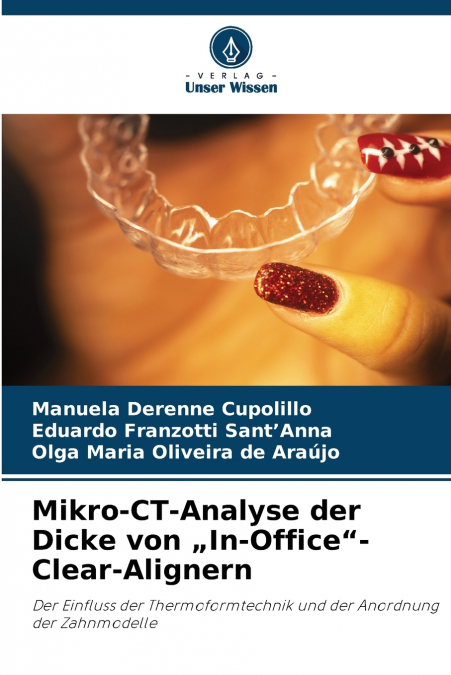
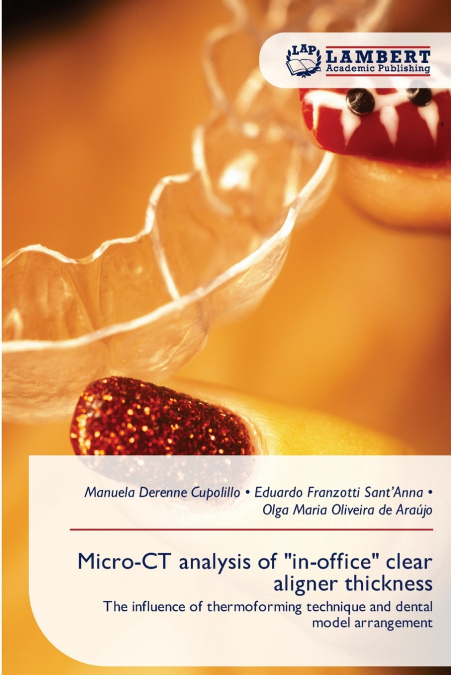
In-office clear aligner production allows orthodontists and local laboratories to oversee the manufacturing workflow, reducing costs and production time while providing greater flexibility to customize appliances and treatment mechanics. However, the lack of standardized protocols may introduce variability and compromise clinical performance. This study examines how two manufacturing factors-the thermoforming technique and dental model arrangement-affect the final thickness and thickness uniformity of in-office aligners. Forty-three upper-arch aligners made from 0.63 mm PET-G sheets were evaluated by micro-computed tomography at 30 reference points. Three methods were compared: pressure thermoforming, digital air vacuum thermoforming, and conventional air vacuum thermoforming. Each was tested with either a single upper-arch model or paired upper- and lower-arch models. The findings support more standardized, predictable, and clinically reliable in-office aligner production. This work was developed in collaboration with Luísa Schubach da Costa Barreto, Amanda Cunha Regal de Castro, Ricardo Tadeu Lopes, and Carlo Marassi.