
Inicio > Sociedad y ciencias sociales > Educación pedagogía > Escuelas > Escuelas secundarias > Informatics Education - Supporting Computational Thinking
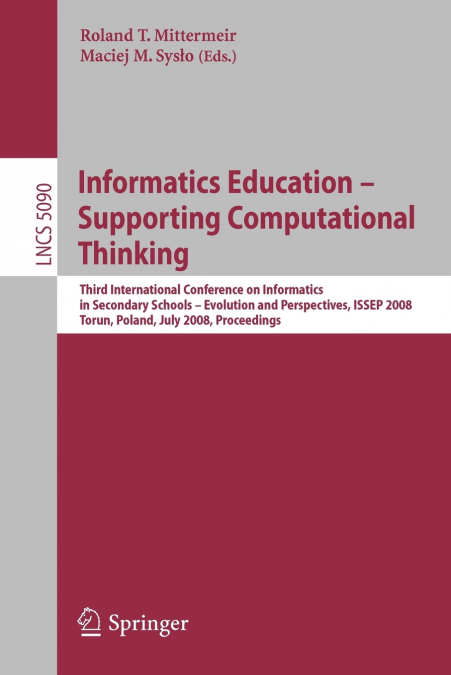
Informatics Education - Supporting Computational Thinking

Informatics Education - Supporting Computational Thinking


65,86 €
IVA incluido
Disponible
Editorial:
Springer Nature B.V.
Año de edición:
2008
Materia
Escuelas secundarias
ISBN:
9783540699231
65,86 €
IVA incluido
Disponible

Selecciona una librería:

  • Librería Samer Atenea
  • Librería Aciertas (Toledo)
  • Kálamo Books
  • Librería Perelló (Valencia)
  • Librería Elías (Asturias)
  • Donde los libros
  • Librería Kolima (Madrid)
  • Librería Proteo (Málaga)

Informatics Education - Supporting Computational Thinking contains papers presented at the Third International Conference on Informatics in Secondary Schools - Evolution and Perspective, ISSEP 2008, held in July 2008 in Torun, Poland. As with the proceedings of the two previous ISSEP conferences (2005 in Klag- furt, Austria, and 2006 in Vilnius, Lithuania), the papers presented in this volume address issues of informatics education transcending national boundaries and, the- fore, transcending differences in the various national legislation and organization of the educational system. Observing these issues, one might notice a trend. The p- ceedings of the First ISSEP were termed From Computer Literacy to Informatics F- damentals [1]. There, broad room was given to general education in ICT. The ECDL, the European Computer Driving License, propagated since the late 1990s, had pe- trated school at this time already on a broad scale and teachers, parents, as well as pupils were rather happy with this situation. Teachers had material that had a clear scope, was relatively easy to teach, and especially easy to examine. Parents had the assurance that their children learn 'modern and relevant stuff,' and for kids the c- puter was sufficiently modern so that anything that had to do with computers was c- sidered to be attractive. Moreover, the difficulties of programming marking the early days of informatics education in school seemed no longer relevant. Some colleagues had a more distant vision though.
Artículos relacionados

  • Creating Home Economics Futures
    Kaija Turkki
    In 2012, the World Congress of the International Federation of Home Economics (IFHE), first established over 100 years ago, was hosted by Home Economics Victoria in Melbourne, Australia. As the profession commences its second century of influence, this collection of works presented at the Congress provides a platform for outlining what the future of Home Economics might look li...
    Disponible

    47,94 €

  • Privilege
    Shamus Rahman Khan
    An inside look at how one of the country’s most elite private schools prepares its students for successAs one of the most prestigious high schools in the nation, St. Paul’s School in Concord, New Hampshire, has long been the exclusive domain of America’s wealthiest sons. But times have changed. Today, a new elite of boys and girls is being molded at St. Paul’s, one that reflect...
    Disponible

    25,25 €

  • Pride and Prejudice
    Elizabeth May
    This Graphic Revision Guide for Pride and Prejudice, has been specially written to support Special Needs (SEN), lower ability and less confident students.This Graphic Revision Guide for Jane Austen’s Pride and Prejudice makes studying or revising this iconic novel easy. Suitable for all GCSE English Literature examinations. Brilliant Publications’ Graphic Revision Guide for Pri...
    Disponible

    22,71 €

  • Jane Eyre
    Elizabeth May
    This Graphic Revision Guide for Charlotte Brontë’s Jane Eyre, specially written to support Special Needs (SEN) and lower ability students, contains teaching resources especially tailored to strengthen the student’s understanding of plot, characters, quotes, themes and more.This Graphic Revision Guide for Jane Eyre makes studying or revising this iconic novel easy. Suitable for ...
    Disponible

    22,34 €

  • 14-18 - A New Vision for Secondary Education
    Kenneth Baker
    Former Secretary of State for Education Kenneth Baker claims that secondary education has become a five-year programme with a single, narrow aim: to prepare pupils for high-stakes GCSE exams at 16. From 2015, all young people will be legally required to stay in education or training until they are 18. Kenneth Baker sees this as a historic opportunity to re-think the aims an...
  • Greater Expectations
    Alex Crossman / Ian Warwick
    ...