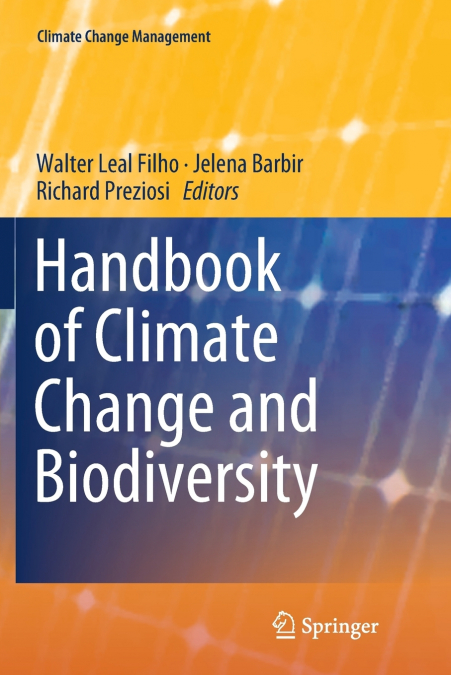

Handbook of Climate Change and Biodiversity

Handbook of Climate Change and Biodiversity


210,46 €
IVA incluido
Disponible
Editorial:
Springer Nature B.V.
Año de edición:
2019
Materia
Ecología, la biosfera
ISBN:
9783030075194
210,46 €
IVA incluido
Disponible

Selecciona una librería:

  • Librería Samer Atenea
  • Librería Aciertas (Toledo)
  • Kálamo Books
  • Librería Perelló (Valencia)
  • Librería Elías (Asturias)
  • Donde los libros
  • Librería Kolima (Madrid)
  • Librería Proteo (Málaga)

This book comprehensively describes essential research and projects on climate change and biodiversity. Moreover, it includes contributions on how to promote the climate agenda and biodiversity conservation at the local level. Climate change as a whole and global warming in particular are known to have a negative impact on biodiversity in three main ways. Firstly, increases in temperatures are detrimental to a number of organisms, especially those in sensitive habitats such as coral reefs and rainforests. Secondly, the pressures posed by a changing climate may lead to sets of responses in areas as varied as phenology, range and physiology of living organisms, often leading to changes in their lifecycles (especially but not only in reproduction), losses in productivity or even death. In some cases, the very survival of very sensitive species may be endangered. Thirdly, the impacts of climate change on biodiversity will be felt in the short term with regard to some species and ecosystems, but also in the medium and long term in many biomes. Indeed, if left unchecked, some of these impacts may be irreversible. Many individual governments, financial institutes and international donors are currently spending billions of dollars on projects addressing climate change and biodiversity, but with little coordination. Quite often, the emphasis is on adaptation efforts, with little emphasis on the connections between physio-ecological changes and the lifecycles and metabolisms of fauna and flora, or the influence of poor governance on biodiversity. As such, there is a recognized need to not only better understand the impacts of climate change on biodiversity, but to also identify, test and implement measures aimed at managing the many risks that climate change poses to fauna, flora and micro-organisms. In particular, the question of how to restore and protect ecosystems from the impact of climate change also has to be urgently addressed. This book was written to address this need. The respective papers explore matters related to the use of an ecosystem-based approach to increase local adaptation capacity, consider the significance of a protected areas network in preserving biodiversity in a changing northern European climate, and assess the impacts of climate change on specific species, including wild terrestrial animals. The book also presents a variety of case studies such as the Yellowstone to Yukon Conservation Initiative, the effects of climate change on the biodiversity of Aleppo pine forest in Senalba (Algeria), climate change and biodiversity response in the Niger Delta region, and the effects of forest fires on the biodiversity and the soil characteristics of tropical peatlands in Indonesia. This is a truly interdisciplinary publication, and will benefit all scholars, social movements, practitioners and members of governmental agencies engaged in research and/or executing projects on climate change and biodiversity around the world.

Artículos relacionados

  • Water from a Transdisciplinary Perspective
    Ana Isabel Pereira Cardoso / Teresinha M. Gonçalves
    Life in cities has distanced human beings from nature and made it difficult to understand the ecology of life dependent on the environment. Urban water collection and distribution processes contribute significantly to the fragmentation of knowledge and the vital recognition of the water cycle. Without the effective participation of the subject in environmental actions, it is no...
    Disponible

    43,82 €

  • Modeling Populations of Adaptive Individuals
    Bret C. Harvey / Steven F. Railsback
    Ecologists now recognize that the dynamics of populations, communities, and ecosystems are strongly affected by adaptive individual behaviors. Yet until now, we have lacked effective and flexible methods for modeling such dynamics. Traditional ecological models become impractical with the inclusion of behavior, and the optimization approaches of behavioral ecology cannot be use...
    Disponible

    65,53 €

  • Scaling in Ecology with a Model System
    Aaron Ellison / Aaron M. Ellison / Nicholas J. Gotelli
    A groundbreaking approach to scale and scaling in ecological theory and practiceScale is one of the most important concepts in ecology, yet researchers often find it difficult to find ecological systems that lend themselves to its study. Scaling in Ecology with a Model System synthesizes nearly three decades of research on the ecology of Sarracenia purpurea-the northern pitcher...
  • Population Ecology
    Deborah E. Goldberg / John H. Vandermeer
    The essential introduction to population ecology-now expanded and fully updatedEcology is capturing the popular imagination like never before, with issues such as climate change, species extinctions, and habitat destruction becoming ever more prominent. At the same time, the science of ecology has advanced dramatically, growing in mathematical and theoretical sophistication. He...
    Disponible

    124,92 €

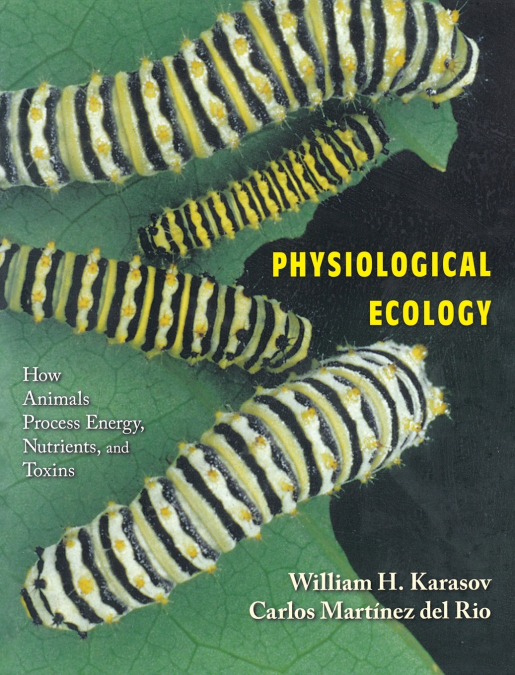
  • Physiological Ecology
    Carlos Martínez del Rio / William H. Karasov
    Unlocking the puzzle of how animals behave and how they interact with their environments is impossible without understanding the physiological processes that determine their use of food resources. But long overdue is a user-friendly introduction to the subject that systematically bridges the gap between physiology and ecology. Ecologists--for whom such knowledge can help clarif...
  • Critical Transitions in Nature and Society
    Marten Scheffer
    How do we explain the remarkably abrupt changes that sometimes occur in nature and society--and can we predict why and when they happen? This book offers a comprehensive introduction to critical transitions in complex systems--the radical changes that happen at tipping points when thresholds are passed. Marten Scheffer accessibly describes the dynamical systems theory behind cr...
    Disponible

    89,46 €