
Inicio > Matemáticas y ciencia > Química > Eine karibische Perspektive auf Acrylamid - das Lebensmittelgift
Eine karibische Perspektive auf Acrylamid - das Lebensmittelgift

Eine karibische Perspektive auf Acrylamid - das Lebensmittelgift

Grace-Anne E. Bent

135,10 €
IVA incluido
Disponible
Editorial:
KS OmniScriptum Publishing
Año de edición:
2026
Materia
Química
ISBN:
9786209833922
135,10 €
IVA incluido
Disponible

Selecciona una librería:

  • Librería Samer Atenea
  • Kálamo Books
  • Librería Elías (Asturias)
  • Librería Kolima (Madrid)
  • Librería Proteo (Málaga)

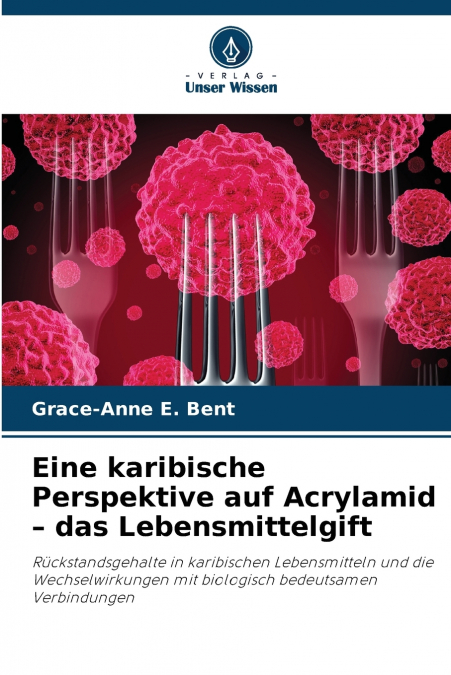
Acrylamid, ein bekanntes Neurotoxin und potenzielles Karzinogen für den Menschen, entsteht beim Kochen bei Temperaturen über 100 °C (212 °F). Es ist ein Nebenprodukt der Maillard-Reaktion, der nicht-enzymatischen Bräunungsreaktion, die für die Karamellisierung und die Aromen von Lebensmitteln verantwortlich ist. Acrylamid kommt in hohen Konzentrationen in kohlenhydratreichen Lebensmitteln vor. Bei der Aufnahme kann Acrylamid durch enzymkatalysierte Reaktionen in Glycidamid umgewandelt werden. Glycidamid ist nachweislich wesentlich reaktiver als Acrylamid und hat das Potenzial, DNA zu mutieren. In Europa, den USA und Großbritannien wird derzeit geforscht, um den Acrylamidgehalt in Lebensmitteln zu quantifizieren und dessen chemische und biochemische Eigenschaften zu untersuchen. Bislang liegen nur wenige Berichte über Lebensmittel aus der Karibik vor. Die karibische Ernährung besteht aus großen Mengen stärkehaltiger Lebensmittel, von denen viele in der Region heimisch sind. Diese Veröffentlichung soll etwas Licht in die Acrylamid-Debatte bringen, allerdings aus karibischer Perspektive. Sie zielt darauf ab, den Acrylamidgehalt in einer Vielzahl karibischer Lebensmittel zu bewerten und die Wechselwirkungsmechanismen mit bestimmten im Körper vorkommenden biologischen Komponenten, nämlich Thiolen und Kupfer(II), zu untersuchen.
Artículos relacionados

  • Suzuki-Miyaura Cross-Coupling Reaction and Potential Applications
    Suzuki–Miyaura cross-coupling remains a powerful tool in organic synthesis for C–C bond formation and has various industrial applications, for example, the synthesis of pharmaceuticals and materials. Intensive research efforts are being made into finding ways of improving and expanding the scope of this process, and the development of more efficient catalytic systems for this e...
    Disponible

    67,89 €

  • Catalysis for Low Temperature Fuel Cells
    Today, the development of active and stable catalysts still represents a challenge to overcome in the research field of low temperature fuel cells. Operation at low temperatures demands the utilization of highly active catalysts to reduce the activation energy of the electrochemical reactions involved at the electrodes, and thus obtain practical performances and high efficienci...
    Disponible

    59,74 €

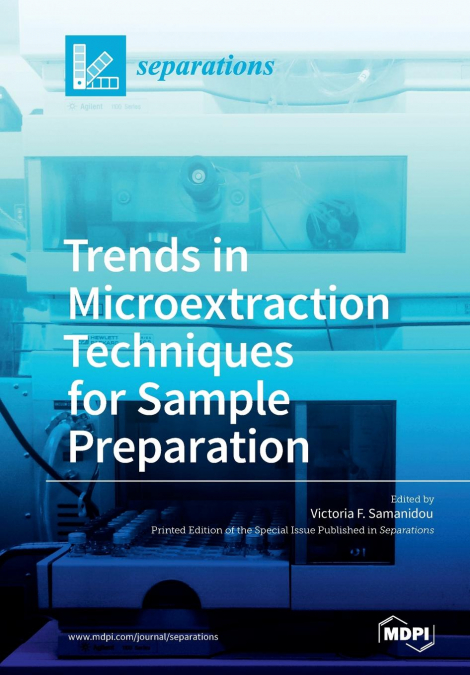
  • Trends in Microextraction Techniques for Sample Preparation
    Micro-extraction techniques in sample preparation are gaining interest among analytical chemists as they comply with green analytical chemistry demands and ensure environmental protection and public safety. Savings in cost and time are considered as valuable benefits by using novel micro-extraction approaches in sample handling. Selectivity, sensitivity and lower detection limi...
    Disponible

    59,87 €

  • Advances and Applications of Nano-antimicrobial Treatments
    Nowadays, great concerns are associated with the resistance demonstrated by many microorganisms towards the conventional antibiotic therapies. The failure of traditional antimicrobials, and the increasing healthcare costs, have encouraged scientific research and the development of novel antimicrobial agents. Particularly, there is a great deal of interest in nanotechnologies an...
    Disponible

    51,68 €

  • Handbook of Research on Uncovering New Methods for Ecosystem Management through Bioremediation
    Kajal Srivastava / Shivom Singh
    Maintaining and preserving the environment is a crucial consideration in an era where climate change and rising sea levels are common knowledge. It is important for researchers and developers alike to explore potential solutions for a steadily warming world. The Handbook of Research on Uncovering New Methods for Ecosystem Management through Bioremediation focuses on the agricul...
  • Structural Design and Properties of Coordination Polymers
    The assembly of organic ligands and metal centres yields coordination polymers, many of which find applications in conductivity, catalysis, magnetism, gas sorption, biological sensing and luminescence. The structure and topology of coordination polymers may be manipulated by changing the reaction conditions, leading to a large variety of structurally and topologically unique pr...
    Disponible

    43,77 €

Otros libros del autor

  • Une perspective caribéenne sur l’acrylamide - la toxine alimentaire
    Grace-Anne E. Bent
    L’acrylamide, une neurotoxine connue et un cancérigène potentiel pour l’homme, se forme lors de la cuisson à des températures supérieures à 100 °C (212 °F). C’est un sous-produit de la réaction de Maillard, la réaction de brunissement non enzymatique responsable de la caramélisation et des arômes des aliments. L’acrylamide est présent en quantités élevées dans les aliments rich...
    Disponible

    133,79 €

  • Karaibskie spojrzenie na akrylamid - toksynę spożywczą
    Grace-Anne E. Bent
    Akrylamid, znana neurotoksyna i potencjalny czynnik rakotwórczy dla ludzi, powstaje podczas gotowania w temperaturach powyżej 100°C (212°F). Jest to produkt uboczny reakcji Maillarda, nieenzymatycznej reakcji brązowienia odpowiedzialnej za karmelizację i aromaty w żywności. Akrylamid występuje w dużych ilościach w produktach bogatych w węglowodany. Po spożyciu akrylamid może ul...
    Disponible

    135,11 €

  • Una prospettiva caraibica sull’acrilammide
    Grace-Anne E. Bent
    L’acrilammide, nota neurotossina e potenziale agente cancerogeno per l’uomo, si forma durante la cottura a temperature superiori ai 100 °C (212 °F). Si tratta di un sottoprodotto della reazione di Maillard, la reazione di doratura non enzimatica responsabile della caramellizzazione e degli aromi degli alimenti. L’acrilammide è presente in quantità elevate negli alimenti ricchi ...
    Disponible

    135,11 €

  • Uma perspetiva caribenha sobre a acrilamida - a toxina alimentar
    Grace-Anne E. Bent
    A acrilamida, uma neurotoxina conhecida e potencial carcinogéneo humano, forma-se durante a cozedura a temperaturas superiores a 100 °C (212 °F). É um subproduto da reação de Maillard, a reação de escurecimento não enzimática responsável pela caramelização e pelos aromas dos alimentos. A acrilamida é encontrada em níveis elevados em alimentos ricos em hidratos de carbono. Quand...
    Disponible

    135,11 €