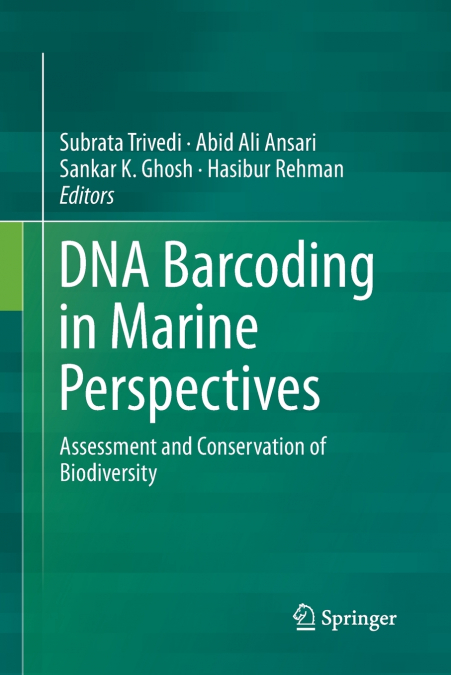

DNA Barcoding in Marine Perspectives

DNA Barcoding in Marine Perspectives


210,20 €
IVA incluido
Disponible
Editorial:
Springer Nature B.V.
Año de edición:
2018
Materia
Ecología, la biosfera
ISBN:
9783319824420
210,20 €
IVA incluido
Disponible

Selecciona una librería:

  • Librería Desdémona
  • Librería Samer Atenea
  • Librería Aciertas (Toledo)
  • Kálamo Books
  • Librería Perelló (Valencia)
  • Librería Elías (Asturias)
  • Donde los libros
  • Librería Kolima (Madrid)
  • Librería Proteo (Málaga)

More than two third of the surface area of our planet is covered by oceans and assessment of the marine biodiversity is a challenging task. With the increasing global population, there is a tendency to exploit marine recourses for food, energy and other requirements. This puts pressure on the fragile marine environment and needs sustainable conservation efforts.  Marine species identification using traditional taxonomical methods are often burdened with taxonomic controversies. Here in this book we will discuss the comparatively new concept of DNA barcoding and its significance in marine perspective. This molecular technique can be helpful in the assessment of cryptic species which are widespread in marine environment, and can also be used to link the different life cycle stages to the adult which is difficult to accomplish in marine ecosystems. Other advantages of DNA barcoding include authentication and safety assessment of seafood, wildlife forensics, conservation genetics and detection of invasive alien species (IAS). Global DNA barcoding efforts in the marine habitat include MarBOL, CeDAMar, CMarZ, SHARK-BOL, etc.   DNA barcoding of different marine groups ranging from the microbes to mammals is to be revealed. In conjugation with newer and faster techniques like high throughput sequencing, DNA barcoding is serving as an effective modern tool in marine biodiversity assessment and conservation.
Artículos relacionados

  • Microalgae
    Maria-Nefeli Tsaloglou
    ...
  • Etude floristique des steppes à armoise blanche (Artemisia herba-alba)
    Leila Kadik / Rachda Berrached
    Les écosystèmes steppiques ont connu une dégradation importante affectant leur structure, leur fonctionnement et les services écologiques rendus. Cependant, déterminer les facteurs abiotiques et/ou biotiques agissant sur la composition et la diversité floristique, la structure du couvert végétal et la phénologie des espèces permettrait de contribuer à la gestion de ces écosystè...
  • Structural connectivity analysis in eastern Antioquia
    Daniel A Martinez Castano
    Biological connectivity is understood as those 'corridors' that allow the connection between two or more natural elements of interest at a landscape scale. These corridors indicate, for example, how two patches of forest can be linked and which is the most appropriate path to achieve this connection, so that animal and plant species can use them and pass through them to get fro...
  • Analyse de la connectivité structurelle dans l’est d’Antioquia
    Daniel A Martinez Castano
    La connectivité biologique s’entend comme les 'corridors' qui permettent la connexion entre deux ou plusieurs caractéristiques naturelles d’intérêt à l’échelle du paysage. Ces corridors indiquent, par exemple, comment deux parcelles de forêt peuvent être reliées et quelle est la manière la plus appropriée de réaliser cette connexion, afin que les espèces animales et végétales p...
  • Анализ структурной связанности в Восточной Антиокии
    Дан Мартинес Кастано
    Под биологической связностью понимаются те 'коридоры', которые обеспечивают связь между двумя или более природными объектами, представляющими интерес в ландшафтном масштабе. Эти коридоры указывают, например, на то, как можно соединить два участка леса и какой способ соединения является наиболее подходящим, чтобы виды животных и растений могли использовать их и проходить через н...
  • Цветение бамбука и болезни, переносимые грызунами, в регионе NEH, Индия
    Шьямал Бисвас
    Бамбук является универсальным видом недревесной продукции леса (НДЛП). Из 125 видов бамбука, произрастающих в Индии, 8,4 таксона встречаются в регионе NEH. Мизорам занимает наибольшую площадь лесов (30,8%) под различными видами бамбука, за ним следует Мегхалая с 26,0%. Бамбук является природным ресурсом и составляет примерно 12,8% от общей площади лесов в Индии, особенно в севе...