
Biotic Interactions in Arid Lands

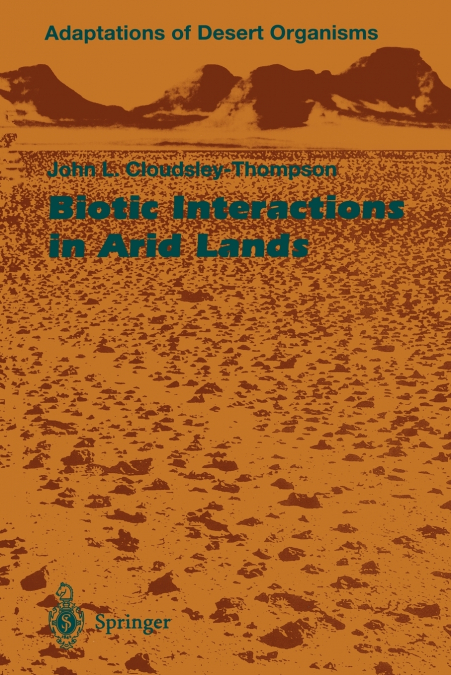
Biotic Interactions in Arid Lands

John L. Cloudsley-Thompson

134,23 €
IVA incluido
Disponible
Editorial:
Springer Nature B.V.
Año de edición:
2011
Materia
Ecología, la biosfera
ISBN:
9783642646379
134,23 €
IVA incluido
Disponible

Selecciona una librería:

  • Librería Samer Atenea
  • Librería Aciertas (Toledo)
  • Kálamo Books
  • Librería Perelló (Valencia)
  • Librería Elías (Asturias)
  • Donde los libros
  • Librería Kolima (Madrid)
  • Librería Proteo (Málaga)

The exigencies of life in the desert environment have resulted in the se­ lection of a diversity of adaptations, both morphological and physiologi­ cal, in the flora and fauna. At the same time, many plants and most small animals are able not merely to exist but even to thrive under desert conditions - mainly by avoiding thermal extremes and by the refine­ ment of pre-existing abilities to economise in water. In the same way, the biotic interactions of the flora and fauna of the desert do not involve many new principles. Nevertheless, conditions in arid regions frequently do invoke refinements of the complex interrelations between predators and their prey, parasites and their hosts, as well as between herbivores and the plants upon which they feed. In this book, I shall discuss not only such interactions and their feedback effects, but also community processes and population dynamics in the desert. The physical conditions of the desert that principally affect predators and their prey are its openness and the paucity of cover. This is re­ stricted to scattered plants, occasional rocks, holes, and crevices in the ground. Furthermore, nightfall does not confer relative invisibility, as it does in many other ecobiomes, because of the clarity of the atmosphere. The bright starlight of the desert renders nearby objects visible even to the human eye, while an incandescent moon bathes the empty landscape with a flood of silver light. Consequently, adaptive coloration is func­ tional at all hours of the day and night.
Artículos relacionados

  • Water from a Transdisciplinary Perspective
    Ana Isabel Pereira Cardoso / Teresinha M. Gonçalves
    Life in cities has distanced human beings from nature and made it difficult to understand the ecology of life dependent on the environment. Urban water collection and distribution processes contribute significantly to the fragmentation of knowledge and the vital recognition of the water cycle. Without the effective participation of the subject in environmental actions, it is no...
    Disponible

    43,82 €

  • Modeling Populations of Adaptive Individuals
    Bret C. Harvey / Steven F. Railsback
    Ecologists now recognize that the dynamics of populations, communities, and ecosystems are strongly affected by adaptive individual behaviors. Yet until now, we have lacked effective and flexible methods for modeling such dynamics. Traditional ecological models become impractical with the inclusion of behavior, and the optimization approaches of behavioral ecology cannot be use...
    Disponible

    65,53 €

  • Scaling in Ecology with a Model System
    Aaron Ellison / Aaron M. Ellison / Nicholas J. Gotelli
    A groundbreaking approach to scale and scaling in ecological theory and practiceScale is one of the most important concepts in ecology, yet researchers often find it difficult to find ecological systems that lend themselves to its study. Scaling in Ecology with a Model System synthesizes nearly three decades of research on the ecology of Sarracenia purpurea-the northern pitcher...
    Disponible

    156,19 €

  • Population Ecology
    Deborah E. Goldberg / John H. Vandermeer
    The essential introduction to population ecology-now expanded and fully updatedEcology is capturing the popular imagination like never before, with issues such as climate change, species extinctions, and habitat destruction becoming ever more prominent. At the same time, the science of ecology has advanced dramatically, growing in mathematical and theoretical sophistication. He...
    Disponible

    124,92 €

  • Physiological Ecology
    Carlos Martínez del Rio / William H. Karasov
    Unlocking the puzzle of how animals behave and how they interact with their environments is impossible without understanding the physiological processes that determine their use of food resources. But long overdue is a user-friendly introduction to the subject that systematically bridges the gap between physiology and ecology. Ecologists--for whom such knowledge can help clarif...
    Disponible

    161,63 €

  • Critical Transitions in Nature and Society
    Marten Scheffer
    How do we explain the remarkably abrupt changes that sometimes occur in nature and society--and can we predict why and when they happen? This book offers a comprehensive introduction to critical transitions in complex systems--the radical changes that happen at tipping points when thresholds are passed. Marten Scheffer accessibly describes the dynamical systems theory behind cr...
    Disponible

    89,46 €

Otros libros del autor

  • Ecophysiology of Desert Arthropods and Reptiles
    John L. Cloudsley-Thompson
    Ecophysiology of Desert Arthropods and Reptiles starts with a new classification of the world’s deserts, based upon the type of precipitation and the effect on their faunas of arthropods and reptiles. This is followed by an account of microclimates and the avoidance of environmental extremes. Whereas thermoregulation is primarily behavioural, response...
    Disponible

    134,26 €

  • The Diversity of Amphibians and Reptiles
    John L. Cloudsley-Thompson
    An introduction to the evolution and adaptation of amphibians and reptiles, bridging the gulf between the plethora of ’popular’ books and the more advanced texts directed towards the needs of specialist research workers, thus making it accessible to advanced students worldwide. It explains basic principles in non-technical terms, and covers the adapti...
    Disponible

    66,38 €

  • Ecology and Behaviour of Mesozoic Reptiles
    John L. Cloudsley-Thompson
    1. Classification 1.1 Introduction 1.2 Amphibians 1.3 Reptiles 1.4 Note on Colouration 2. Diversification of Palaeozoic Reptiles 2.1 Introduction 2.2 Continental Drift 2.3 Reptilian Ancestors 2.4 Anapsid Reptiles 2.5 Synapsid Reptiles 3. The Mesozoic Environment 3.1 Introduction 3.2 The Triassic Period 3.3 The Jurassic and Cretaceous Periods 4. Amphibious Mesozoic Reptiles 4...
    Disponible

    281,75 €

  • Ecology and Behaviour of Mesozoic Reptiles
    John L. Cloudsley-Thompson
    This richly illustrated book clothes the skeletons of dinosaurs and other Mesozoic reptiles with flesh, and shows how these fascinating animals evolved and probably lived. Expert author John L. Cloudsley-Thompson synthesizes current views on ecology, physiology and behaviour, and outlines the various hypotheses that have been proposed to explain their...
    Disponible

    206,62 €

  • Evolution and Adaptation of Terrestrial Arthropods
    John L. Cloudsley-Thompson
    Thisisnotintendedtobeacomprehensivetextbookofentomology andarachnology,butratheraconcisesynthesisofcertainbasic informationrequiredfor BSc(Hons)andMSc(Entomology) examinations. Theapproachisprimarilyfunctional:forinstance, theskeletalandwaterproofingpropertiesofthearthropodcuticle arediscussed,butnotitsbiochemistry;andIhaveincludedonly thosepointswith...
    Disponible

    134,57 €