Inicio > Matemáticas y ciencia > Biologia, ciencias de la vida > Ciencias de la vida: cuestiones generales > Ecología, la biosfera > Biologie de reproduction du corbeau domestique Corvus splendens à Mansehra, au Pakistan
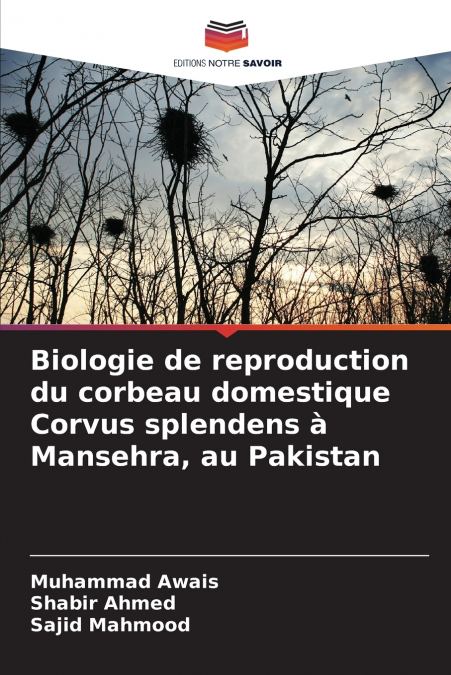
Biologie de reproduction du corbeau domestique Corvus splendens à Mansehra, au Pakistan

Biologie de reproduction du corbeau domestique Corvus splendens à Mansehra, au Pakistan

Muhammad Awais / SAJID MAHMOOD / Shabir Ahmed

82,98 €
IVA incluido
Disponible
Editorial:
KS OmniScriptum Publishing
Año de edición:
2025
Materia
Ecología, la biosfera
ISBN:
9786209387951
82,98 €
IVA incluido
Disponible

Selecciona una librería:

  • Librería Samer Atenea
  • Librería Aciertas (Toledo)
  • Kálamo Books
  • Librería Perelló (Valencia)
  • Librería Elías (Asturias)
  • Donde los libros
  • Librería Kolima (Madrid)
  • Librería Proteo (Málaga)

Le corbeau domestique est un oiseau passereau qui vient du sous-continent indien. Il est de taille moyenne à petite. La saison de reproduction dure de début juin à septembre. La densité moyenne des nids de corbeaux domestiques étudiés était de 2,4 nids/acre. Ils nichaient sur 4 espèces d’arbres différentes : Melia azedarach, Pinus roxburgii, Platanus orientalis et Populus euphratica. La hauteur moyenne des arbres était de 14,8 m, et la hauteur moyenne des nids était de 11,8 m. Le diamètre moyen maximum des nids était de 42,3 cm, le diamètre minimum était de 39,0 cm, et la profondeur moyenne des nids était de 19,3 cm. Le diamètre maximum de la coupe des nids était de 15,6 cm, et le diamètre minimum était de 13,3 cm. La profondeur moyenne de la coupe était de 8,3 cm. Le poids moyen des nids était de 1,4 kg. La taille de la couvée était de 4,0 avec une fourchette de 1 à 6 œufs. Le poids moyen des œufs était de 12,30 g. La longueur moyenne des œufs était de 38,6 mm, leur largeur de 26,0 mm, leur volume calculé de 13,34 cm3 et leur indice de forme de 1,42. Le taux de réussite des œufs était de 0,551 (64/116), celui des nids était de 0,690 (29/42) et le nombre moyen de poussins ayant pris leur envol par nid était de 1,44. On peut conclure que le corbeau domestique niche dans les arbres et préfère les arbres à la canopée dense et de grande taille pour construire ses nids.

Artículos relacionados

  • Water from a Transdisciplinary Perspective
    Ana Isabel Pereira Cardoso / Teresinha M. Gonçalves
    Life in cities has distanced human beings from nature and made it difficult to understand the ecology of life dependent on the environment. Urban water collection and distribution processes contribute significantly to the fragmentation of knowledge and the vital recognition of the water cycle. Without the effective participation of the subject in environmental actions, it is no...
    Disponible

    43,82 €

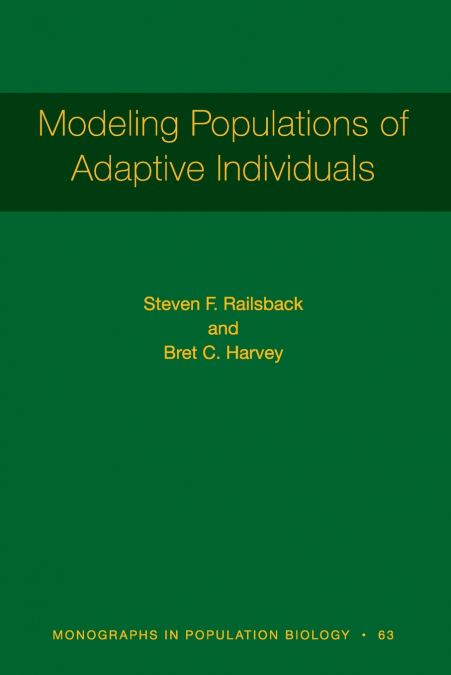
  • Modeling Populations of Adaptive Individuals
    Bret C. Harvey / Steven F. Railsback
    Ecologists now recognize that the dynamics of populations, communities, and ecosystems are strongly affected by adaptive individual behaviors. Yet until now, we have lacked effective and flexible methods for modeling such dynamics. Traditional ecological models become impractical with the inclusion of behavior, and the optimization approaches of behavioral ecology cannot be use...
    Disponible

    65,53 €

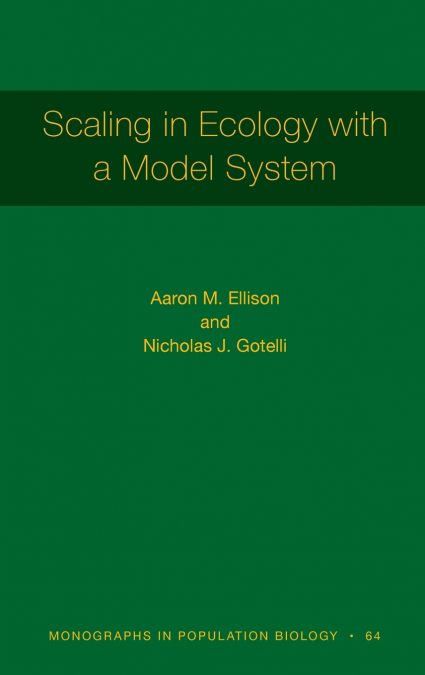
  • Scaling in Ecology with a Model System
    Aaron Ellison / Aaron M. Ellison / Nicholas J. Gotelli
    A groundbreaking approach to scale and scaling in ecological theory and practiceScale is one of the most important concepts in ecology, yet researchers often find it difficult to find ecological systems that lend themselves to its study. Scaling in Ecology with a Model System synthesizes nearly three decades of research on the ecology of Sarracenia purpurea-the northern pitcher...
    Disponible

    156,19 €

  • Population Ecology
    Deborah E. Goldberg / John H. Vandermeer
    The essential introduction to population ecology-now expanded and fully updatedEcology is capturing the popular imagination like never before, with issues such as climate change, species extinctions, and habitat destruction becoming ever more prominent. At the same time, the science of ecology has advanced dramatically, growing in mathematical and theoretical sophistication. He...
    Disponible

    124,92 €

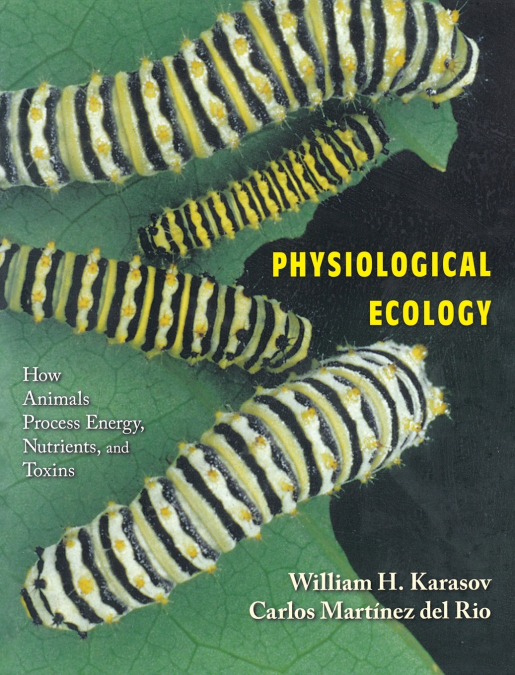
  • Physiological Ecology
    Carlos Martínez del Rio / William H. Karasov
    Unlocking the puzzle of how animals behave and how they interact with their environments is impossible without understanding the physiological processes that determine their use of food resources. But long overdue is a user-friendly introduction to the subject that systematically bridges the gap between physiology and ecology. Ecologists--for whom such knowledge can help clarif...
    Disponible

    161,63 €

  • Critical Transitions in Nature and Society
    Marten Scheffer
    How do we explain the remarkably abrupt changes that sometimes occur in nature and society--and can we predict why and when they happen? This book offers a comprehensive introduction to critical transitions in complex systems--the radical changes that happen at tipping points when thresholds are passed. Marten Scheffer accessibly describes the dynamical systems theory behind cr...
    Disponible

    89,46 €

Otros libros del autor

  • Biologia riproduttiva del corvo domestico Corvus splendens a Mansehra, Pakistan
    Muhammad Awais / SAJID MAHMOOD / Shabir Ahmed
    Il corvo domestico è un uccello passeriforme che viene dal subcontinente, di dimensioni che vanno da grandi a medio-piccole. La stagione riproduttiva va da inizio giugno a settembre. La densità media dei nidi di corvo domestico nella ricerca era di 2,4 nidi per acro. Hanno nidificato su 4 diverse specie di alberi, cioè Melia azedarach, Pinus roxburgii, Platanus orientalis e Pop...
    Disponible

    82,98 €

  • Biologia rozrodu wrony domowej Corvus splendens w Mansehra w Pakistanie
    Muhammad Awais / SAJID MAHMOOD / Shabir Ahmed
    Wrona domowa to ptak z rzędu wróblowych, pochodzący z subkontynentu, o wielkości od dużej do średniej. Sezon lęgowy trwa od początku czerwca do września. Średnia gęstość gniazd wron domowych w badaniu wynosiła 2,4 gniazda/akr. Gniazdowały one na 4 różnych gatunkach drzew, a mianowicie Melia azedarach, Pinus roxburgii, Platanus orientalis i Populus euphratica. Średnia wysokość d...
    Disponible

    82,98 €

  • Biologia reprodutiva do corvo-doméstico Corvus splendens em Mansehra, Paquistão
    Muhammad Awais / SAJID MAHMOOD / Shabir Ahmed
    O corvo-doméstico é uma ave passeriforme originária do subcontinente, com tamanho que varia de grande a médio-pequeno. A época de reprodução vai do início de junho a setembro. A densidade média de ninhos do corvo-doméstico na pesquisa foi de 2,4 ninhos/acre. Eles fizeram ninhos em quatro espécies diferentes de árvores, a saber: Melia azedarach, Pinus roxburgii, Platanus orienta...
    Disponible

    82,98 €

  • Fortpflanzungsbiologie der Hauskrähe (Corvus splendens) in Mansehra, Pakistan
    Muhammad Awais / SAJID MAHMOOD / Shabir Ahmed
    Die Hauskrähe ist ein Sperlingsvogel, der auf dem Subkontinent lebt und von groß bis mittelgroß ist. Die Brutzeit geht von Anfang Juni bis September. Die durchschnittliche Nestdichte der Hauskrähe lag in der Studie bei 2,4 Nester pro Hektar. Sie nisteten auf vier verschiedenen Baumarten, nämlich Melia azedarach, Pinus roxburgii, Platanus orientalis und Populus euphratica. Die d...
    Disponible

    82,98 €