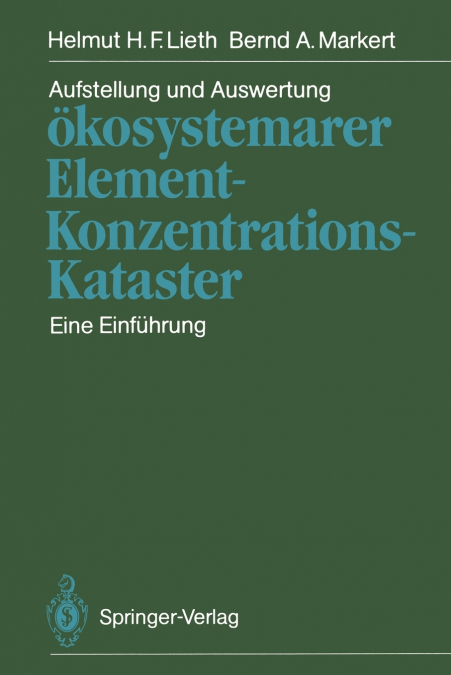
Aufstellung und Auswertung ökosystemarer Element-Konzentrations-Kataster

Aufstellung und Auswertung ökosystemarer Element-Konzentrations-Kataster

Bernd A. Markert / Helmut H.F. Lieth

85,13 €
IVA incluido
Disponible
Editorial:
Springer Nature B.V.
Año de edición:
1988
Materia
Ecología, la biosfera
ISBN:
9783540188094
85,13 €
IVA incluido
Disponible

Selecciona una librería:

  • Librería Samer Atenea
  • Librería Aciertas (Toledo)
  • Kálamo Books
  • Librería Perelló (Valencia)
  • Librería Elías (Asturias)
  • Donde los libros
  • Librería Kolima (Madrid)
  • Librería Proteo (Málaga)

Von der Arbeits gruppe Systemforschung an der Universität Osnabrück wird im Auftrag der International Union of Biologica1 Sciences (IUBS) ein Projekt zur Erstellung von sogenannten Element-Konzentrations­ Katastern in Ökosystemen (ECCE) entwickelt, das alle großen Ökosysteme der Erde einschließen soll. Während unserer Pilotstudien in den Jahren 1983-1986 ist es uns mit Hilfe befreundeter Wissenschaftler gelungen, zwischen 60 und 70 der etwa 90 natürlich vorkommenden Elemente zu erfassen. Die in den Arbeiten auftretenden Schwierigkeiten und Fehler, aber auch enormen Möglichkeiten, die sich aus der Aufstellung von ECCEs für die moderne Ökosystemanalyse ergaben, hatten uns dazu ermutigt, unsere bisherige Methodik und Fragestellungen der IUBS für ein internationales Programm anzubieten. Die IUBS hat dieses Angebot angenommen und uns beauftragt, ein internationales Programm zu entwickeln. Der Wortlaut des Antrages, mit dem dieses Projekt der IUBS General Assembly 1985 in Budapestund 1986 in Syracuse~ N. Y., zur Annahme empfohlen wurde, ist im Anhang wiedergegeben. Als wesentliche Gründe für das Projekt sind darin angegeben, daß vollständige Elementaranalysen folgende Vorteile für die Ökosystemforschung bringen werden: VI 1. Sie werden die Basisinformation für den globalen Kreislauf aller chemischen Elemente liefern. 2. Sie werden Elementbilanzen für die verschiedenen Ökosysteme in den unterschiedlichen klimatischen und edaphischen Bedingungen ermöglichen. 3. Sie können den Einfluß verschiedener Elementkonzentrationen auf die Evolution von Pflanzen- und Tierarten aufzeigen. 4. Sie können den Einfluß der Elementkonzentrationen auf die Vegetations- und Bodenstruktur in den . verschiedenen Ökosystemen aufzeigen. 5. Sie können die Verteilungsmuster der einzelnen Elemente in den pflanzlichen und tierischen Organismen des Ökosystems liefern.
Artículos relacionados

  • Water from a Transdisciplinary Perspective
    Ana Isabel Pereira Cardoso / Teresinha M. Gonçalves
    Life in cities has distanced human beings from nature and made it difficult to understand the ecology of life dependent on the environment. Urban water collection and distribution processes contribute significantly to the fragmentation of knowledge and the vital recognition of the water cycle. Without the effective participation of the subject in environmental actions, it is no...
    Disponible

    43,82 €

  • Modeling Populations of Adaptive Individuals
    Bret C. Harvey / Steven F. Railsback
    Ecologists now recognize that the dynamics of populations, communities, and ecosystems are strongly affected by adaptive individual behaviors. Yet until now, we have lacked effective and flexible methods for modeling such dynamics. Traditional ecological models become impractical with the inclusion of behavior, and the optimization approaches of behavioral ecology cannot be use...
    Disponible

    65,53 €

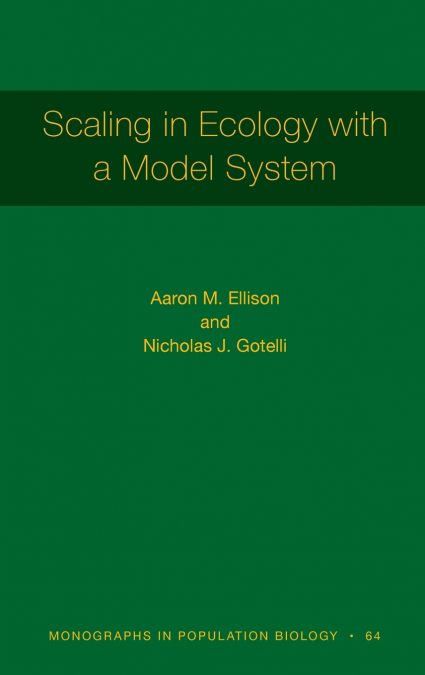
  • Scaling in Ecology with a Model System
    Aaron Ellison / Aaron M. Ellison / Nicholas J. Gotelli
    A groundbreaking approach to scale and scaling in ecological theory and practiceScale is one of the most important concepts in ecology, yet researchers often find it difficult to find ecological systems that lend themselves to its study. Scaling in Ecology with a Model System synthesizes nearly three decades of research on the ecology of Sarracenia purpurea-the northern pitcher...
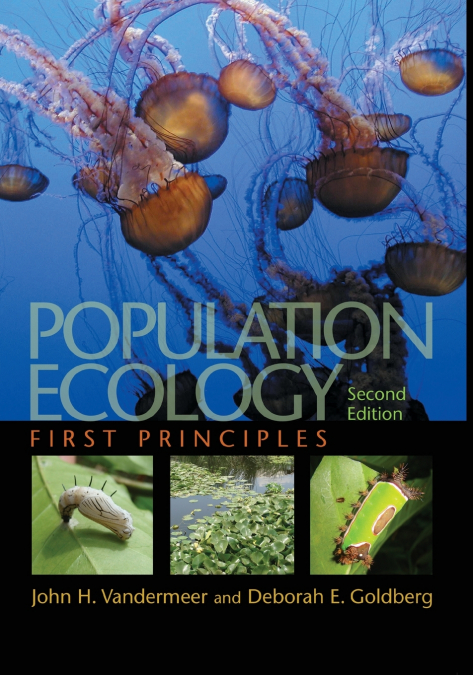
  • Population Ecology
    Deborah E. Goldberg / John H. Vandermeer
    The essential introduction to population ecology-now expanded and fully updatedEcology is capturing the popular imagination like never before, with issues such as climate change, species extinctions, and habitat destruction becoming ever more prominent. At the same time, the science of ecology has advanced dramatically, growing in mathematical and theoretical sophistication. He...
    Disponible

    124,92 €

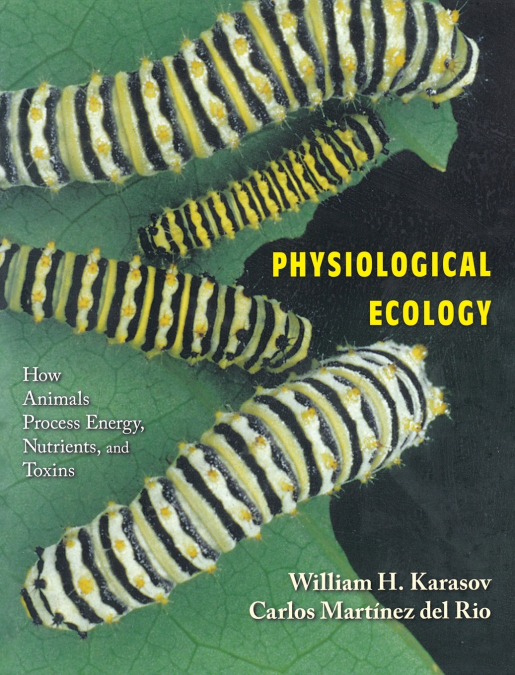
  • Physiological Ecology
    Carlos Martínez del Rio / William H. Karasov
    Unlocking the puzzle of how animals behave and how they interact with their environments is impossible without understanding the physiological processes that determine their use of food resources. But long overdue is a user-friendly introduction to the subject that systematically bridges the gap between physiology and ecology. Ecologists--for whom such knowledge can help clarif...
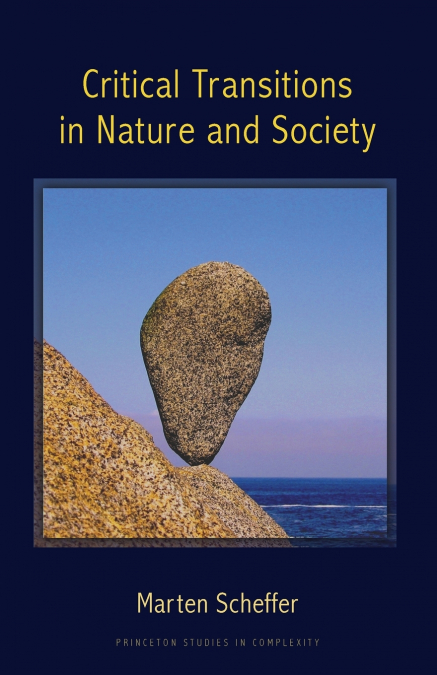
  • Critical Transitions in Nature and Society
    Marten Scheffer
    How do we explain the remarkably abrupt changes that sometimes occur in nature and society--and can we predict why and when they happen? This book offers a comprehensive introduction to critical transitions in complex systems--the radical changes that happen at tipping points when thresholds are passed. Marten Scheffer accessibly describes the dynamical systems theory behind cr...
    Disponible

    89,46 €