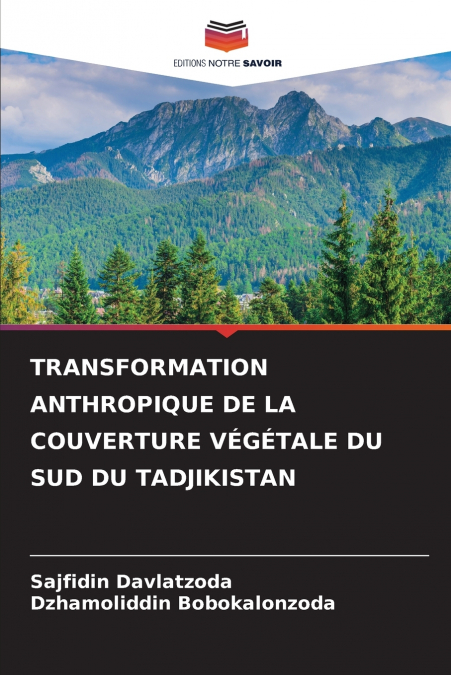
Dzhamoliddin Bobokalonzoda / Sajfidin Davlatzoda
 Librería Samer Atenea
 Kálamo Books
 Librería Elías (Asturias)
 Librería Kolima (Madrid)
 Librería Proteo (Málaga)
The vegetation cover of Southern Tajikistan is a complex system formed under conditions of pronounced altitudinal zonation, moisture contrasts, and high mosaicism of soil-geomorphological conditions. In the 21st century, this system is experiencing increasing anthropogenic pressure associated with the expansion of land use, the development of livestock farming, construction, industrial infrastructure, and resource development. As a result, community structure, the spatial distribution of vegetation types, and ecosystem stability are changing, which is reflected in biodiversity, the forage base, soil-protective functions, and the conservation priorities of the region.The leading role in understanding these processes belongs to the monitoring of natural ecosystems in Central Asia. For Tajikistan, as for neighboring republics, significant material has been accumulated on floristics and the description of vegetation in individual areas. However, in recent decades, the task of a comprehensive assessment of the influence of anthropogenic factors on biodiversity and vegetation cover has become particularly relevant, especially in Southern Tajikistan as one of the key regions of the country’s socio-economic development.