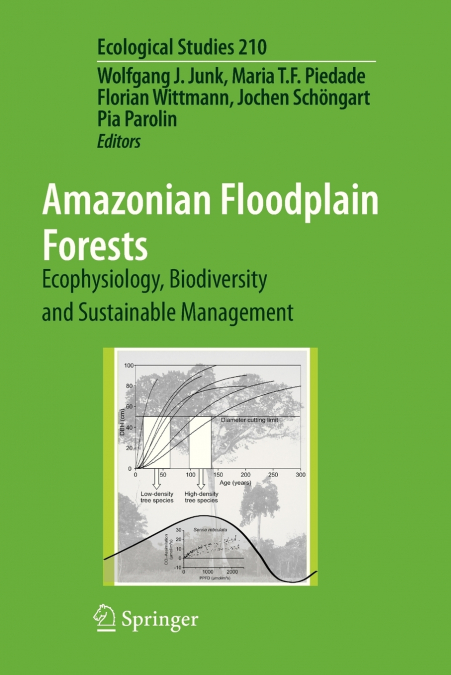

Amazonian Floodplain Forests

Amazonian Floodplain Forests


267,53 €
IVA incluido
Disponible
Editorial:
Springer Nature B.V.
Año de edición:
2012
Materia
Ecología, la biosfera
ISBN:
9789400733633
267,53 €
IVA incluido
Disponible

Selecciona una librería:

  • Librería Samer Atenea
  • Librería Aciertas (Toledo)
  • Kálamo Books
  • Librería Perelló (Valencia)
  • Librería Elías (Asturias)
  • Donde los libros
  • Librería Kolima (Madrid)
  • Librería Proteo (Málaga)

Central Amazonian floodplain forests are an unique and endangered ecosystem. The forests grow in areas that are annually flooded by large rivers during mean periods of up to 8 months and at depths of up to 10 m. Despite this severe stress, these forests consist of over 1,000 species and are by far the most species-rich floodplain forests worldwide. The trees show a broad range of morphological, anatomical, physiological, and phenological adaptations that enable them not only to survive the adverse environmental conditions, but also to produce large amounts of biomass when the nutrient levels in water and soils are sufficiently high. This is the case in the floodplains of white-water rivers, which are used for fisheries, agriculture, and cattle-ranching but which also have a high potential for the production of timber and non-timber products, when adequately managed. Latest research on ecophysiology gives insight how tree species adapt to the oscillating flood-pulse focusing on their photosynthesis, respiration, sap flow, biochemistry, phenology, wood and leave anatomy, root morphology and functioning, fruit chemistry, seed germination, seedling establishment, nitrogen fixation and genetic variability. Based on tree ages, lifetime growth rates and net primary production, new concepts are developed to improve the sustainability of traditional forest managements in the background of an integrated natural resource management. This is the first integrative book on the functioning and ecologically oriented use of floodplain forests in the tropics and sub-tropics.It provides fundamental knowledge for scientist, students, foresters and other professionals on their distribution, evolution and phytogeography. 'This book is an excellent testimony to the interdisciplinary collaboration of a group of very dedicated scientists to unravel the functioning of the Amazonian Floodplain forests. They have brought together a highly valuable contribution on the distribution, ecology, primary production, ecophysiology, typology, biodiversity, and human use of these forests offering recommendations for sustainable management and future projects in science and development of these unique wetland ecosystems. It lays a solid scientific foundation for wetland ecologists, foresters, environmentalists, wetland managers, and all those interested in sustainable management in the tropics and subtropics.' Brij Gopal, Executive Vice President International Society for Limnology (SIL).

Artículos relacionados

  • Water from a Transdisciplinary Perspective
    Ana Isabel Pereira Cardoso / Teresinha M. Gonçalves
    Life in cities has distanced human beings from nature and made it difficult to understand the ecology of life dependent on the environment. Urban water collection and distribution processes contribute significantly to the fragmentation of knowledge and the vital recognition of the water cycle. Without the effective participation of the subject in environmental actions, it is no...
    Disponible

    43,82 €

  • Modeling Populations of Adaptive Individuals
    Bret C. Harvey / Steven F. Railsback
    Ecologists now recognize that the dynamics of populations, communities, and ecosystems are strongly affected by adaptive individual behaviors. Yet until now, we have lacked effective and flexible methods for modeling such dynamics. Traditional ecological models become impractical with the inclusion of behavior, and the optimization approaches of behavioral ecology cannot be use...
    Disponible

    65,53 €

  • Scaling in Ecology with a Model System
    Aaron Ellison / Aaron M. Ellison / Nicholas J. Gotelli
    A groundbreaking approach to scale and scaling in ecological theory and practiceScale is one of the most important concepts in ecology, yet researchers often find it difficult to find ecological systems that lend themselves to its study. Scaling in Ecology with a Model System synthesizes nearly three decades of research on the ecology of Sarracenia purpurea-the northern pitcher...
  • Population Ecology
    Deborah E. Goldberg / John H. Vandermeer
    The essential introduction to population ecology-now expanded and fully updatedEcology is capturing the popular imagination like never before, with issues such as climate change, species extinctions, and habitat destruction becoming ever more prominent. At the same time, the science of ecology has advanced dramatically, growing in mathematical and theoretical sophistication. He...
    Disponible

    124,92 €

  • Physiological Ecology
    Carlos Martínez del Rio / William H. Karasov
    Unlocking the puzzle of how animals behave and how they interact with their environments is impossible without understanding the physiological processes that determine their use of food resources. But long overdue is a user-friendly introduction to the subject that systematically bridges the gap between physiology and ecology. Ecologists--for whom such knowledge can help clarif...
  • Critical Transitions in Nature and Society
    Marten Scheffer
    How do we explain the remarkably abrupt changes that sometimes occur in nature and society--and can we predict why and when they happen? This book offers a comprehensive introduction to critical transitions in complex systems--the radical changes that happen at tipping points when thresholds are passed. Marten Scheffer accessibly describes the dynamical systems theory behind cr...
    Disponible

    89,46 €