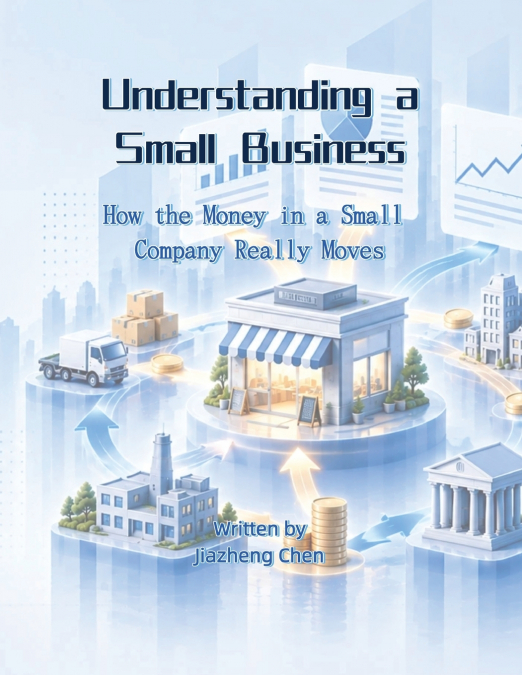

Understanding Small Business

Understanding Small Business

Jiazheng Chen

76,08 €
IVA incluido
Disponible
Editorial:
Jiazheng Chen
Año de edición:
2026
Materia
Emprendimiento y emprendedores
ISBN:
9798907420250
76,08 €
IVA incluido
Disponible

Selecciona una librería:

  • Librería Samer Atenea

  • Kálamo Books
  • Librería Elías (Asturias)
  • Librería Kolima (Madrid)
  • Librería Proteo (Málaga)

Money moves through a small business every day. Customers pay, suppliers get paid, payroll goes out, rent is due, the loan takes its bite, and the state wants the sales tax that was never yours to begin with. At the end of the month the owner wants to know three things: did we make money, where did it go, and will there be enough to make payroll next month. This book answers that kind of question. It does not teach you how to run a business. It teaches you how to read the money in one.The book runs thirty-eight chapters. It starts with the three numbers that get confused more than any others - revenue, profit, and the bank balance - and shows why they rarely agree and when each one will mislead you. From there it works through the money flow map, the counterintuitive parts of accounting, and the three financial statements: the income statement, which says whether the business earns; the balance sheet, which records what it owns and owes; and the cash flow statement, the hardest one to dress up.Then come the numbers an owner faces every week: cash runway and forecasting, the cash squeeze that growth creates, cost structure and break-even, pricing and discounts, unit economics, the costs that never show up on a statement, what an employee really costs, inventory, receivables, payables, equipment, debt, paying yourself, what your own labor is worth, taxes, insurance, card fees, platforms, marketing, the quality of growth, budgets and scenarios, and the metrics worth tracking. The last chapters take services, retail, food, online selling, pet care, gig work and professional practices one at a time, then cover fraud and controls, outside bookkeeping help, when to close a losing line, and what a buyer will pay.Four fictional businesses run through the whole book: a neighborhood bakery, a dog boarding and daycare business, a small plumbing and electrical contractor, and a one-person online shop. None of them has a name, and every figure attached to them was computed and checked. Their numbers do the teaching: what one month’s income statement actually says, what a free warranty callback costs when the shop is fully booked, why a $28 order can lose money after the platform takes its cut. The book carries 260 tables and 38 figures, all black and white, all original. Seventy-four short boxes called The Owner’s Money Illusion take on the beliefs that cost owners the most: big revenue means big money, money in the bank means the business is healthy, an employee at $20 an hour costs $20 an hour, a loss can be fixed by selling more. Every chapter closes with the same five questions - where is this money coming from, when does it actually arrive, what did it really cost to get it, what if it does not go to plan, and is this worth the owner’s time and money right now - so the method travels from the page to your own numbers. Seven appendices work as reference: a 290-entry glossary, quick guides to the three statements and the key ratios, the numbers that matter in each line of business, and the illusions collected in one table.Who it is for: someone who just opened a shop or took one over, someone planning to start and wanting to understand the money first, an owner with no in-house accountant who sees one statement a month, and the partner or family member trying to read the books. No accounting background is needed. Every term is explained in plain words the first time it appears.Tax, employment, insurance, lending and payment material is written against the United States, with figures current as of 2026; rules differ by state and change, so follow official sources and your own professional. This book explains how to read the numbers, makes no decision for the owner, and is not accounting, tax, legal or insurance advice.

Artículos relacionados

  • The Shortest Distance Between You and Your New Product, 2nd Edition
    Katherine Radeka
    Do your products take too long to get to market? The Rapid Learning Cycles framework is an approach to product development that has helped hundreds of teams get their products to market faster.When you can get your product into customers' hands faster, you see your vision brought to life sooner. You can beat any competition to market with your best ideas. You can shorten th...
    Disponible

    18,92 €

  • Your Book is the Hook
    Karen Williams
    Writing a book is a great way for business owners to inspire and educate their clients, and leverage their knowledge and expertise.It will help you to get known for what you do, establish yourself as an authority, and get noticed by more people who need your help.In Your Book is the Hook, Karen takes you through her proven six-step process to plan, write, publish and market the...
    Disponible

    13,03 €

  • The New Startup
    David Pike
    Do you want to be your own boss? Are you working in a cubicle, counting down the hours until 5 o’clock (or later) when you can leave the office? Are you unemployed? This book is for you. Starting a business might seem like a complex maze, but there are steps and guidelines you should follow. Based on my personal experience of 10+ ventures, research on entrepreneurship, and conv...
  • Modern Entrepreneurship and E-Business Innovations
    Süphan Nasır
    Technology has emerged as an important component in businesses and organizations by allowing for modern innovations through the internet and other information and communication technologies. Modern Entrepreneurship and E-Business Innovations provides advanced knowledge of e-entrepreneurship and innovation as well as emerging theories, applications and challenges. This book is a...
  • Handbook of Research on Global Competitive Advantage through Innovation and Entrepreneurship
    Helen Lawton Smith / João JMFerreira / Luis M Farinha
    As businesses seek to compete on a global stage, they must be constantly aware of pressures from all levels: regional, local, and worldwide. The organizations that can best build advantages in diverse environments achieve the greatest success. The Handbook of Research on Global Competitive Advantage through Innovation and Entrepreneurship explores the emergence of new ideas and...
  • Start-Up Enterprises and Contemporary Innovation Strategies in the Global Marketplace
    In an ever-expanding economic world, the need for new businesses with the ability to create and evolve simultaneously is paramount to ensure success. Hybrid business models are essential to foster growth and promote prosperity. Start-Up Enterprises and Contemporary Innovation Strategies in the Global Marketplace is a critical scholarly resource that examines the relationship be...

Otros libros del autor

  • Core to Score
    Jiazheng Chen
    AP® Statistics is often studied as two separate courses: graphs and study design in the fall, probability and inference formulas in the spring. The exam treats it as one. A single free-response question can start with how a study collected its data, ask you to describe a graph, and end with a confidence interval or a significance test. Core to Score is written to make those con...
  • Core to Score
    Jiazheng Chen
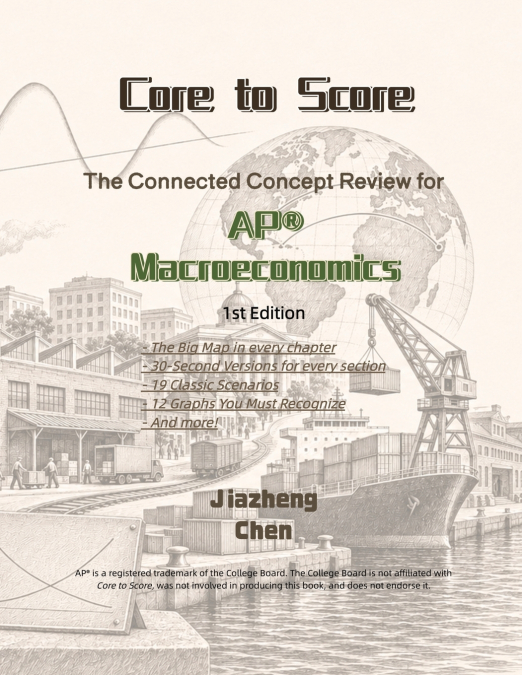
    Most students who struggle in AP® Macroeconomics have memorized the graphs. What they can’t do yet is follow one change through all of them. A higher interest rate on reserves starts in the reserve market, moves interest rates, shifts aggregate demand, changes employment, and ends in the foreign exchange market. The exam is built on chains like that one.Core to Score: The Conne...
  • Core to Score
    Jiazheng Chen
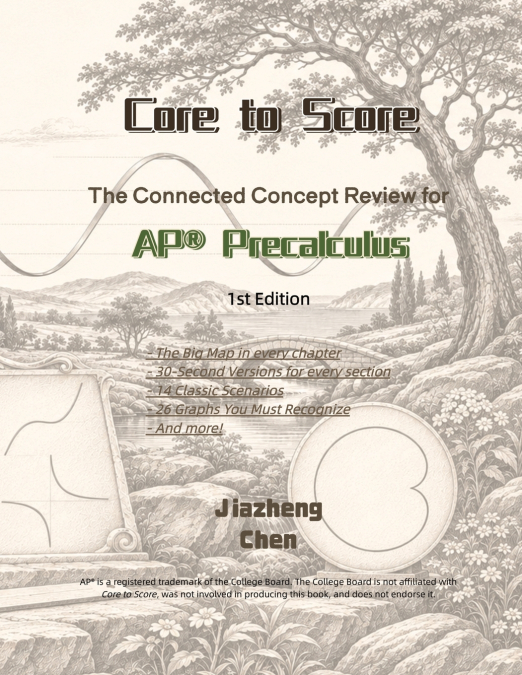
    AP® Precalculus is not a list of formulas to memorize. Every unit keeps asking the same few questions: How is the output changing? What does this graph, table, or formula tell you? Which kind of function fits this situation, and how far can you trust it? Core to Score: The Connected Concept Review for AP® Precalculus makes those common questions visible, so the course finally f...
  • Core to Score
    Jiazheng Chen
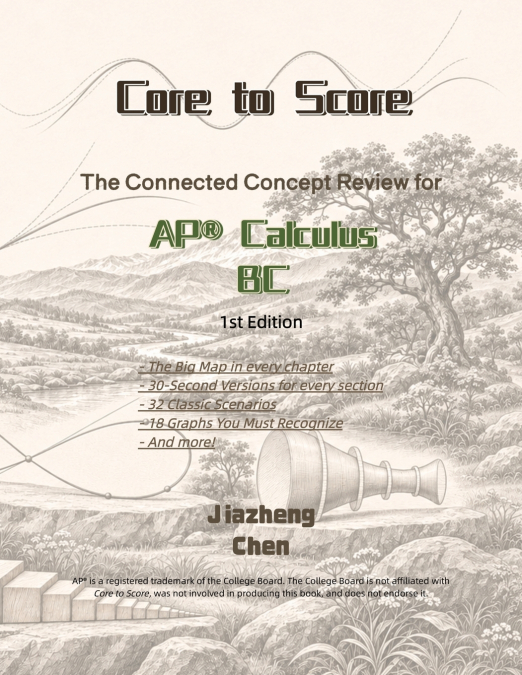
    AP® Calculus BC is not ten separate units. It is one set of ideas, the limit, the derivative, and the integral, extended three times: to parametric curves, to polar graphs, and to infinite series. Core to Score: The Connected Concept Review for AP® Calculus BC is written to make those connections visible, so you can use the course’s ideas on questions you have never seen before...
  • Core to Score
    Jiazheng Chen
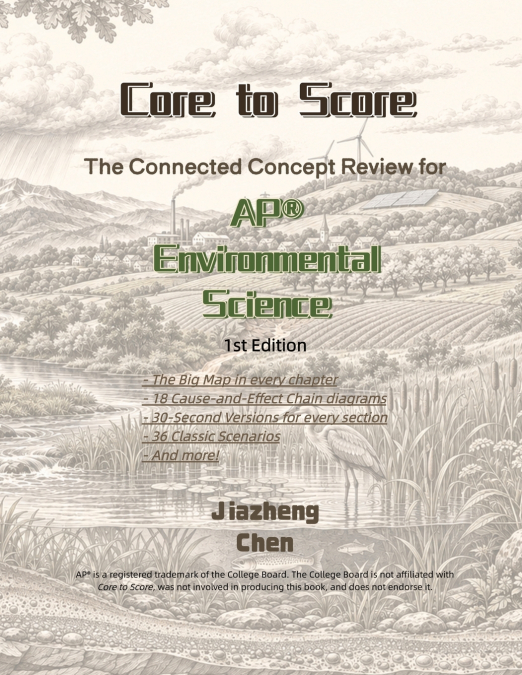
    AP® Environmental Science is not a list of separate topics. Energy flows from the sun through food webs. Carbon moves from power plants into the air and the oceans. Fertilizer on a Midwestern farm becomes a dead zone in the Gulf of Mexico. Population growth drives demand for land, water, and energy. This book is built to show you those connections, because the exam rewards stud...
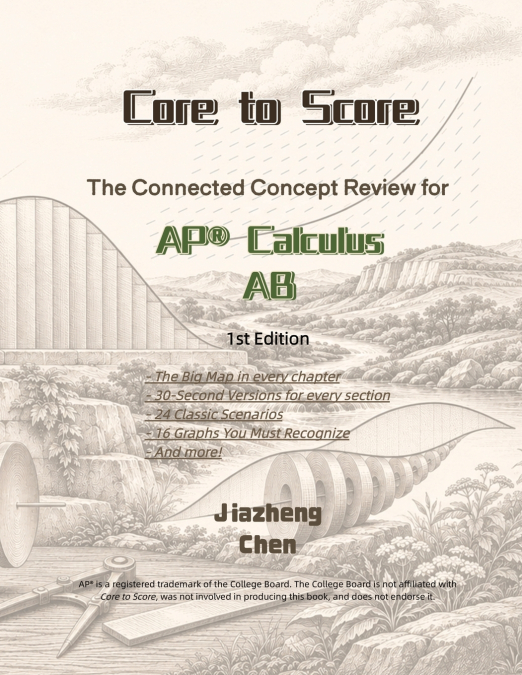
  • Core to Score
    Jiazheng Chen
    AP® Calculus AB is often taught as a list of rules: a rule for each kind of derivative, a test for each kind of extremum, a technique for each kind of integral. Students memorize them, and then a free-response question gives a table of values or the graph of a derivative, and the rules no longer seem to apply. Core to Score is written for that moment. It explains where every ru...