
Inicio > > Bases de datos > Diseño y teoría de bases de datos > UML Requirements Modeling For Business Analysts
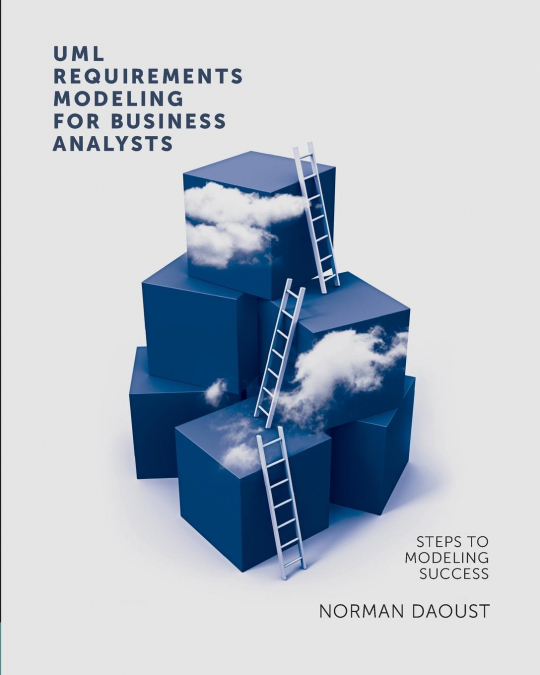
UML Requirements Modeling For Business Analysts

UML Requirements Modeling For Business Analysts

UML Requirements Modeling For Business Analysts

Norman Daoust

36,43 €
IVA incluido
Disponible
Editorial:
Technics Publications
Año de edición:
2012
Materia
Diseño y teoría de bases de datos
ISBN:
9781935504245
36,43 €
IVA incluido
Disponible

Selecciona una librería:

  • Librería Samer Atenea
  • Librería Aciertas (Toledo)
  • Kálamo Books
  • Librería Perelló (Valencia)
  • Librería Elías (Asturias)
  • Donde los libros
  • Librería Kolima (Madrid)
  • Librería Proteo (Málaga)

This book provides you with a collection of best practices, guidelines, and tips for using the Unified Modeling Language (UML) for business analysis. The contents have been assembled over the years based on experience and documented best practices. Over sixty easy to understand UML diagram examples will help you to apply these ideas immediately. If you use, expect to use, or think you should use the Unified Modeling Language (UML) or use cases in your business analysis activities, this book will help you: communicate more succinctly and effectively with your stakeholders including your software development team, increase the likelihood that your requirements will be reviewed and understood, reduce requirements analysis, documentation, and review time. The first three chapters explain the reasons for utilizing the UML for business analysis, present a brief history of the UML and its diagram categories, and describe a set of general modeling guidelines and tips applicable to all of the UML diagram types. Each of the next thirteen chapters is dedicated to a different UML diagram type: Use Case Diagrams Activity Diagrams Interaction Overview Diagrams Class Diagrams Object Diagrams State Machine Diagrams Timing Diagrams Sequence Diagrams Communication Diagrams Composite Structure Diagrams Component Diagrams Deployment Diagrams Package Diagrams The next two chapters explain additional diagram types that are important for business analysts and that can be created using UML notation: Context Diagrams using Communication diagram notation Data Models using Class diagram notation These chapters are followed by a chapter that describes criteria for selecting the various diagram types. The final chapter presents a case study.

Artículos relacionados

  • Hands-On Machine Learning on Google Cloud Platform
    Alexis Perrier / Giuseppe Ciaburro / Kishore Ayyadevara
    Enhance your understanding of Computer Vision and image processing by developing real-world projects in OpenCV 3Key FeaturesGet to grips with the basics of Computer Vision and image processingThis is a step-by-step guide to developing several real-world Computer Vision projects using OpenCV 3This book takes a special focus on working with Tesseract OCR, a free, open-source libr...
    Disponible

    72,22 €

  • MLOps with Red Hat OpenShift
    Faisal Masood / Ross Brigoli
    Build and manage MLOps pipelines with this practical guide to using Red Hat OpenShift Data Science, unleashing the power of machine learning workflowsKey FeaturesGrasp MLOps and machine learning project lifecycle through concept introductionsGet hands on with provisioning and configuring Red Hat OpenShift Data ScienceExplore model training, deployment, and MLOps pipeline buildi...
    Disponible

    64,10 €

  • Data Labeling in Machine Learning with Python
    Vijaya Kumar Suda
    Take your data preparation, machine learning, and GenAI skills to the next level by learning a range of Python algorithms and tools for data labelingKey FeaturesGenerate labels for regression in scenarios with limited training dataApply generative AI and large language models (LLMs) to explore and label text dataLeverage Python libraries for image, video, and audio data analysi...
    Disponible

    86,16 €

  • Data Engineering with Scala and Spark
    David Radford / Eric Tome / Rupam Bhattacharjee
    Take your data engineering skills to the next level by learning how to utilize Scala and functional programming to create continuous and scheduled pipelines that ingest, transform, and aggregate dataKey Features- Transform data into a clean and trusted source of information for your organization using Scala- Build streaming and batch-processing pipelines with step-by-step expla...
    Disponible

    54,33 €

  • Mastering Snowflake Platform
    Pooja Kelgaonkar
    Embark on the data journey with the ultimate guide to Snowflake masteryDESCRIPTION Handling ever evolving data for business needs can get complex. Traditional methods create bulky and costly-to-maintain data systems. Here, Snowflake emerges as a cost-effective solution, catering to both traditional and modern data needs with zero or minimal maintenance costs.This book helps you...
    Disponible

    50,54 €

  • BASI DI DATI - PROGETTAZIONE, REALIZZAZIONE E PROGRAMMAZIONE
    Roberto Bandiera
    Il lettore viene guidato nelle diverse fasi della progettazione e realizzazione di un database relazionale.Nelle numerose esemplificazioni pratiche viene utilizzato MySQL come software di gestione database.Viene poi trattato il linguaggio SQL per interrogare ed aggiornare il database. Infine vengono presentate le tecniche e gli strumenti per realizzare una applicazione gestiona...
    Disponible

    34,65 €