Transhumance

Transhumance

Maman Bachir Aboubacar Cheffou

73,46 €
IVA incluido
Disponible
Editorial:
KS OmniScriptum Publishing
Año de edición:
2026
Materia
Botánica y ciencias de las plantas
ISBN:
9786630013900
73,46 €
IVA incluido
Disponible

Selecciona una librería:

  • Librería Samer Atenea
  • Kálamo Books
  • Librería Elías (Asturias)
  • Librería Kolima (Madrid)
  • Librería Proteo (Málaga)

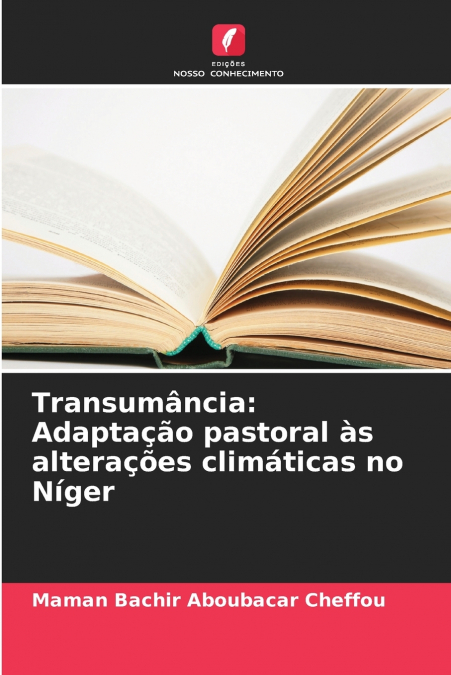
Niger is a Sahelian country where the predominantly rural population relies on agriculture for its livelihood. Livestock farming is the country’s second largest economic activity. In the aftermath of independence, livestock farming accounted for over 20% of the national Gross Domestic Product. Following the droughts of 1973 and 1984, this share fell by half between 1961 and 2000. Livestock numbers, the main factor of production, have declined considerably. In response to these crises, which revealed profound climate changes, the government has implemented sector-specific measures to improve animal health and pastoral water management. Pastoralist communities, for their part, have developed adaptive strategies to survive shortages of fodder and water for their livestock. Thus, through mobility, transhumance has provided a genuine lifeline during periods of scarcity. This reveals the essence of sustainable development in Niger’s transhumant pastoral sector, where herders and their animals might find some security amidst the great uncertainty of the unpredictability that governs climate forecast models for the coming years.

Artículos relacionados

  • The Green Architecture
    Ali Mirshafieyan / Ghazal Yeganeh / Maryam Zamani Motlagh
    Protecting green energy as well as non-renewable energy, as well as their sustainable use, many advances in the technology of extracting oil products and other reserves under the ground have caused many improvements. In this regard, proposing the design of buildings in which the consumption of fossil fuels reaches its lowest level is considered one of the important solutions in...
    Disponible

    82,54 €

  • Responsible Use and Management of Agrochemicals
    Juan Carlos Nava
    Uso y manejo responsable de agroquímicos is a work product of the author’s experiences (undergraduate and graduate professor, with research and extension projects), aimed at producers, companies, professionals, students, advisors, researchers, among others.Due to its structure and content, it is expected to be a valuable aid to all people directly or indirectly involved in the ...
    Disponible

    49,45 €

  • Hope in the Soil
    Ellen G White
    Before edible classrooms began 'sprouting' in elementary schools, before buzzwords like 'sustainable agriculture', 'organic,' or 'veganic' came into existence, an exceptional woman named Ellen G. White penned numerous letters and articles on the importance of farming, an outdoor life, and manual labor. Though often remembered for other things, Mrs. White was actively engaged in...
    Disponible

    18,38 €

  • The Green Revolution
    Binitha Sophine Emmanuel
    The Green Revolution, a transformative era in the annals of agriculture, emerged as a game-changing force during the mid-20th century, fundamentally reshaping the methodology of food production and steering the trajectory of global food security. Characterized by a sequence of technological breakthroughs, the Green Revolution aimed to substantially augment agricultural producti...
    Disponible

    53,23 €

  • Utilization of Stingless Bees, Tetragonula laeviceps (Smith)
    Dr. J. J. Pastagia / Dr. V. C. Gadhiya
    The present investigations on utilization of stingless bees, T. laeviceps Smith in net house condition carried out with the broad aspects like flowers visited by stingless bees, T. laeviceps Smith, toxicity of insecticides to T. laeviceps Smith workers, floral biology of musk melon, foraging behavior of stingless bees, T. laeviceps Smith in net house condition, effect of pollin...
    Disponible

    84,80 €

  • La révolution verte
    Binitha Sophine Emmanuel
    La révolution verte, une ère transformatrice dans les annales de l’agriculture, est apparue comme une force qui a changé la donne au milieu du 20e siècle, remodelant fondamentalement la méthodologie de la production alimentaire et orientant la trajectoire de la sécurité alimentaire mondiale. Caractérisée par une série de percées technologiques, la révolution verte visait à augm...
    Disponible

    53,29 €

Otros libros del autor

  • Transhumanz
    Maman Bachir Aboubacar Cheffou
    Niger ist ein Land in der Sahelzone, in dem die überwiegend ländliche Bevölkerung von der Landwirtschaft lebt. Die Viehzucht ist der zweitwichtigste Wirtschaftszweig des Landes. Nach der Unabhängigkeit betrug der Anteil der Viehzucht am Bruttoinlandsprodukt mehr als 20 %. Infolge der Dürreperioden von 1973 und 1984 sank dieser Anteil zwischen 1961 und 2000 um die Hälfte. Der Vi...
    Disponible

    73,52 €

  • Transumanza
    Maman Bachir Aboubacar Cheffou
    Il Niger è un paese del Sahel in cui la popolazione, prevalentemente rurale, vive delle attività agricole. L’allevamento è la seconda attività economica del Paese. All’indomani dell’indipendenza, la quota dell’allevamento nel Prodotto Interno Lordo nazionale superava il 20%. A causa delle siccità del 1973 e del 1984, tale quota si è dimezzata tra il 1961 e il 2000. Il patrimoni...
    Disponible

    73,46 €

  • Wędrówka stad
    Maman Bachir Aboubacar Cheffou
    Niger to kraj położony w regionie Sahelu, gdzie ludność, w większości wiejska, utrzymuje się z działalności rolniczej. Hodowla zwierząt jest drugą co do wielkości gałęzią gospodarki kraju. Tuż po uzyskaniu niepodległości udział hodowli w krajowym produkcie krajowym brutto przekraczał 20%. W wyniku susz w latach 1973 i 1984 udział ten spadł o połowę w latach 1961-2000. Stado, gł...
    Disponible

    73,46 €

  • Transumância
    Maman Bachir Aboubacar Cheffou
    O Níger é um país do Sahel onde a população, maioritariamente rural, vive das atividades agrícolas. A pecuária é a segunda atividade económica do país. No rescaldo das independências, a quota da pecuária no Produto Interno Bruto nacional ultrapassava os 20%. Com os episódios de seca de 1973 e 1984, essa quota caiu para metade entre 1961 e 2000. O efectivo de gado, principal fat...
    Disponible

    73,46 €