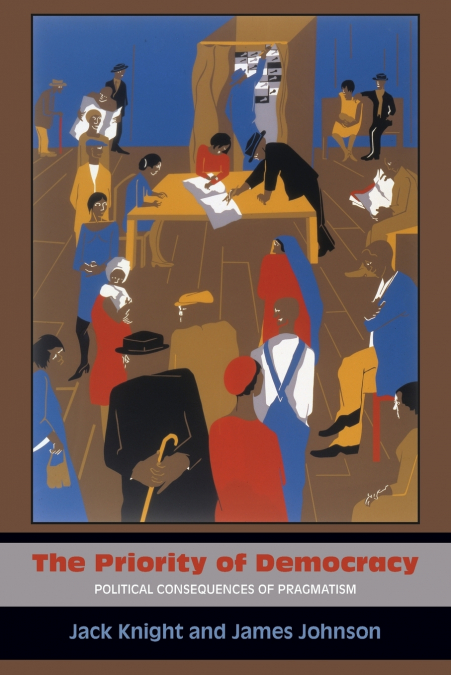

The Priority of Democracy

The Priority of Democracy

The Priority of Democracy

Jack Knight / James Johnson

40,09 €
IVA incluido
Disponible
Editorial:
Princeton University Press
Año de edición:
2014
Materia
Estructuras políticas: democracia
ISBN:
9780691163338
40,09 €
IVA incluido
Disponible

Selecciona una librería:

  • Librería Samer Atenea
  • Librería Aciertas (Toledo)
  • Kálamo Books
  • Librería Perelló (Valencia)
  • Librería Elías (Asturias)
  • Donde los libros
  • Librería Kolima (Madrid)
  • Librería Proteo (Málaga)

Why democracy is the best way of deciding how decisions should be madePragmatism and its consequences are central issues in American politics today, yet scholars rarely examine in detail the relationship between pragmatism and politics. In The Priority of Democracy, Jack Knight and James Johnson systematically explore the subject and make a strong case for adopting a pragmatist approach to democratic politics-and for giving priority to democracy in the process of selecting and reforming political institutions.What is the primary value of democracy? When should we make decisions democratically and when should we rely on markets? And when should we accept the decisions of unelected officials, such as judges or bureaucrats? Knight and Johnson explore how a commitment to pragmatism should affect our answers to such important questions. They conclude that democracy is a good way of determining how these kinds of decisions should be made-even if what the democratic process determines is that not all decisions should be made democratically. So, for example, the democratically elected U.S. Congress may legitimately remove monetary policy from democratic decision-making by putting it under the control of the Federal Reserve.Knight and Johnson argue that pragmatism offers an original and compelling justification of democracy in terms of the unique contributions democratic institutions can make to processes of institutional choice. This focus highlights the important role that democracy plays, not in achieving consensus or commonality, but rather in addressing conflicts. Indeed, Knight and Johnson suggest that democratic politics is perhaps best seen less as a way of reaching consensus or agreement than as a way of structuring the terms of persistent disagreement.


Artículos relacionados

  • Argumentos de filosofía política de la tercera y cuarta transformaciones de México. Una aproximación interdisciplinar
    Ana Paola Tiro Chagoyán / Virginia Aspe Armella
    Presentamos al lector el tercero de los tres libros que fueron resultado del proyecto de investigación semilla Fondo Fomento a la Investigación de la Universidad Panamericana que en nuestro caso fue titulado Argumentos de filosofía política de las cuatro transformaciones de México, etapa primera, la Ilustración mexicana de los siglos XVIII y primeros años del XIX, la Independen...
    Disponible

    30,68 €

  • Making Democracy Fun
    Josh A. Lerner
    ...
    Disponible

    33,87 €

  • Resist Turbulent Times
    Verda Harris-Olayinka
    Resist Turbulent Times is for Everyday People and College students (who are also Everyday Ppl) - and their professors who assign textbooks for their students.Verda H. Olayinka followed the advice of noted Kemetic (African) American visionary, Harold Cruse who advised theCultural Intellectual to 'Synthesize a Black Social Science methodology in the process of developing a functi...
    Disponible

    16,64 €

  • By Executive Order
    Andrew Rudalevige
    How the executive branch-not the president alone-formulates executive orders, and how this process constrains the chief executive’s ability to act unilaterallyThe president of the United States is commonly thought to wield extraordinary personal power through the issuance of executive orders. In fact, the vast majority of such orders are proposed by federal agencies and shaped ...
    Disponible

    43,00 €

  • The Autocratic Middle Class
    Bryn Rosenfeld
    How middle-class economic dependence on the state impedes democratization and contributes to authoritarian resilienceConventional wisdom holds that the rising middle classes are a force for democracy. Yet in post-Soviet countries like Russia, where the middle class has grown rapidly, authoritarianism is deepening. Challenging a basic tenet of democratization theory, Bryn Rosenf...
    Disponible

    163,52 €

  • The Autocratic Middle Class
    Bryn Rosenfeld
    How middle-class economic dependence on the state impedes democratization and contributes to authoritarian resilienceConventional wisdom holds that the rising middle classes are a force for democracy. Yet in post-Soviet countries like Russia, where the middle class has grown rapidly, authoritarianism is deepening. Challenging a basic tenet of democratization theory, Bryn Rosenf...
    Disponible

    54,14 €