
Inicio > Matemáticas y ciencia > Ciencia: cuestiones generales > The ’New’ Science of Scientific Writing
The ’New’ Science of Scientific Writing

The ’New’ Science of Scientific Writing

George David Gopen

21,41 €
IVA incluido
Disponible
Editorial:
Wimbledon Publishing
Año de edición:
2026
Materia
Ciencia: cuestiones generales
ISBN:
9781801360937
21,41 €
IVA incluido
Disponible

Selecciona una librería:

  • Librería Samer Atenea
  • Kálamo Books
  • Librería Elías (Asturias)
  • Librería Kolima (Madrid)
  • Librería Proteo (Málaga)

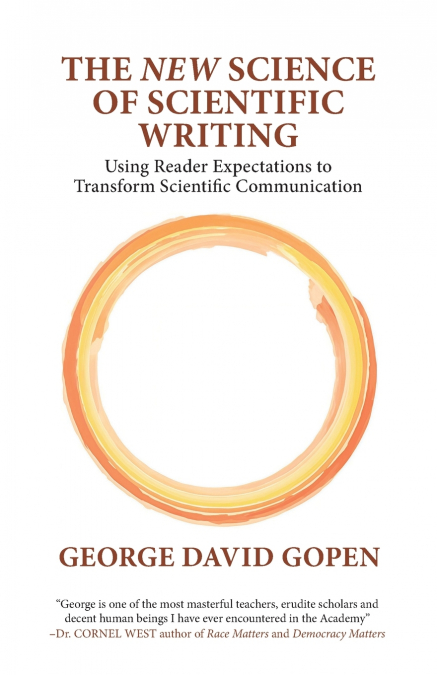
A practical guide to scientific writing that applies George David Gopen’s Reader Expectation Approach to help researchers communicate with greater clarity, precision, and reader impact.For more than three decades, George David Gopen’s Reader Expectation Approach (REA) has transformed how scientists, researchers, and professionals write-not by prescribing rules, but by revealing how readers read. REA was first introduced in his highly acclaimed 1990 American Scientist article, 'The Science of Scientific Writing,' co-authored with Judith A. Swan, which has become the publication’s second most viewed online article-approaching 148,000 views since 2017. The framework rests on a deceptively simple insight: Readers of English have unconscious expectations about where in a sentence they will find certain kinds of information. When writers fulfill those expectations, readers can easily interpret the meaning the writer intended. When writers violate reader expectations, even the most accurate science becomes difficult to follow, not because the ideas are complex, but because the prose is working against the reader’s natural interpretive process. The New Science of Scientific Writing expands and deepens Gopen’s foundational work, drawing on decades of his teaching across research universities, national laboratories, medical schools, law firms, and corporations worldwide. Where other writing guides offer style rules and structural templates, Gopen offers something more fundamental: A cognitive account of how meaning is made. REA was developed independently through observation and practice, and has been corroborated by findings in cognitive psychology, psycholinguistics, and discourse analysis. Its applications extend across every form of scientific communication-from peer-reviewed manuscripts and grant proposals to computer programming, research presentations, and science education. Scientists who learn REA do not merely write more clearly; they think more precisely, because the discipline of structuring prose for a reader’s expectations forces a writer to confront exactly what they are communicating will be interpreted. This book arrives at a critical moment for global science communication. With millions of non-native English speakers required to publish in English-language journals, and with research funding increasingly contingent on the clarity of grant proposals, the need for a principled, reader-centered writing framework has never been greater. For scientists whose careers depend on being understood-and whose funding depends on making reviewers believe-this book offers what no style guide can: a principled account of how readers make meaning and a practical method for working with that process rather than against it. 6

Artículos relacionados

  • Cases on Research-Based Teaching Methods in Science Education
    Eugene de Silva
    While the great scientists of the past recognized a need for a multidisciplinary approach, today’s schools often treat math and science as subjects separate from the rest. This not only creates a disinterest among students, but also a potential learning gap once students reach college and then graduate into the workforce. Cases on Research-Based Teaching Methods in Science Educ...
  • Enhancing Qualitative and Mixed Methods Research with Technology
    Shalin Hai-Jew
    In light of the expensive nature of quantitative research, such as experiments, researchers must seek other methods of understanding the world around them. As such, new qualitative methods are gaining ground in the modern research community. Enhancing Qualitative and Mixed Methods Research with Technology explores the integration of new digital tools into the research process. ...
  • Emerging Research on Bioinspired Materials Engineering
    Mohamed Bououdina
    Bioinspired materials can be defined as the organic or inorganic materials that mimic naturally occurring substances. With applications in a number of fields such as biomedical, chemical, mechanical, and civil engineering, research on the development of biologically-inspired materials is essential to further advancement. Emerging Research on Bioinspired Materials Engineering pr...
  • Contemporary Knowledge and Systems Science
    As branches of research and knowledge continue to expand, platforms for gathering and understanding new information become important aspects of organizational improvement. Contemporary Knowledge and Systems Science provides emerging research on the methods and applications of knowledge systems in social science, economics, and technological developments. While highlighting topi...
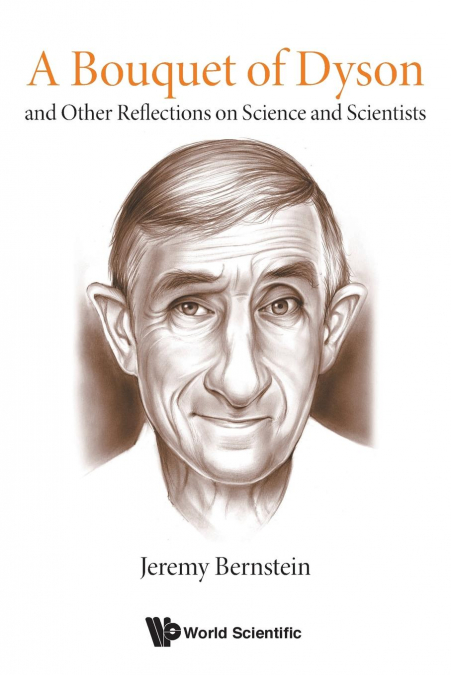
  • BOUQUET OF DYSON, A
    BERNSTEIN JEREMY / Jeremy Bernstein
    University of Texas at Austin My friendship with Freeman Dyson goes back over a half century. My first contact with him goes back to the late 1950s, when I was at the Institute for Advanced Study, and then evolved when I was a consultant at General Atomics in La Jolla, California. Freeman was then trying to design a space ship — the Orion — which would be propelled by atomic bo...
    Disponible

    33,35 €

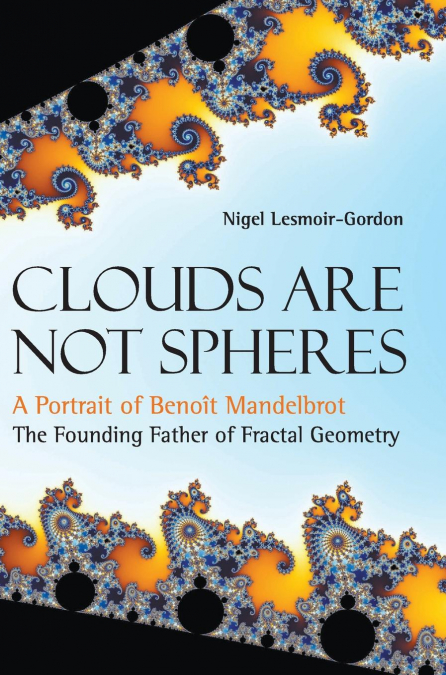
  • CLOUDS ARE NOT SPHERES
    LESMOIR-GORDON NIGEL / NIGEL LESMOIR-GORDON
     The time is right, following Benoît Mandelbrot's death in 2010, to publish this landmark book about the life and work of this maverick math genius.This compact book celebrates the life and achievements of Benoît Mandelbrot with the ideas of fractals presented in a way that can be understood by the interested lay-person. Mathematics is largely avoided. Instead, Mandelbrot&#...