 Librería Samer Atenea
 Kálamo Books
 Librería Elías (Asturias)
 Librería Kolima (Madrid)
 Librería Proteo (Málaga)
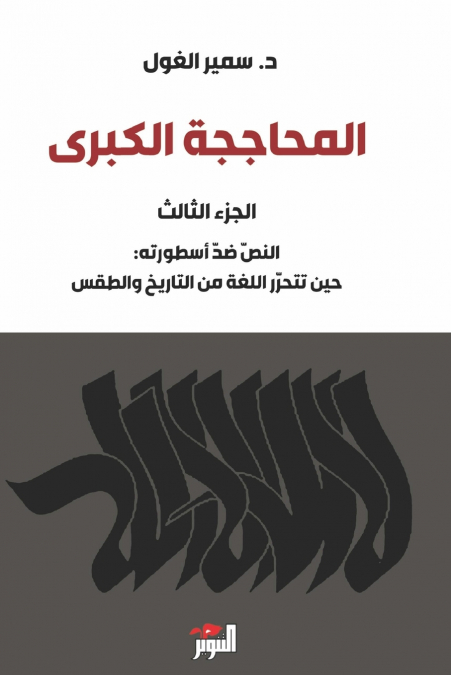
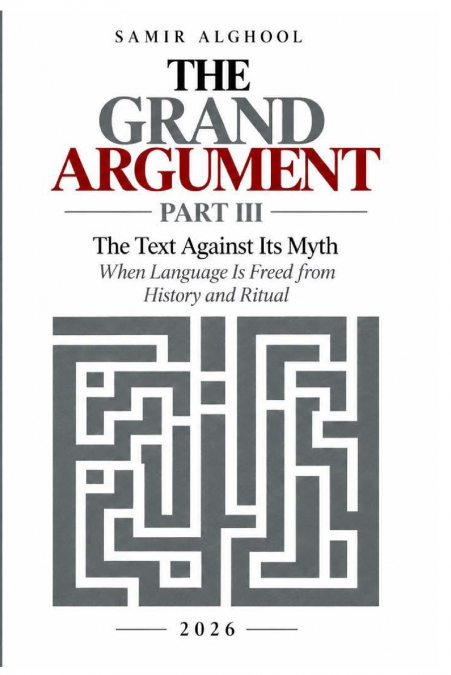
The Grand Argument - Part ThreeThe Text Against Its Myth: When Language Breaks Free from History and RitualWhat happens when we take a text that has accumulated centuries of interpretation, tradition, and ritual, and examine it from within-apart from the images shaped by memory and history?After Part One uncovered the structure from which meaning begins, and Part Two moved from the letter to the name and the ideas it carries about God, humanity, consciousness, and evil, Part Three takes the most ambitious step: applying the method to the text itself, especially where language has become deeply entangled with history and inherited tradition.The question is no longer about a single letter or name.It becomes:What does the text say when we read its language before we read its history?The investigation begins by examining the relationship between Isra’ and Israel, and exploring whether movement and migration might extend beyond a particular historical narrative into a broader principle governing human communities, their development, and coexistence.But the most radical shift comes with Hajj-the pilgrimage.Here, the method confronts one of the most established readings in religious history. Was Hajj, in its original linguistic structure, simply a description of a ritual practice-or does analysis of the word itself lead toward argument, proof, reasoning, and the establishment of evidence?The question is whether the language itself supports the meaning that history has given the word.The book then turns to its own method. Can the framework developed throughout this investigation constitute a system capable of measurement, replication, prediction, and falsification-or is it simply a coherent interpretive construction?The method is examined through independence, prediction, reproducibility, internal consistency, and compatibility with modern scientific knowledge, while being placed in critical dialogue with linguistics, philosophy, and cognitive linguistics.No conclusion is imposed in advance. If a hypothesis withstands testing, it remains open to further development; if it does not, it must be reconsidered. The value of the method lies not in protecting a predetermined conclusion, but in creating a framework in which conclusions can be challenged.And here, the circle closes.The book is not simply trying to replace an old interpretation with a new one. It searches for the distance between the text and what has been built around it-between language and history, meaning and memory, and what a word actually says and what human beings have come to see in it.If Part One opened the door of the letter, and Part Two crossed the threshold of the name, Part Three enters the text as a whole-and ultimately turns back to question the very instrument through which the text has been read.At its conclusion, The Grand Argument does not offer a closed certainty. It returns the question to the reader:What if the myth we have built around the text has been hiding what the text itself is saying?If Part One asked:How does language work?And Part Two asked:What has language done to humanity by naming the things it could not explain?Then Part Three asks the final question:What remains of the text when language is placed against history, and meaning against myth?