 Librería Samer Atenea
 Kálamo Books
 Librería Elías (Asturias)
 Librería Kolima (Madrid)
 Librería Proteo (Málaga)
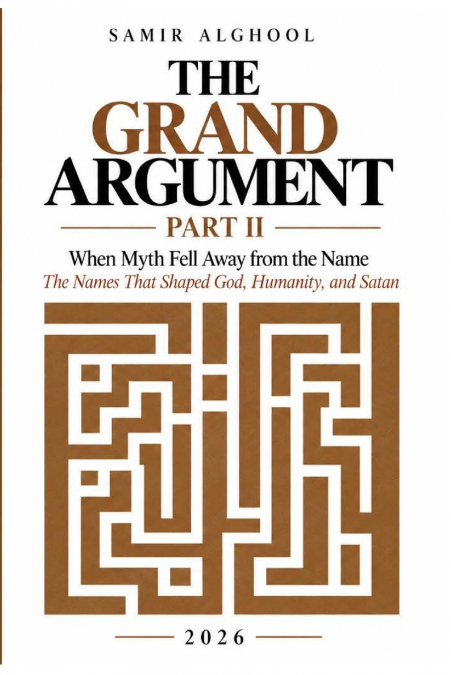
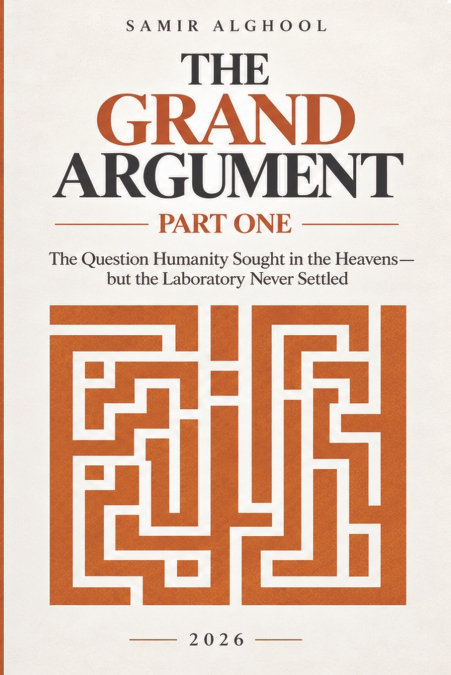
The Grand Argument - Part OneWhen Language Answered a Question Humanity Had Pursued in the Heavens and the LaboratoryCould there be a deeper order behind the apparent order of existence? And is it possible to find evidence that does not depend on inherited belief, but can instead be examined, analyzed, and tested?For thousands of years, humanity has looked to the heavens for answers to this question. Modern science then pursued it in the laboratory. But what if part of the answer has been hiding somewhere much closer to us all along-in language itself?In The Grand Argument - Part One, the question shifts from 'What does the text say?' to a more fundamental one:'How does the text work?'The book begins with the premise that language may be more than a tool for describing the world. It may be a system whose internal structure contains relationships that can be discovered, analyzed, and tested. From this starting point, the investigation moves from the letter and the sound to the word and its meaning, and from linguistic structure to deeper questions about consciousness and existence.The author places language under the microscope, beginning with a comparison of the ancient languages that helped shape humanity’s religious thought-from Hebrew, to the Aramaic spoken by Jesus, and finally to the Arabic in which the Qur’an was written. Language is then examined almost as one would examine a phenomenon in the laboratory, drawing on linguistics, semantic analysis, philosophy, information and systems theory, and the logic of reproducible testing.At the heart of the investigation is an analytical method that explores the relationship between sound and meaning. The method is then tested across a range of phenomena-from the names of metals, colors, and numbers to the internal structure of words-before reaching one of the most intriguing and controversial linguistic phenomena in the Qur’an: the Disjointed Letters that appear at the beginning of certain chapters.Here, the analysis leads toward a possibility very different from traditional assumptions about the nature and function of language, opening another way of thinking about the relationship between language, meaning, humanity, and existence.The question is not whether the reader accepts or rejects a particular religious interpretation. The book deliberately sets that question aside in order to ask something else:Can language reveal an internal order that can be observed, measured, and tested?And if a letter carries a structural regularity beyond its basic phonetic function, could language be connected to something deeper in the way human beings organize and perceive reality?This book does not offer a ready-made certainty, nor does it ask the reader to accept a predetermined conclusion. Instead, it invites the reader into a laboratory within language itself-where words become objects of analysis, hypotheses become testable, and conclusions remain open to scrutiny, criticism, and revision.It is a journey that begins with a question that is as old as human consciousness:Is there an order behind our existence?But it leads to a question much closer to home:What if that order has left its imprint on the way we speak?The Grand Argument - Part One is not a book about faith so much as a book about evidence, language, meaning, consciousness, and the search for an underlying order within what appears familiar.You are not asked to believe.You are asked to test.