 Librería Samer Atenea
 Kálamo Books
 Librería Elías (Asturias)
 Librería Kolima (Madrid)
 Librería Proteo (Málaga)
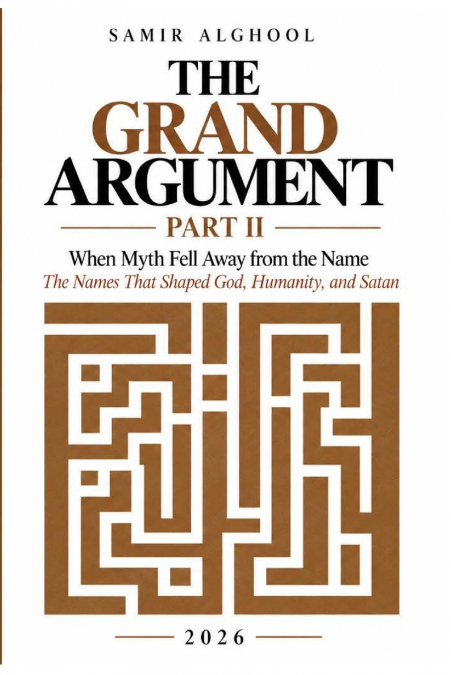
The Grand Argument - Part TwoWhen Myth Fell Away from the Name: The Names That Shaped God, Humanity, and SatanAfter Part One moved from the letter and sound to the inner structure of language, The Grand Argument - Part Two takes the next step: from the letter to the name.What happens when influential names are separated from the myths, images, fears, and interpretations accumulated around them?This volume examines names that have shaped human consciousness: Allah, the Word, Revelation, the Angels, the Spirit, the Self, Iblis, Satan, the Believer, the Disbeliever, the Jew, the Christian, the Magian, and the Polytheist.The question is not simply What do these names mean? It is more fundamental:What does language reveal when a name is returned to its linguistic structure?Using the method developed in Part One, the book examines letters, sounds, roots, morphology, context, and relationships between words, asking whether these structures reveal meanings beneath the interpretations history has built around them.At the center stands the name Allah. Rather than beginning with an inherited image of God, the analysis begins with the name itself. What remains when the name is examined before the myths and assumptions surrounding it?The same approach is applied to the Spirit and the Self, concepts long associated with mystery and the unseen. Their linguistic and contextual structures are examined to ask:How does language shape the way human beings understand consciousness and themselves?The investigation then moves to numbers. The numbers one through ten are examined not merely as instruments of counting, but as linguistic structures whose sequence may represent a progression of formation, perception, and consciousness. Dimensions are then explored as possible levels of consciousness and perception.The inquiry returns to the human being.Terms such as Muslim, believer, Jew, Christian, Magian, disbeliever, and polytheist are reconsidered not simply as fixed identities, but as linguistic structures that may describe states or patterns of consciousness.Was language classifying groups of people-or describing states that can exist within every human being?The analysis of Iblis and Satan follows the same path, examining whether these names may represent forms of disruption within consciousness rather than beginning with the familiar inherited image.Across these investigations, a recurring possibility emerges:A name can become buried beneath the story built around it.Myth can become a layer of meaning accumulated around a name until the image obscures the structure beneath it. To remove that layer is to ask what remains when the name is examined before inherited interpretation speaks for it.If Part One asked:How does language work?Part Two asks a deeper question:What has language done to humanity by giving names to what it could not explain?The Grand Argument - Part Two enters the intersection of language, religion, philosophy, consciousness, and existence, exploring the possibility that names are more than labels: they may be structures through which human beings organize reality, construct identity, understand the divine, and experience the self.This book does not ask you to accept another creed.Look at the name before you look at the myth built around it.