 Librería Samer Atenea
 Kálamo Books
 Librería Elías (Asturias)
 Librería Kolima (Madrid)
 Librería Proteo (Málaga)
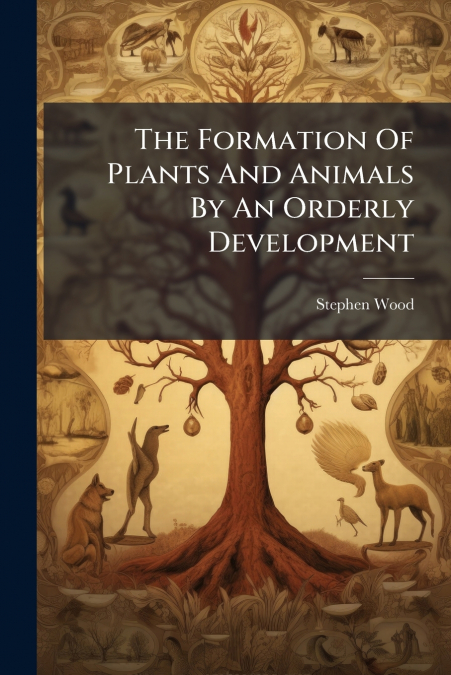
In 'The Formation Of Plants And Animals By An Orderly Development,' Stephen Wood presents a detailed critique of Charles Darwin’s theory of transmutation. This essay challenges the core tenets of Darwin’s evolutionary framework, specifically focusing on the concept of natural selection and its implications for the development of life forms. Wood argues against the idea that species evolve through random variations and environmental pressures, proposing instead that the development of plants and animals follows a more orderly and predetermined path.This work offers a fascinating glimpse into the scientific and philosophical debates surrounding evolution in the late 19th century. It provides a contrasting viewpoint to Darwin’s, appealing to readers interested in the history of science, the intersection of religion and science, and alternative theories of biological development. Wood’s meticulous arguments and detailed observations invite readers to reconsider the foundations of evolutionary theory and explore the complexities of life’s origins.This work has been selected by scholars as being culturally important, and is part of the knowledge base of civilization as we know it. This work was reproduced from the original artifact, and remains as true to the original work as possible. Therefore, you will see the original copyright references, library stamps (as most of these works have been housed in our most important libraries around the world), and other notations in the work.This work is in the public domain in the United States of America, and possibly other nations. Within the United States, you may freely copy and distribute this work, as no entity (individual or corporate) has a copyright on the body of the work.As a reproduction of a historical artifact, this work may contain missing or blurred pages, poor pictures, errant marks, etc. Scholars believe, and we concur, that this work is important enough to be preserved, reproduced, and made generally available to the public. We appreciate your support of the preservation process, and thank you for being an important part of keeping this knowledge alive and relevant.