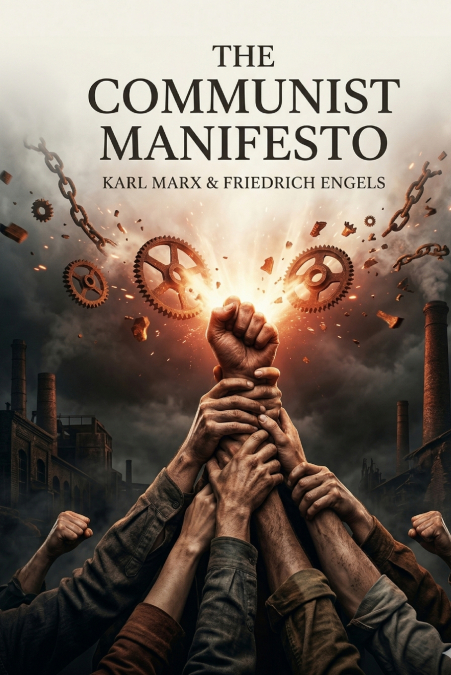

The Communist Manifesto

The Communist Manifesto

Karl Marx

21,86 €
IVA incluido
Disponible
Editorial:
Les prairies numériques
Año de edición:
2026
Materia
Teoría social
ISBN:
9791043137013
21,86 €
IVA incluido
Disponible

Selecciona una librería:

  • Librería Samer Atenea

  • Kálamo Books
  • Librería Elías (Asturias)
  • Librería Kolima (Madrid)
  • Librería Proteo (Málaga)

The Communist Manifesto (German: Das Kommunistische Manifest), originally the Manifesto of the Communist Party (Manifest der Kommunistischen Partei), is a political pamphlet written by Karl Marx and Friedrich Engels. It was commissioned by the Communist League and published in London in 1848. The text represents the first and most systematic attempt by the two founders of scientific socialism to codify for wide consumption the historical materialist idea, namely, that 'the history of all hitherto existing society is the history of class struggles', in which social classes are defined by the relationship of people to the means of production. Published amid the Revolutions of 1848 in Europe, the manifesto has become one of the world’s most influential political documents.In the Manifesto, Marx and Engels combine philosophical materialism with the Hegelian dialectical method in order to analyze the development of European society through its modes of production, including primitive communism, antiquity, feudalism, and capitalism, noting the emergence of a new, dominant class at each stage. The text outlines the relationship between the means of production, relations of production, forces of production, and mode of production, and posits that changes in society’s economic 'base' affect changes in its 'superstructure'. The authors assert that capitalism is marked by the exploitation of the proletariat (working class of wage labourers) by the ruling bourgeoisie, which is 'constantly revolutionising the instruments [and] relations of production, and with them the whole relations of society'.They argue that capital’s need for a flexible labour force dissolves the old relations, and that its global expansion in search of new markets creates 'a world after its own image'.The Manifesto concludes that capitalism does not offer humanity the possibility of self-realization, instead ensuring that human beings are perpetually stunted and alienated. It theorizes that capitalism will bring about its own destruction by polarizing and unifying the proletariat, and predicts that a revolution will lead to the emergence of communism, a classless society in which 'the free development of each is the condition for the free development of all'.[3] Marx and Engels propose the following transitional policies: abolition of private property in land and inheritance; introduction of a progressive income tax; confiscation of emigrants’ and rebels’ property; nationalisation of credit, communication, and transport; expansion and integration of industry and agriculture; enforcement of universal obligation of labour; provision of universal education; and elimination of child labour.[4] The text ends with three rousing sentences, reworked and popularized into the famous slogan of working-class solidarity: 'Workers of the world, unite! You have nothing to lose but your chains'.
Artículos relacionados

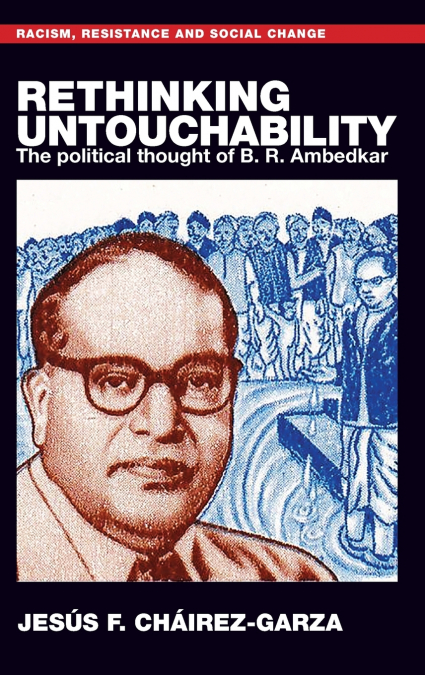
  • Rethinking untouchability
    Jesús F. Cháirez-Garza
    This book examines the transformation of untouchability into a political idea in India during the first half of the twentieth century. At its heart is Ambedkar’s role and the concepts he used to champion untouchability as a political problem. Ambedkar’s main objective was to comprehend the numerous avatars of untouchability in order to eradicate this practice. Ambedkar understo...
  • Islands of Order
    J. Stephen Lansing / Murray P. Cox
    Two pioneering anthropologists reveal how complexity science can help us better understand how societies change over timeOver the past two decades, anthropologist J. Stephen Lansing and geneticist Murray Cox have explored dozens of villages on the islands of the Malay Archipelago, combining ethnographic research with research into genetic and linguistic markers to shed light on...
    Disponible

    37,20 €

  • The Sage Handbook of Global Sociology
    ...
  • Human Rights, Security Politics and Embodiment
    Aneira J. Edmunds
    How have human rights been entangled with state control of the body? And how have they failed to intervene effectively on tipping points such as the US’s endorsement of torture that removes the victim’s control over their own body? This book explores the way institutional human rights have glossed over such abuses and been complicit in security politics which see the Muslim bod...
    Disponible

    35,86 €

  • Better?
    Brian Martin
    Over the past fifty years, have things been getting better or worse? Brian Martin sets out to address this big question by looking at a range of topics, from climate to feminism, from happiness to war, from deschooling to death. Along the way, he offers personal stories and assessments of key studies. This is an invitation to avoid excessive gloom and unwarranted optimism by th...
    Disponible

    27,71 €

Otros libros del autor

  • Economic and Philosophic Manuscripts of 1844
    Karl Marx
    In the Economic and Philosophic Manuscripts of 1844 Marx explains how, under capitalism, people rely on labor to live. In the past people could rely on Nature itself for their natural needs; in modern society, if one wants to eat, one must work: it is only through money that one may survive. Thus, man becomes a slave to his wages. It is only through his work that he can find en...
  • Manifesto of the Communist Party
    Karl Marx
    The Communist Manifesto was first published on February 21, and it is one of the world’s most influential political tracts. Commissioned by the Communist League and written by communist theorists Karl Marx and Friedrich Engels, it laid out the League’s purposes and program. The Manifesto suggested a course of action for a proletarian (working class) revolution to overthrow the ...
  • Contribution à la critique de l’économie politique
    Karl Marx
    Étape essentielle dans l’élaboration de sa pensée économique qui aboutira plus tard au Capital, cet ouvrage de Karl Marx développe sa théorie de la valeur-travail et sa critique systématique des catégories fondamentales de l’économie politique classique, tout en exposant dans sa célèbre préface les grandes lignes du matérialisme historique. Texte fondateur du marxisme économiqu...
    Disponible

    15,20 €

  • Notes on INDIAN HISTORY
    Karl Marx
    Notes on Indian History is a comprehensive and insightful historical study that traces the political, social, cultural, and administrative evolution of India from the Mughal period to the expansion of British rule, covering major dynasties, regional powers, colonial administration, wars, reforms, and significant historical events in a clear and accessible narrative ideal for st...
    Disponible

    19,95 €

  • Complete Works of Karl Marx
    Karl Marx
    NA ...
    Disponible

    33,66 €