 Librería Samer Atenea
 Kálamo Books
 Librería Elías (Asturias)
 Librería Kolima (Madrid)
 Librería Proteo (Málaga)
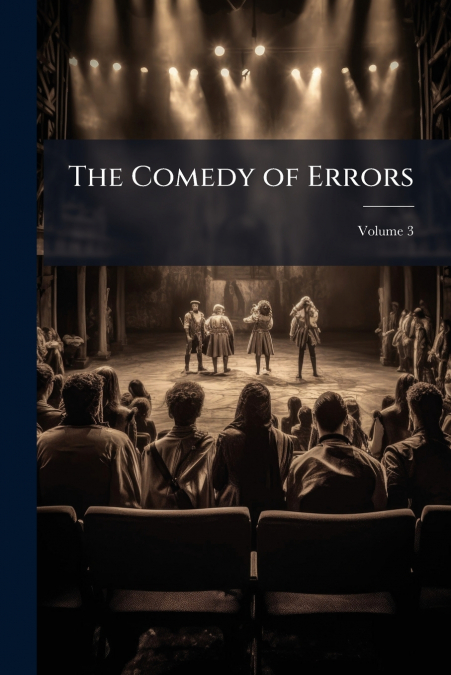
'The Comedy of Errors,' a play by William Shakespeare, is a farcical comedy centered around mistaken identity. The story follows two sets of identical twins, separated at birth, whose unexpected arrival in the same city leads to a series of hilarious confusions and mishaps. Antipholus of Syracuse and his servant, Dromio of Syracuse, arrive in Ephesus, unaware that their identical twins, Antipholus of Ephesus and Dromio of Ephesus, already reside there. As the two pairs unknowingly interact with the residents of Ephesus, chaos ensues, resulting in wrongful beatings, false accusations, and romantic entanglements. Shakespeare’s witty dialogue and clever plot twists create a whirlwind of comedic situations, exploring themes of identity, fate, and the absurdity of human error. 'The Comedy of Errors' remains one of Shakespeare’s most beloved and frequently performed comedies, celebrated for its lightheartedness and enduring appeal.This work has been selected by scholars as being culturally important, and is part of the knowledge base of civilization as we know it. This work was reproduced from the original artifact, and remains as true to the original work as possible. Therefore, you will see the original copyright references, library stamps (as most of these works have been housed in our most important libraries around the world), and other notations in the work.This work is in the public domain in the United States of America, and possibly other nations. Within the United States, you may freely copy and distribute this work, as no entity (individual or corporate) has a copyright on the body of the work.As a reproduction of a historical artifact, this work may contain missing or blurred pages, poor pictures, errant marks, etc. Scholars believe, and we concur, that this work is important enough to be preserved, reproduced, and made generally available to the public. We appreciate your support of the preservation process, and thank you for being an important part of keeping this knowledge alive and relevant.