 Librería Samer Atenea
 Kálamo Books
 Librería Elías (Asturias)
 Librería Kolima (Madrid)
 Librería Proteo (Málaga)
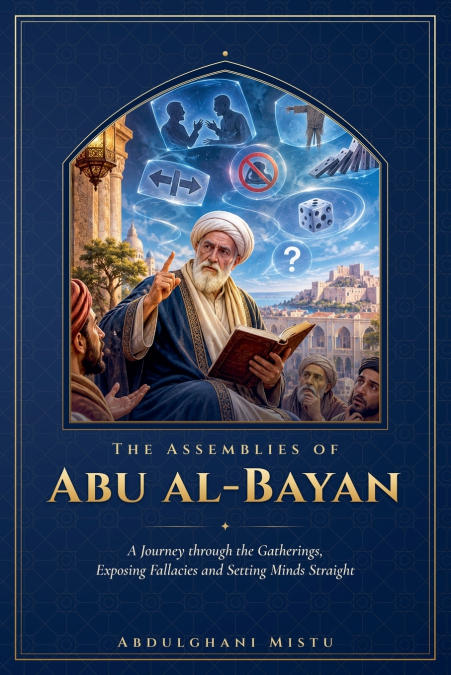
'Most of the falsehood that people believe is believed not because it seemed true but because it seemed reasonable.'The Assemblies of Abu al-Bayan is a book about fallacies told as stories. It takes the form of the maqama, the classical Arabic genre of tales set in gatherings that al-Hamadhani and al-Hariri made famous, and whose name English translators have long rendered as 'assemblies.'In Part One, a young man who was right in an argument and lost it all the same becomes the apprentice of an old bookbinder, the Shaykh. In a workshop where books are taken apart and bound again, he learns the tools of inquiry in ten chapters: what an argument is; validity, truth, and soundness; deduction, induction, and inference to the best explanation; the burden of proof; the unstated premise; the most charitable reading; why a claim that nothing could refute tells us nothing; proportioning belief to the evidence; the difference between a fallacy and a bias; and how to dissect a long piece of discourse.In Part Two he goes out with a notebook to find Abu al-Bayan, a master of eloquence who appears in a different guise at every gathering: a preacher in a pulpit, a thinker at a symposium, a figure on a television screen, a merchant in the market. Across thirty assemblies in five books, the narrator watches him carry audiences with fallacies of language and meaning (equivocation, the loaded question, loaded words), of relevance (the straw man, attacking the speaker, appeals to status, ignorance, emotion, and numbers), of assumption and structure (begging the question, the false dilemma, the slippery slope, false analogy, double standards), of cause and explanation (post hoc reasoning, confusing correlation with causation, theories that explain everything, effects that are never seen), and of number and probability (biased samples, survivorship bias, cherry-picking, neglect of the base rate, the gambler’s fallacy, and figures stripped of their context).Each assembly tells the tale, shows why the trick worked, defines the fallacy and sets out its form, and then draws the dividing line: when the same kind of reasoning is legitimate and sound. It closes with a remedy, with examples from politics, the media, religious discourse and its critics, and everyday disputes, and with exercises. The book draws on the careful methods of the Muslim legal theorists (usul al-fiqh) alongside modern logic and research on cognitive bias, and it takes its examples from every side, because fallacies belong to no single party.There are 195 exercises, forty of them 'binding exercises' that turn the tools on the reader’s own reasoning, with keys to many of the others in an appendix, together with a table of dividing lines, an index of fallacies, and a glossary of Arabic terms. The book’s aim is not a reader who believes nothing, but one who knows why he believes what he believes and proportions his assent to the evidence in his hands.