 Librería Samer Atenea
 Kálamo Books
 Librería Elías (Asturias)
 Librería Kolima (Madrid)
 Librería Proteo (Málaga)
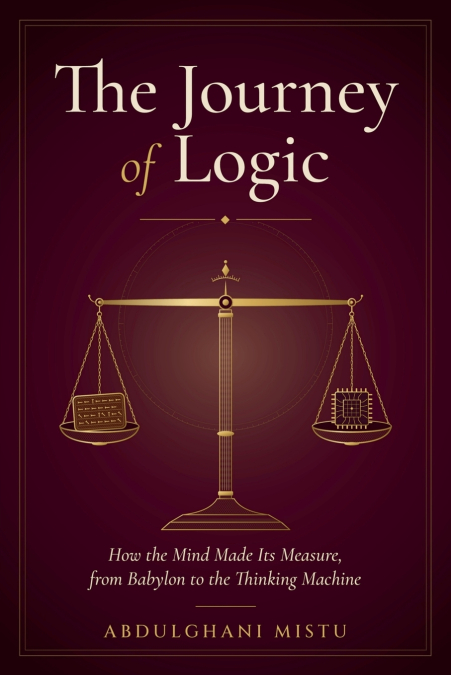
Aristotle did not invent logic. He named it.Long before the Organon, reasoning was already at work in the clay tablets of Babylon, among them the mathematical tablet known as Plimpton 322, in the law code of Hammurabi, the geometry of Egypt, the grammar of Panini, and the moral teaching of ancient China. The Journey of Logic follows this measure of the mind across nearly four thousand years, from the first civilizations to the machines that now reason on our behalf, and asks what became of it in the civilization of Islam.The journey passes through Aristotle and the syllogism that governed reasoning for two thousand years, and through the Stoics, above all Chrysippus, whose five basic forms of argument still underlie every proof and every diagnosis, and whose logic of propositions anticipated modern logic and was then almost entirely lost along with the libraries of Alexandria. It continues to Abbasid Baghdad and the House of Wisdom, where Hunayn ibn Ishaq and the translation movement brought Greek learning into Arabic, and to the three minds who carried logic to its height in Islam: al-Farabi, Ibn Sina (Avicenna), and Ibn Rushd (Averroes). A chapter sets Christianity, Judaism, and Islam side by side, from Tertullian to Thomas Aquinas and from Maimonides to the burning of his books at Montpellier, to show how each faith came to terms with reason.At the heart of the book lies a turning point. Al-Ghazali made logic a condition of sound scholarship and, in the same gesture, fenced it in. Ibn al-Salah declared it forbidden, and Ibn Taymiyya and Ibn al-Qayyim built the most searching case against it; the book reconstructs their arguments in their own terms and contexts rather than as slogans. It then turns to the scholars who defended logic, from Fakhr al-Din al-Razi and al-Amidi to al-Qarafi, Ibn Khaldun, and Muhammad Abduh, and shows how logic, driven out through the front door, kept working through the back: in theology, legal theory, rhetoric, the art of disputation, and grammar, where the famous debate between the grammarian al-Sirafi and the logician Matta ibn Yunus still echoes.The book then steps outside to ask how Western scholars have read this legacy: the German philologists such as Hellmut Ritter and Josef van Ess who restored its standing, Renan and Gibb who belittled it, the gray zone of Massignon and Watt, George Makdisi’s case for the Islamic roots of the college, and the Arab responses of Edward Said and Mohammed Abed al-Jabri. It closes with the break of 1879, when Frege stopped using logic to weigh thought and began to build with it, a road that leads through Russell and Whitehead, Gödel, Turing, Shannon, and the Dartmouth workshop of 1956 to artificial intelligence, and to a hard question about the Arab world’s absence from that story.This is not a textbook of symbolic logic, nor a verdict on the fatwas by the measure of religious law. It is a narrative history of ideas for general readers, students, and anyone curious about how reason came to be measured, and about what a civilization loses when it lets go of the instrument it thinks with. Its author, a scholar of Islamic legal theory and philosophy, writes from inside the tradition he examines, with notes, a chronology, a glossary of terms, and a bibliography for readers who want to go further.