 Librería Samer Atenea
 Kálamo Books
 Librería Elías (Asturias)
 Librería Kolima (Madrid)
 Librería Proteo (Málaga)
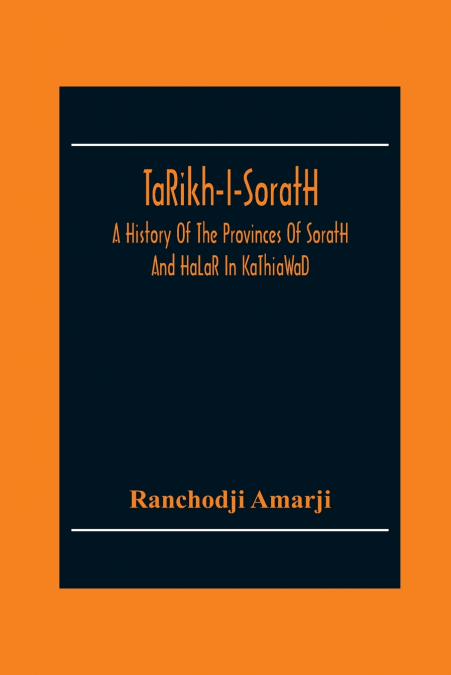
Tarikh-i-Sorath by Ranchodji Amarji brings the provinces of Sorath and Halar into clear historical focus. Rooted in princes and plains.Composed in the milieu of nineteenth-century India, this historical chronicle captures the political texture and local life of the Sorath and Halar region. Amarji’s narrative balances meticulous attention to succession and ceremony with an eye for social detail, making the work valuable both as Indian regional history and as a Kathiawar history book for general readers. The volume maps the activity of regional dynasties in India and the networks of the princely states of India that defined Kathiawar’s political geography, while framing those developments within the wider currents of Gujarat provincial history and colonial administration. For students and scholars it is a rich source for colonial India studies and academic research in India; for Indian history enthusiasts it offers a compelling, grounded account of place. Historically, the book helps fill a gap between imperial records and local memory: by recording local perspectives it illuminates how smaller polities negotiated power, allegiance and continuity in an era of rapid change. Literarily, Amarji’s prose carries the authority of a contemporary observer, granting the text significance beyond mere archival value. That dual character - both documentary and readable - means the chronicle works as a robust addition to any history reference collection and as a rewarding read for those who seek regional voices from nineteenth-century India.Republished by Alpha Editions in a careful modern edition, this volume preserves the spirit of the original while making it effortless to enjoy today - a heritage title prepared for readers and collectors alike. Accessible to casual readers and prized by classic-literature collectors, the edition sits comfortably on both the reading table and the collector’s shelf. Librarians and scholars building a history reference collection or pursuing academic research in India will find this work complements broader studies of the princely states of India and enriches colonial India studies of Gujarat and Kathiawar.