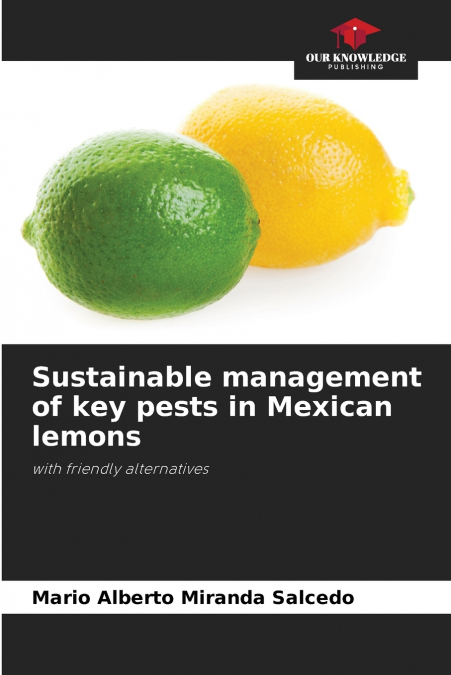

Sustainable management of key pests in Mexican lemons

Sustainable management of key pests in Mexican lemons

Mario Alberto Miranda Salcedo

55,60 €
IVA incluido
Disponible
Editorial:
KS OmniScriptum Publishing
Año de edición:
2024
Materia
Botánica y ciencias de las plantas
ISBN:
9786208024529
55,60 €
IVA incluido
Disponible

Selecciona una librería:

  • Librería Desdémona
  • Librería Samer Atenea
  • Librería Aciertas (Toledo)
  • Kálamo Books
  • Librería Perelló (Valencia)
  • Librería Elías (Asturias)
  • Donde los libros
  • Librería Kolima (Madrid)
  • Librería Proteo (Málaga)

Mexico is the leading producer of Mexican lemons in the world with an area of 120 thousand hectares, Michoacán has 75 thousand hectares, with a production of 900 thousand tons and an economic flow of MNX $ 2,595 billion pesos (SIAP, 2021). On the other hand, citrus trees are attacked by a large number of pests and diseases that affect their vigor, reduce their production, fruit quality and sometimes the loss of trees. These organisms attack various parts of the tree and the Asian citrus psyllid, scales, thrips and spider mites stand out for their importance (Miranda-Salcedo et al., 2020a). Currently, the Asian citrus psyllid Diaphorina citri (Kuwayama) 1908 (Hemiptera: Liviidae) is the most important pest attacking citrus in Mexico. The insect is distributed throughout Mexico (López-Arroyo et al., 2008) and its importance lies in the fact that it is the vector of Huanglongbing (HLB) the most devastating citrus disease, which affects all citrus species and varieties (Bove, 2006; Bassanezi, 2012; Stansly, 2012).

Artículos relacionados

  • Omics in Plant Disease Resistance
    Vijai Bhadauria
    ...
  • Suitable Microbial Strain for Enhanced Production of Laccase
    Lalit Kumar Singh
    Enzymes are known to humanity since ancient times and getting increased impetus in the recent years due to its increasing importance in industries. Proteins enzymes are essentially created by living things to control their biochemical activities. Enzymes can also be thought of as catalysts that speed up biological reactions on their own. Based on their catalysed reaction types,...
  • Abiotic Stress Management
    J. B. GAJERA / S. J. DEVRA / S. P. KACHHADIYA
    'Abiotic Stress Management for Resilient Agriculture' offers a comprehensive guide to addressing environmental challenges in agriculture. This book explores innovative strategies and cutting-edge research to mitigate the impact of abiotic stresses such as drought, salinity, and extreme temperatures on crops. It provides practical insights into sustainable agricultural practices...
  • DEMOGRAFÍA DE LA PALMA DE SIERRA ESPIRITUANA EN BAMBURANAO, CUBA
    Abel Hernández-Muñoz
    Las poblaciones vegetales constituyen en muchos casos, fuentes importantes de recursos en los aspectos agropecuarios, forestales, recreativos y como refugio de fauna, por ello, su estudio es un aspecto necesario a abordar. Dentro de las características de las poblaciones de plantas en general, la densidad y distribución son importantes. La presente obra constituye el primer est...
  • The Green Architecture
    Ali Mirshafieyan / Ghazal Yeganeh / Maryam Zamani Motlagh
    Protecting green energy as well as non-renewable energy, as well as their sustainable use, many advances in the technology of extracting oil products and other reserves under the ground have caused many improvements. In this regard, proposing the design of buildings in which the consumption of fossil fuels reaches its lowest level is considered one of the important solutions in...
    Disponible

    82,54 €

  • Caractérisation des plantes envahissantes des marais
    Frédéric BANGIRINAMA / Jean Bosco Igirukwishaka
    Les invasions biologiques constituent la seconde source de destruction des écosystèmes. Mais les connaissances sur les taxons envahissants restent lacunaires au Burundi. Pour appuyer les gestionnaires des plantes envahissantes, une étude a été conduite dans les marais de la rivière Ruvubu, la plus importante rivière du Burundi. L’objectif étant de : Faire un inventaire floristi...

Otros libros del autor

  • Nachhaltiges Management der wichtigsten Schädlinge an mexikanischen Zitronen
    Mario Alberto Miranda Salcedo
    Mexiko ist mit einer Anbaufläche von 120.000 ha der weltweit führende Produzent mexikanischer Zitronen, Michoacán verfügt über 75.000 ha, mit einer Produktion von 900.000 t und einem wirtschaftlichen Umsatz von MNX $ 2.595 Milliarden Pesos (SIAP, 2021). Andererseits werden Zitrusbäume von einer Vielzahl von Schädlingen und Krankheiten befallen, die ihre Vitalität beeinträchtige...
    Disponible

    55,72 €

  • Gestion durable des principaux ravageurs des citrons mexicains
    Mario Alberto Miranda Salcedo
    Le Mexique est le premier producteur mondial de citrons mexicains avec une superficie de 120 000 hectares, le Michoacán ayant 75 000 ha, avec une production de 900 000 t et un chiffre d’affaires économique de 2 595 milliards de pesos MNX (SIAP, 2021). D’autre part, les agrumes sont attaqués par un grand nombre de ravageurs et de maladies qui affectent leur vigueur, réduisent le...
    Disponible

    55,66 €

  • Gestione sostenibile dei principali parassiti dei limoni messicani
    Mario Alberto Miranda Salcedo
    Il Messico è il principale produttore di limoni messicani nel mondo con una superficie di 120.000 ettari, il Michoacán ne ha 75.000, con una produzione di 900.000 t e un fatturato economico di 2.595 miliardi di pesos (SIAP, 2021). D’altra parte, gli agrumi sono attaccati da un gran numero di parassiti e malattie che ne compromettono il vigore, riducono la produzione, la qualità...
    Disponible

    55,66 €

  • Gestão sustentável das principais pragas dos limões mexicanos
    Mario Alberto Miranda Salcedo
    O México é o principal produtor de limões mexicanos no mundo, com uma área de 120.000 hectares, Michoacán tem 75.000 ha, com uma produção de 900.000 t e um volume de negócios económico de MNX $ 2.595 mil milhões de pesos (SIAP, 2021). Por outro lado, os citrinos são atacados por um grande número de pragas e doenças que afectam o seu vigor, reduzem a sua produção, a qualidade do...
    Disponible

    55,66 €

  • Manejo sustentable de plagas clave del limón mexicano
    Mario Alberto Miranda Salcedo
    México es el primer productor de limón mexicano en el mundo en una superficie de 120 mil hectáreas, Michoacán presenta 75 mil ha, con una producción de 900 mil t y una derrama económica de MNX $ 2,595 mil millones de pesos (SIAP, 2021). Por otra parte, los cítricos son atacados por una gran cantidad de plagas y enfermedades que afectan su vigor, reducen su producción, la calida...
    Disponible

    53,48 €