 Librería Samer Atenea
 Kálamo Books
 Librería Elías (Asturias)
 Librería Kolima (Madrid)
 Librería Proteo (Málaga)
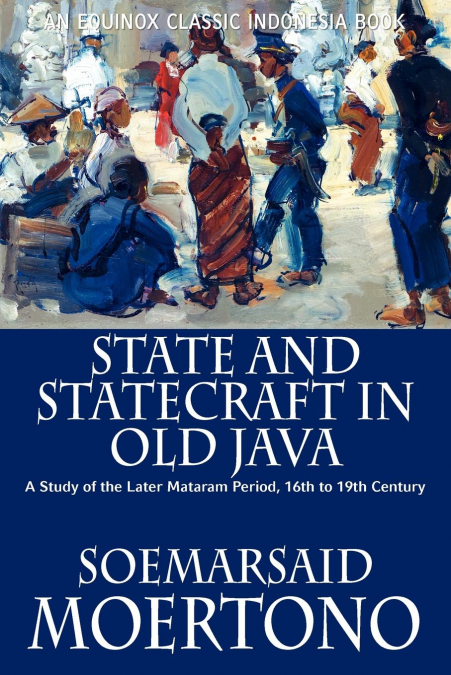
Soemarsaid Moertono was born in East Java in 1922 and entered the Indonesian Civil Service in 1944. In 1962, before he came to the United States, he was teaching at Malang in the Academy of Public Administration under the auspices of the Ministry of Internal Affairs. In 1964 he successfully submitted this study as a M.A. thesis in the Department of History, Cornell University. Several Indonesian Dutch scholars, as well as contemporary Dutch observers, have examined aspects of Javanese government during the Later Mataram period, but few studies are at present available in the English language. The outstanding exception, to which Mr. Moertono pays tribute, is the late Professor Schrieke's Indonesian Sociological Studies, Volume II, The Hague, 1957, which is a translation of some of Professor Schrieke's unpublished manuscripts.In addition to published Dutch sources, Mr. Moertono has used his own substantial knowledge of Javanese literature, and, as a result, the reader of this study has the sensation that he is being helped to see the situation in Later Mataram from within. The reader will become aware of the rich contents of the Javanese sources, for which Dr. Th. G. Th. Pigeaud has recently provided a valuable survey in the first volume of his Literature of Java, The Hague, 1967. Perhaps students will be attracted to the study of the almost entirely unexplored Javanese context of Dutch activities in Java.Students of contemporary and near-contemporary Java will certainly wish to take into account the background of political ideas which Mr. Moertono has reconstructed and analyzed. Readers will use this study for a variety of purposes in addition to its contribution to the history of the Later Mataram period. For example, some of the technical terms for describing the attributes of kingship are derived from Sanskrit, and they are also found in Cambodian epigraphy and can be studied in Professor George Coedès' Inscriptions du Cam-bodge. Thus an aid is offered for the comparative study of government in earlier South East Asia. Another aspect of Mr. Moertono's work which may attract attention is his observations on the education necessary for the cultivation of suitable moral and practical qualities in the service of the king.The reader may ask himself whether he is dealing with increasingly obsolete features of Javanese culture or with a culture which possessed the capacity for self-renewal. This is a question which cannot be broached until scholarship has advanced sufficiently to permit historical insights to be used more appropriately in the study of recent Javanese history. In the meantime, Mr. Moertono has shown that the piwulang genre of literature exemplifies a critical spirit. That the tradition was sensitive to contemporary needs is also suggested by the work of Raden Ngabei Ranggawarsita (1802-1873), regarded by the Javanese as the last great pudjangga. Mr. Moertono notes the suggestion that this person was influenced by Dutch scholars and administrators, and this circumstance may be interpreted as a scholar's facility for adjusting himself to new needs without deserting established values. The continuing process of Javanese adjustment to so-called modern conditions lies outside the scope of this study.The author's achievement has been to illuminate the way Javanese political ideas, though assailed by an unfavorable environment, did not cease to command conviction. Above all, the sense of the dignity of public service and the attribution of high qualities to public servants survived. One may permit oneself the hope that Mr. Moertono will, in spite of his present heavy responsibilities, find time to continue his research into more recent times, once again helping his reader to see the subject from a privileged position inside the tradition. - O.W. Wolters, London, England, 1 May 1968