
START-UP Universal Basic Income

START-UP Universal Basic Income

Don Soards

12,89 €
IVA incluido
Disponible
Editorial:
Auctorem House LLC
Año de edición:
2025
Materia
Empresa y gestión
ISBN:
9781965687642
12,89 €
IVA incluido
Disponible

Selecciona una librería:

  • Librería Samer Atenea
  • Librería Aciertas (Toledo)
  • Kálamo Books
  • Librería Perelló (Valencia)
  • Librería Elías (Asturias)
  • Donde los libros
  • Librería Kolima (Madrid)
  • Librería Proteo (Málaga)

We are concerned about too many human workers being replaced by machines. We should be. The harm we face goes far beyond the trauma faced by individuals who have lost their jobs to machines over past centuries. We are moving deeper into a condition of 'Who do these corporations think is going to buy their stuff after they lay us all off?'. Our economy is getting smaller.Fortunately, there is a way forward that will help all individuals and our society as a whole. First, we must understand the production parabola and its opportunities.Section 1 What is the Production Parabola?Section 2 What side of the Production Parabola are we on?Section 3 What are our Opportunities?Section 4 Legislation to implement UBI Progress DollarsSection 5 Implementation GuidelinesSection 6 Universal Basic Income We can’t get it without Progress DollarsImplementing Progress Dollars will give us the maximum Universal Basic Income currently. UBI will rise with technological progress. This will be accomplished without significant inflation or raising any citizen’s taxes.

Artículos relacionados

  • Managing TrumPolitical Projects
    Yasser Osman
    Corrupt politicians and businessmen have been using construction projects to funnel money to secret projects since the first iron shovels broke ground. Yet today, throughout the world, there is little if any protection from it. In many countries, governments themselves don’t just ignore these affairs. They sponsor them.Individual project managers – hired to manage a project’s o...
    Disponible

    14,97 €

  • Climbing The Ladder
    Delroy Constantine-Simms
    Climbing The Ladder is an introductory book to mentoring, for organizational decision makers, that may be considering, the feasibility of maintaining, adopting and diversify their organizational mentoring strategies.Most importantly, the author explains that mentoring can take the form of a one-time intervention or a lifelong partnership, which can be a formal structured progra...
    Disponible

    96,53 €

  • The Gen-Savvy Financial Advisor
    Cam Marston
    There have been big changes in consumers’ buying habits, and financial services are no exception, says Cam Marston, a world-renowned expert on generational issues in the marketplace. Understanding clients’ age-based points of view is an indispensable soft skill that you can use to establish connections and make sales. New attitudes about investing break down along generationa...
    Disponible

    14,82 €

  • Your First Job
    Mark Blayney
    Each year in the UK approximately half a million young people enter the world of work for the first time and begin to compete in their careers.And how well you cope with the pressures and demands of your first year of work can help determine how successful a career you will go on to have, and how far you will reach.But with Your First Job, you can get an unfair advantage over y...
    Disponible

    7,82 €

  • Successful Customer Relationship Management Programs and Technologies
    Riyad Eid
    The field of Customer Relationship Management (CRM) has broadened greatly in recent years as technological applications have expanded. Successful Customer Relationship Management Programs and Technologies: Issues and Trends offers the latest research and developments for researchers, practitioners, and academics alike. This volume contains case studies, methodologies, framework...
  • Feral Information Systems Development
    Kerr
    Management invests in large information systems in order to improve the effectiveness of their organization. However, when these systems fail to meet the needs of organizational employees, feral information systems (FIS) are created in order to assist workers with their jobs or to avoid existing organizational information systems. Feral Information Systems Development: Manageri...

Otros libros del autor

  • Automation Annuity With Magic Oranges
    Don Soards
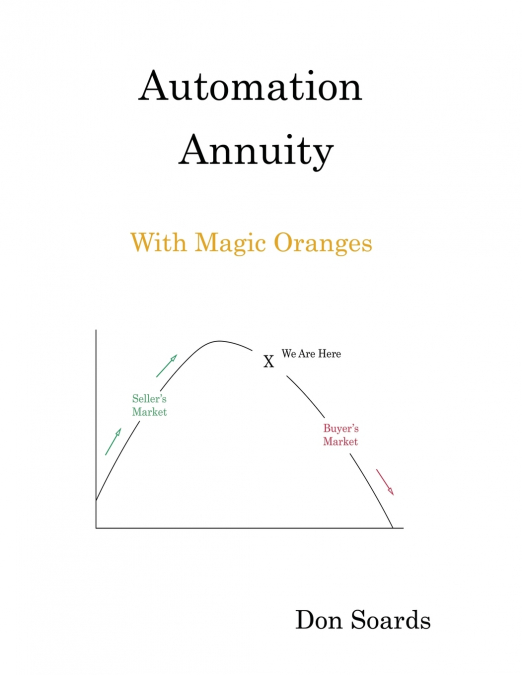
    Automation Annuity with Magic Oranges presents a visionary economic response to the realities of automation. As machines take over more work and traditional wages disappear, economies shift into a dangerous deflationary cycle-what author Don Soards calls the 'buyer’s market' side of the production parabola.The book introduces the Automation Annuity-an innovative income suppleme...
    Disponible

    32,27 €

  • MAXIMUM UBI
    Don Soards
    We are concerned about too many human workers being replaced by machines. We should be. The harm we face goes far beyond the trauma faced by individuals who have lost their jobs to machines over past centuries. We are moving deeper into a condition of 'Who do these corporations think is going to buy their stuff after they lay us all off?'. Our economy is getting smaller.Fortuna...
    Disponible

    42,70 €

  • Progress Dollars From The Production Parabola
    Don Soards
    Since the industrial revolution started in 1800, machines have been taking people’s jobs. For the first two hundred years we prospered from the increasing efficiency. However, in the year 2000, we reached a tipping point where the new technology has taken so many jobs that we can no longer afford to buy all that we can produce. By the year 2006 our gross domestic product per pe...
    Disponible

    28,22 €

  • Progress Dollars From The Production Parabola
    Don Soards
    Since the industrial revolution started in 1800, machines have been taking people’s jobs. For the first two hundred years we prospered from the increasing efficiency. However, in the year 2000, we reached a tipping point where the new technology has taken so many jobs that we can no longer afford to buy all that we can produce. By the year 2006 our gross domestic product per pe...