
Automation Annuity With Magic Oranges

Automation Annuity With Magic Oranges

Don Soards

32,27 €
IVA incluido
Disponible
Editorial:
BookLocker.com Inc
Año de edición:
2025
Materia
Economía política
ISBN:
9781959623601
32,27 €
IVA incluido
Disponible

Selecciona una librería:

  • Librería Samer Atenea
  • Librería Aciertas (Toledo)
  • Kálamo Books
  • Librería Perelló (Valencia)
  • Librería Elías (Asturias)
  • Donde los libros
  • Librería Kolima (Madrid)
  • Librería Proteo (Málaga)

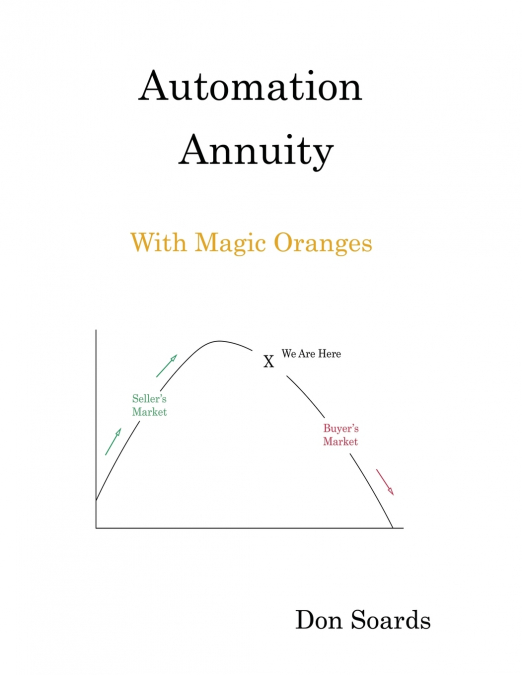
Automation Annuity with Magic Oranges presents a visionary economic response to the realities of automation. As machines take over more work and traditional wages disappear, economies shift into a dangerous deflationary cycle-what author Don Soards calls the 'buyer’s market' side of the production parabola.The book introduces the Automation Annuity-an innovative income supplement funded by 'progress dollars' to help restore purchasing power, protect market stability, and ensure widespread participation in the modern economy. Drawing on decades of economic observation, Soards outlines how public policy can transition from outdated seller’s market logic to a demand-focused economic structure.Accessible yet provocative, the book guides readers through essential ideas such as consumer-driven deflation, structural unemployment, universal basic income, and international coordination in response to automation’s global impact. At its heart lies a simple question: who will buy what the robots make?A practical guide and a philosophical challenge, Automation Annuity with Magic Oranges delivers bold, actionable ideas for anyone concerned about the future of work and the health of our economy.


Artículos relacionados

  • Private Affluence and Public Squalor
    Paul L L Nevins / Paul L Nevins
    Are the values that Americans collectively hold destroying the American Dream? The answer to that question depends upon the answers to some very specific questions. What do we as citizens of the United States believe we owe to one another as citizens? What is the purpose of government? What is of the role of the private enterprise? What is the meaning of equal opportunity? To w...
    Disponible

    24,04 €

  • Of Privacy and Power
    Abraham L. Newman / Henry Farrell
    How disputes over privacy and security have shaped the relationship between the European Union and the United States and what this means for the futureWe live in an interconnected world, where security problems like terrorism are spilling across borders, and globalized data networks and e-commerce platforms are reshaping the world economy. This means that states’ jurisdictions ...
    Disponible

    30,80 €

  • Migration and Democracy
    Abel Escribà-Folch / Covadonga Meseguer / Joseph Wright
    How remittances-money sent by workers back to their home countries-support democratic expansionIn the growing body of work on democracy, little attention has been paid to its links with migration. Migration and Democracy focuses on the effects of worker remittances-money sent by migrants back to their home countries-and how these resources shape political action in the Global S...
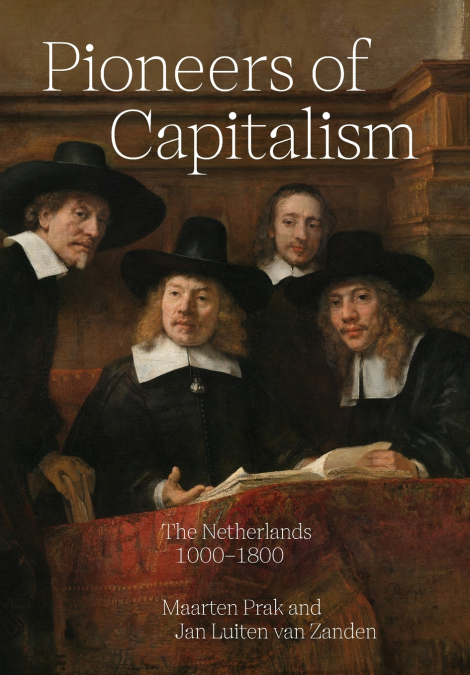
  • Pioneers of Capitalism
    Jan Luiten van Zanden / Maarten Prak / Ian Cressie
    How medieval Dutch society laid the foundations for modern capitalismThe Netherlands was one of the pioneers of capitalism in the Middle Ages, giving rise to the spectacular Dutch Golden Age while ushering in an era of unprecedented, long-term economic growth. Pioneers of Capitalism examines the formal and informal institutions in the Netherlands that made this economic miracle...
  • Pillars of Prosperity
    Timothy Besley / Torsten Persson
    How nations can promote peace, prosperity, and stability through cohesive political institutions'Little else is required to carry a state to the highest degree of opulence from the lowest barbarism, but peace, easy taxes, and a tolerable administration of justice; all the rest being brought about by the natural course of things.' So wrote Adam Smith a quarter of a millennium ag...
    Disponible

    57,93 €

  • Luxury Fever
    Robert H. Frank
    The turn of the twenty-first century witnessed a spectacular rise in gross consumption. With the super-rich setting the pace, everyone spent furiously in a desperate attempt to keep up. As cars and houses grew larger and more expensive, the costs were enormous--not only monetarily but also socially. Consumers spent more time at work and less time with their family and friends; ...
    Disponible

    35,97 €

Otros libros del autor

  • START-UP Universal Basic Income
    Don Soards
    We are concerned about too many human workers being replaced by machines. We should be. The harm we face goes far beyond the trauma faced by individuals who have lost their jobs to machines over past centuries. We are moving deeper into a condition of 'Who do these corporations think is going to buy their stuff after they lay us all off?'. Our economy is getting smaller.Fortuna...
    Disponible

    12,89 €

  • MAXIMUM UBI
    Don Soards
    We are concerned about too many human workers being replaced by machines. We should be. The harm we face goes far beyond the trauma faced by individuals who have lost their jobs to machines over past centuries. We are moving deeper into a condition of 'Who do these corporations think is going to buy their stuff after they lay us all off?'. Our economy is getting smaller.Fortuna...
    Disponible

    42,70 €

  • Progress Dollars From The Production Parabola
    Don Soards
    Since the industrial revolution started in 1800, machines have been taking people’s jobs. For the first two hundred years we prospered from the increasing efficiency. However, in the year 2000, we reached a tipping point where the new technology has taken so many jobs that we can no longer afford to buy all that we can produce. By the year 2006 our gross domestic product per pe...
    Disponible

    28,22 €

  • Progress Dollars From The Production Parabola
    Don Soards
    Since the industrial revolution started in 1800, machines have been taking people’s jobs. For the first two hundred years we prospered from the increasing efficiency. However, in the year 2000, we reached a tipping point where the new technology has taken so many jobs that we can no longer afford to buy all that we can produce. By the year 2006 our gross domestic product per pe...