
Inicio > Matemáticas y ciencia > Biologia, ciencias de la vida > Botánica y ciencias de las plantas > Secondary Metabolites Based Green Synthesis of Nanomaterials and Their Applications
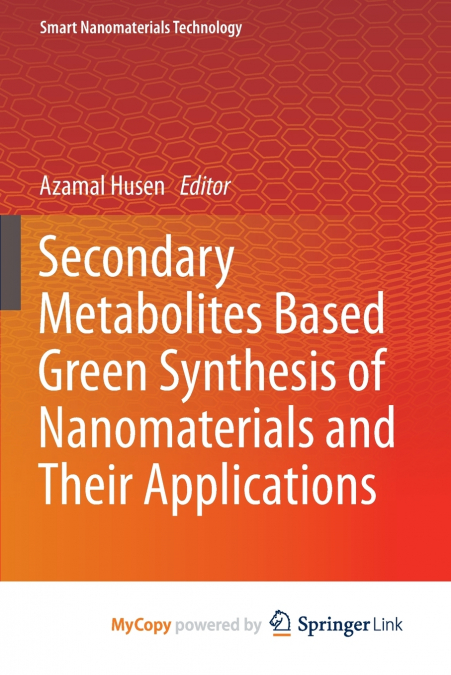
Secondary Metabolites Based Green Synthesis of Nanomaterials and Their Applications

Secondary Metabolites Based Green Synthesis of Nanomaterials and Their Applications

Azamal Husen

47,46 €
IVA incluido
Disponible
Editorial:
Springer Nature B.V.
Año de edición:
2023
Materia
Botánica y ciencias de las plantas
ISBN:
9789819909285
47,46 €
IVA incluido
Disponible

Selecciona una librería:

  • Librería Samer Atenea
  • Librería Aciertas (Toledo)
  • Kálamo Books
  • Librería Perelló (Valencia)
  • Librería Elías (Asturias)
  • Donde los libros
  • Librería Kolima (Madrid)
  • Librería Proteo (Málaga)

Nanotechnology is gaining importance in every field of science and technology. Green synthesis of nanomaterials involves the use of microorganisms such as bacteria, fungi, viruses; and different lower and higher plants. Green synthesis of nanomaterials from plant extracts becoming popular in comparison to synthesis using microorganisms. Plant based-nanomaterials synthesis is easy, have no need to bring back from the culture medium, and is safe. Additionally, plant-based nanomaterials are eco-friendly, in comparison to physical and chemical modes of synthesis. Several lower and higher plants are rich in terms of secondary metabolites. These metabolites have been used as medicine in crude extract form or with some other formulations. They have been also used to isolate the bioactive compounds in modern medicine as well as in herbal medicine systems. Thus, phytochemicals present in the plant and their parts play an important role in nanomaterials synthesis, mainly due to the presence of a significant number of secondary metabolites, for instance, alkaloids, flavonoids, saponins, steroids, tannins, etc. Further, essential and aromatic oils have been also explored for nanomaterials synthesis, and they are also equally useful in terms of their various biological applications. These organic ingredients come from a wide range of plant components, such as leaves, stems, roots, shoots, flowers, bark, and seeds. Globally, the presence of different plants has shown a capability to produce huge and diverse groups of secondary metabolites. The functional groups present in the plant extract acts as capping and stabilizing agent. Most of the time, pure isolated bioactive compounds are more biologically active; hence scholars are focusing their research on the synthesis of nanomaterials using some particular class of secondary metabolites. Investigations have shown that the green synthesized nanomaterials were found to be more biologically active in comparison to chemicallysynthesized nanomaterials. These nanomaterials and or nanocomposites found different applications especially in drug delivery, detection and cure of cancer cells, diagnosis of a genetic disorder, photoimaging, and angiogenesis detection. They have also shown several applications in agricultural, horticultural as well as forestry sectors. The book in hand covers a wide range of topics as mentioned above. It incorporates chapters that the authors have skilfully crafted with clarity and precision, reviewing up-to-date literature with lucid illustrations. The book would cater to the need of graduate students as a textbook and simultaneously be useful for both novices and experienced scientists and or researchers working in the discipline of nanotechnology, nanomedicine, medicinal plants, plant science, economic botany, chemistry, biotechnology, pharmacognosy, pharmaceuticals, industrial chemistry, and many other interdisciplinary subjects. It should also inspire industrialists and policy makers associated with plant-based nano products.

Artículos relacionados

  • Recent Advances in Energy Storage Materials and Devices
    Li Lu
    In the Li-ion battery, Ions’ transportation between positive and negative electrodes relies on organic-based electrolyte with a low flammable point. Therefore, use of this type of electrolyte lead to a lot of safety issues. In addition, the potential window of commercially available organic electrolyte is only up to about 4.5V, resulting that those cathode materials with high p...
    Disponible

    132,86 €

  • Surface Engineering Techniques and Applications
    Loredana Santo / Paulo Davim
    Surface engineering includes many facets of materials science that help regulate the function, quality, and safety of products such as automotive, textile, and electronic materials. New technologies are developing to help enhance the surface performance. Surface Engineering Techniques and Applications: Research Advancements provides recent developments in surface engineering te...
  • Technological Applications of Nano-Hybrid Composites
    In the midst of our contemporary and swiftly evolving technological landscape, the pressing issue lies in the need for multifunctional materials that can transcend traditional boundaries and fuel innovation across diverse industries. This demand arises from the relentless pursuit of greater performance, efficiency, and adaptability in sectors ranging from electronics to aerospa...
  • Rheology Step 1
    Annika Sahlström
    This book is covering the basics of rheology and is based on knowledge gained during many years of both practical and theoretical work with rheological challenges in most industrial branches. It serves to help the reader to gain the understanding needed to plan, perform and interpret rheological measurements to study material properties at rest and during flow. This book is bas...
    Disponible

    72,86 €

  • Advancements in Powder Metallurgy
    Advancements in Powder Metallurgy: Processing, Applications, and Properties addresses a critical issue in academic scholarship by providing a comprehensive resource that has been lacking in the field. Existing books often fall short by merely covering the basics of powder preparation, sintering methods, and general applications, leaving scholars with a limited understanding of ...
  • Advancements in Powder Metallurgy
    Advancements in Powder Metallurgy: Processing, Applications, and Properties addresses a critical issue in academic scholarship by providing a comprehensive resource that has been lacking in the field. Existing books often fall short by merely covering the basics of powder preparation, sintering methods, and general applications, leaving scholars with a limited understanding of ...
    Disponible

    274,93 €

Otros libros del autor

  • Enhanced Crop Production Setup Under Various Micro and Nano Contaminants
    Azamal Husen
    This book explores the uptake, toxicity, and tolerance of various contaminants in crop plants and discusses genetic and molecular methods, as well as biological tools, to improve plant growth under contamination stress. The book also covers defense mechanisms in plants using phytohormones and nanomaterials, along with safety concerns related to micro and nano-contaminants. Cont...
  • Nanobiotechnology for Abiotic Stress Adaptation and Mitigation in Agricultural Crops
    Azamal Husen
    Nanobiotechnology has emerged as an innovative and rapidly advancing field that combines the progress of nanotechnology with biological sciences, especially cellular and molecular biology. Several metal and metal-oxide nanoparticles (NPs) have shown great potential in boosting the performance of agricultural crops under challenging conditions. NPs enhance plant resistance to st...
  • Nanobiosensors for Agricultural and Other Related Sectors
    Azamal Husen
    This book explores the transformative role of nanotechnology in modern farming. With a focus on nanosensors and nanobiosensors, this book highlights their growing applications in agriculture to monitor critical environmental and agricultural factors. Nanosensors, utilizing advanced materials like carbon nanotubes and quantum dots, offer solutions for detecting pollutants, measu...
  • Emerging Carbon Nanomaterials for Sustainable Agricultural Practices
    Azamal Husen
    The potential use of carbon-based nanomaterials in overall plant systems has not yet received much research, and the results that have been reported are typically descriptive and inconsistent with little knowledge of the underlying mechanisms of action. Changes in gene expression and enhanced ROS production are among the physiological processes that may be impacted by interacti...
  • Plant Response to Silver Nanoparticles
    Azamal Husen
    This book looks at the plant response to silver nanoparticles (Ag-NPs), which showed both beneficial and harmful effects in a plant system. These responses of Ag-NPs are primarily dependent on the concentration, plant species or cultivars, exposure time, shape, and size of NPs. In general, lower concentrations of Ag-NPs increase seed germination, rate of photosynthesis, and ove...
  • Agricultural Crop Improvement
    Azamal Husen
    Agricultural Crop Improvement: Plant and Soil Relationships addresses key issues of crop plants yield and production, with molecular and physiological interventions to evolve future strategies that will overcome these challenges faced by the agricultural sector. ...