
Returning to Q’ero

Returning to Q’ero

Steven Webster

168,51 €
IVA incluido
Consulta disponibilidad
Editorial:
Springer Nature B.V.
Año de edición:
2023
Materia
Antropología
ISBN:
9783031049712

Selecciona una librería:

  • Librería Samer Atenea
  • Librería Aciertas (Toledo)
  • Kálamo Books
  • Librería Perelló (Valencia)
  • Librería Elías (Asturias)
  • Donde los libros
  • Librería Kolima (Madrid)
  • Librería Proteo (Málaga)

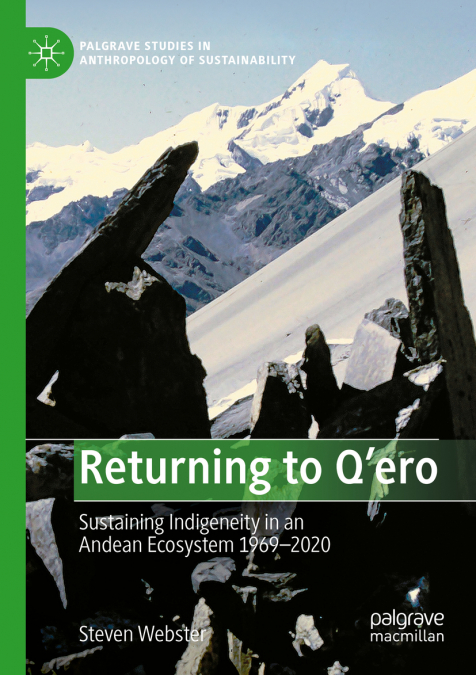
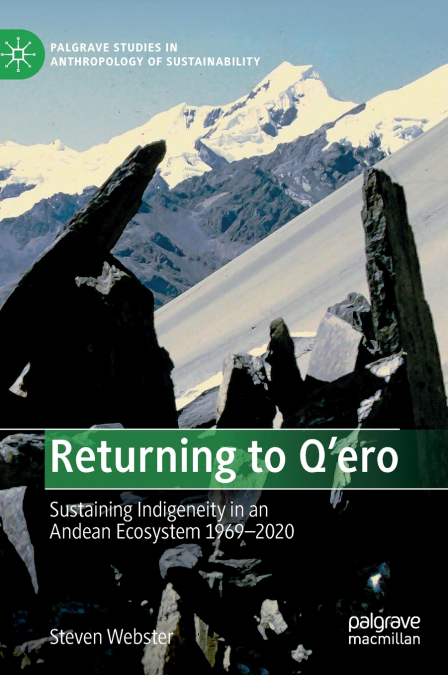
In this book, social anthropologist Steven Webster provides an ethnohistory of sustainability among the indigenous Andean community of Hatun Q’ero since the 1960s. He first revisits his detailed ecological research among the remote Q’ero in the high Andes of Southern Peru in 1969-1970 and 1977. At that time, Q’ero was a community comprised of several hamlets in converging valleys based primarily on alpaca herding at about 4,300 meters, and composed of about 400 persons in about 80 families. He then relies on the few ethnographies by other anthropologists to document changes in Hatun Q’ero by 2020 , spanning 1980-90s when the nation was immersed in agrarian reform followed by virtual civil war between Maoist guerrillas, the government, and the highland peasantry. Through all of these ideological and political-economic developments the sustainability of Q’ero as an integral ecological and social community as well as a famously Incaic cultural tradition becomes a global as well as national issue.  This book argues that while the commercial expansion of ceremonial and shamanist tourism can be seen as extractivist similar to industrial mining, the assertive form of independence characteristic of the Q’eros appears to remain sustainable in the face of both these extractive threats. While the Q’ero community is internally reinforced by their reciprocal relationship with the same non-human forces these forms of extraction seek to exploit, they are externally reinforced by the global as well as national rise of indigeneity movements. Ironically, given the moral force developed in some aspects of shamanist tourism, it can even be argued that it supports environmental sustainability against climate change, globally as well as in Q’ero. This book analyzes the increasing importance of indigeneity in the national politics of Peru as well as the other Andean nations in the last few decades, but it remains to set this form of identity politics in its wider 'intersectional' context of social class and ethnic conflict in the Andes. 
Artículos relacionados

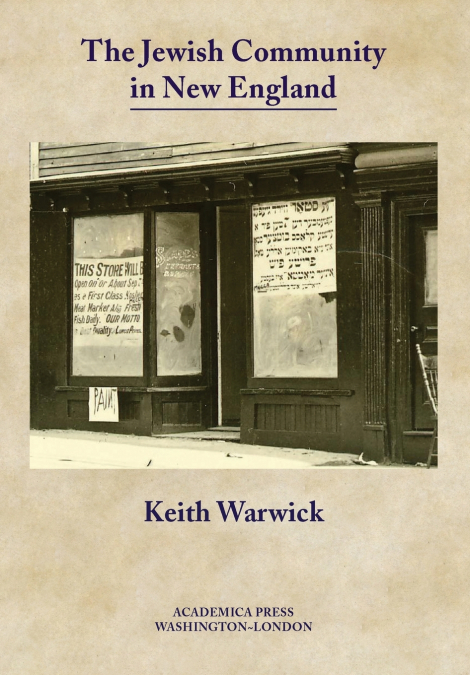
  • The jewish community in new england
    Keith Warwick
    The purpose of The Jewish Community in New England is to inform readers about the Jewish community in each of the six New England States: Rhode Island, Connecticut, Maine, Massachusetts, New Hampshire, and Vermont. Factual, inspirational, and poetic, it serves as a scholarly guide to institutions of Jewish life in this dynamic American region. Stocked with valuable information ...
  • Warfare in the Russian arctic
    Alexander K Nefedkin / Richard L Bland
    Alexander Nefedkin’s highly original new book, translated by the noted American scholar Richard L. Bland, is devoted to the understudied topic of the military and military-political history of Chukotka, the far northeastern region of the Russian Federation, separated from Alaska by Bering Strait. This study is based on primary sources, including archaeological, folkloric, and d...
  • Primitive Man as Philosopher
    Paul Radin
    First published in 1927, Primitive Man as Philosopher represents a landmark in early anthropological studies. In this work, Paul Radin demonstrates the problematic nature of distinguishing between 'primitive' and 'civilized' cultures. He traces such ideas as the nature of Goodness and Truth, the meaning of life, and the reality of death across various cultures, highlighting how...
    Disponible

    24,38 €

  • The Economics of Population Growth
    Julian Lincoln Simon
    Comparison with stationary and very fast rates of population growth shows modern population grwoth to have long-run positive effects on the standards of living. This is Julian Simon’s contention, and he provides support for its validity in both more and less-developed countries. He notes that since each person constitutes a burden in the short run, whether population growth is ...
    Disponible

    153,61 €

  • Running Out
    Lucas Bessire
    Finalist for the National Book AwardAn intimate reckoning with aquifer depletion in America’s heartlandThe Ogallala aquifer has nourished life on the American Great Plains for millennia. But less than a century of unsustainable irrigation farming has taxed much of the aquifer beyond repair. The imminent depletion of the Ogallala and other aquifers around the world is a defining...
    Disponible

    25,19 €

  • The Nation and Its Fragments
    Partha Chatterjee
    In this book, the prominent theorist Partha Chatterjee looks at the creative and powerful results of the nationalist imagination in Asia and Africa that are posited not on identity but on difference with the nationalism propagated by the West. Arguing that scholars have been mistaken in equating political nationalism with nationalism as such, he shows how anticolonialist nation...
    Disponible

    72,17 €

Otros libros del autor

  • Returning to Q’ero
    Steven Webster
    In this book, social anthropologist Steven Webster provides an ethnohistory of sustainability among the indigenous Andean community of Hatun Q’ero since the 1960s. He first revisits his detailed ecological research among the remote Q’ero in the high Andes of Southern Peru in 1969-1970 and 1977. At that time, Q’ero was a community comprised of several hamlets in converging valle...
    Disponible

    47,51 €

  • A Separate Authority (He Mana Motuhake), Volume I
    Steven Webster
    This book is an ethnohistorical reconstruction of the establishment in New Zealand of a rare case of Maori home-rule over their traditional domain, backed by a special statute and investigated by a Crown commission the majority of whom were Tūhoe leaders. However, by 1913 Tūhoe home-rule over this vast domain was being subverted by the Crown, which by 1926 had obtained three-qu...
    Disponible

    136,79 €

  • A Separate Authority (He Mana Motuhake), Volume II
    Steven Webster
    Following on from Volume I on the formation of the Urewera District Native Reserve, this monograph examines the period from 1908 to 1926, during which time the Crown subverted Tūhoe control of the UDNR, established a mere decade earlier. While Volume I described how the Tūhoe were able to deploy kin-based power to manipulate Crown power as well as confront one another, this vol...
    Disponible

    136,88 €

  • A Separate Authority (He Mana Motuhake), Volume II
    Steven Webster
    Following on from Volume I on the formation of the Urewera District Native Reserve, this monograph examines the period from 1908 to 1926, during which time the Crown subverted Tūhoe control of the UDNR, established a mere decade earlier. While Volume I described how the Tūhoe were able to deploy kin-based power to manipulate Crown power as well as confront one another, this vol...
  • A Separate Authority (He Mana Motuhake), Volume I
    Steven Webster
    This book is an ethnohistorical reconstruction of the establishment in New Zealand of a rare case of Maori home-rule over their traditional domain, backed by a special statute and investigated by a Crown commission the majority of whom were Tūhoe leaders. However, by 1913 Tūhoe home-rule over this vast domain was being subverted by the Crown, which by 1926 had obtained three-qu...