 Librería Samer Atenea
 Kálamo Books
 Librería Elías (Asturias)
 Librería Kolima (Madrid)
 Librería Proteo (Málaga)
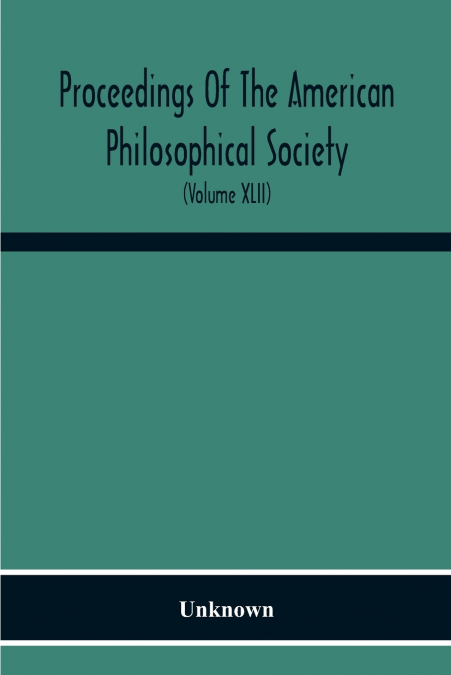
Recorded deliberations, experiments and formal reports from one of America’s formative scholarly gatherings. Ideas shaped a young nation.Proceedings of the American Philosophical Society; Held at Philadelphia for Promoting Useful Knowledge (Volume XLI) assembles the philosophical society proceedings and formal papers that circulated among members and correspondents - a nineteenth-century academic journal sensibility rendered into an American scholarly anthology. The entries illuminate early American science and the history of scientific discoveries that preoccupied the society: observational notes, methodical reports and minutes that show how empirical claims were debated and tested. Its voice is precise and juridical; evidence is foregrounded over rhetoric, which makes the work indispensable for researchers and historians seeking an exacting academic reference volume and for readers who enjoy primary-source accounts of intellectual life. Read as an intellectual discourse collection, the volume maps the networks of Philadelphia learned societies and the civic institutions that supported enquiry across the 1800s United States.Republished by Alpha Editions in a careful modern edition, this volume preserves the spirit of the original while making it effortless to enjoy today - a heritage title prepared for readers and collectors alike. Set beside other Enlightenment-era publications, the proceedings form a vital node in any scientific periodical archive: they chart modes of observation, exchange and critique that shaped subsequent disciplines. It offers a dependable resource for libraries and scholars assembling period collections, rewarding close reading by anyone interested in the mechanics of intellectual exchange. The procedural detail and direct reporting illuminate how specialised knowledge moved from private correspondence into institutions of public utility. For scholars it supplies the granular detail often absent from later histories, enabling the tracing of process rather than polished narrative. Libraries and private collections seeking to represent 1800s United States scholarship are likely to find the volume a natural complement to holdings of scientific periodical archive material. Its sober, documentary tone makes it unusually readable as social and intellectual history. As such, the volume is as useful to teaching and citation as it is desirable for classic-literature collectors seeking authentic period exemplars.